
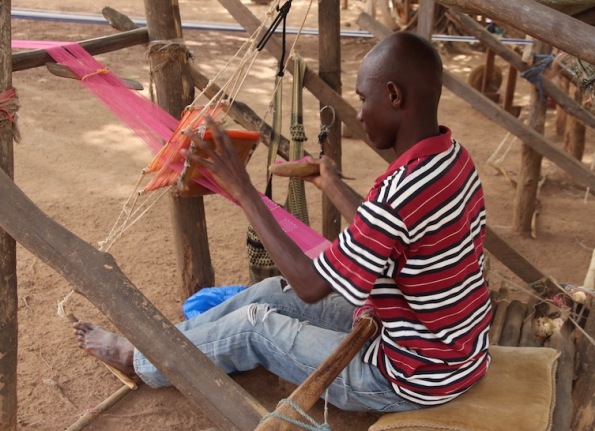
Looms are hand and foot operated
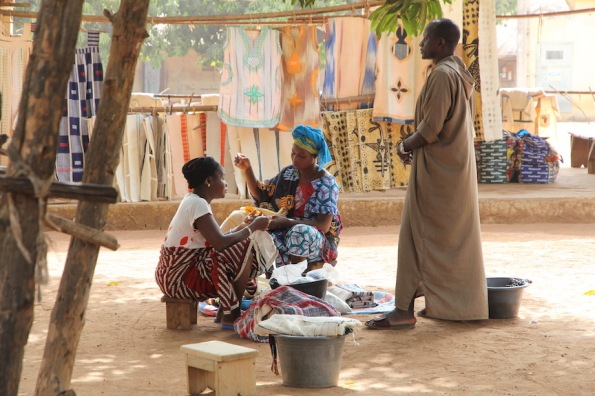
Women decorating Korhogo cloth
Back in early March, we were in Korhogo in the Ivory Coast (Cote d’Ivoire) in West Africa.
We figure there’s no sense going to these far flung places if we don’t have a good look around, so we took advantage of a full day of guided visits to several touristic destinations. I’ve already written about the bead-making and granite chipping sites, but today I wanted to tell you about two fabric sites.
Frankly, I have a weakness for cloth and textiles in general. It is the souvenir I am most likely to bring home with me—that or some cooking gadget—and these two sites were especially appealing.
I hadn’t realised that Korhogo cloth is world famous. It’s up there with bogolafini (mud cloth) from Mali and Kente cloth from Ghana. I own some of both from previous travels in West Africa.
Korhogo cloth got going in the late 1960s and early 1970s. Back then, American Peace Corps volunteers encouraged the Senufo people to explore new styles of clothing production. They already made fila cloth and that provided inspiration for Korhogo cloth.
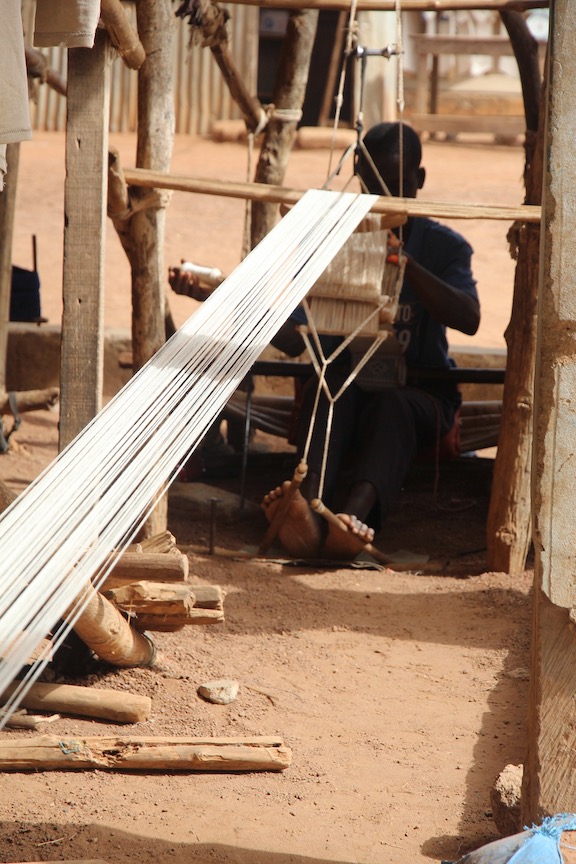
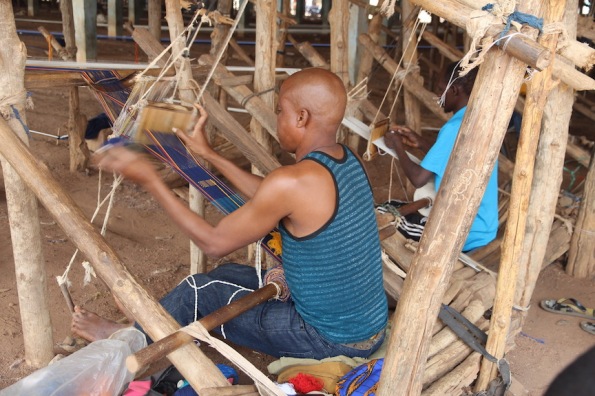
The cloth is made of hand woven and hand spun cotton. Men and women cultivate the cotton (we saw huge piles of cotton as we travelled through the country). Women spin it into yarn and prepare the dyes, while men weave and decorate the fabric. The looms are foot operated. We also saw women embroidering pieces of clothing.
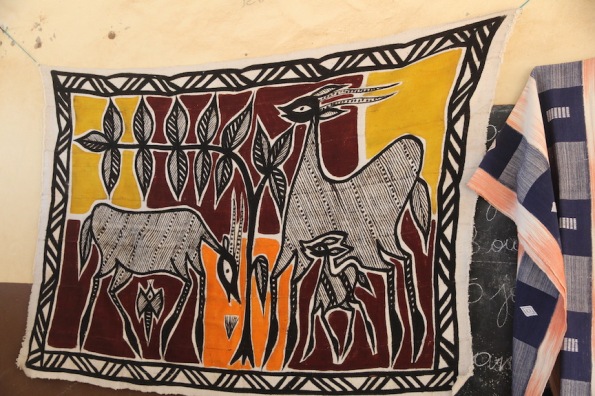
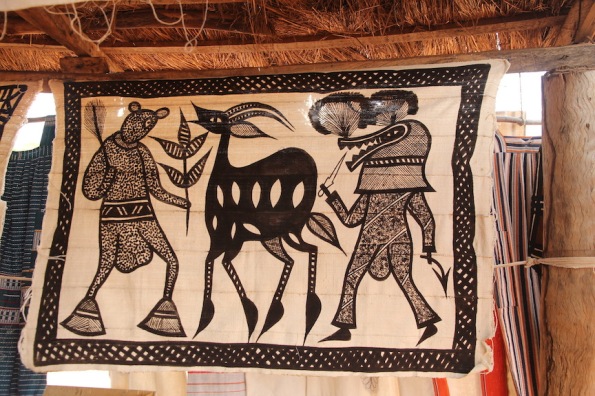
Some finished cloth is made into garments and household accessories, such as bedspreads and tablecloths. Other pieces are turned into artworks. The paintings are done using specially fermented mud and plant-based pigments that darkens over time.
Our first stop was at a place that abounded with cotton, looms and men weaving fabric. Around the perimeter there were women adding embroidery to works already completed. Lots and lots of clothing or household items were on display. In fact, even the trees were festooned with fabric. Of course I bought something…er, somethings.


Later in the day, we visited another site where people were painting or embellishing cloth. For example, one fellow was splattering paint (or mud) on pants. Two fellows were adding designs to rectangles of fabric.
Designs usually depict human forms or animals that are important in Senufo culture and mythology. I resisted buying anything at this stop. Although looking at the pics , I am now suffering from regret.
I couldn’t resist sharing a lot of pics (not all have captions). Too much gorgeousness to look at.
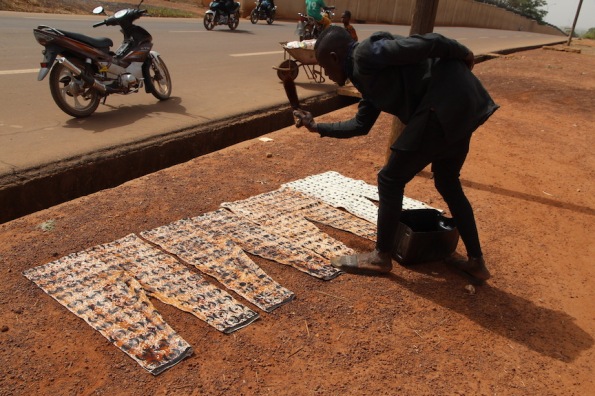
Splattering paint or mud on Korhogo pants
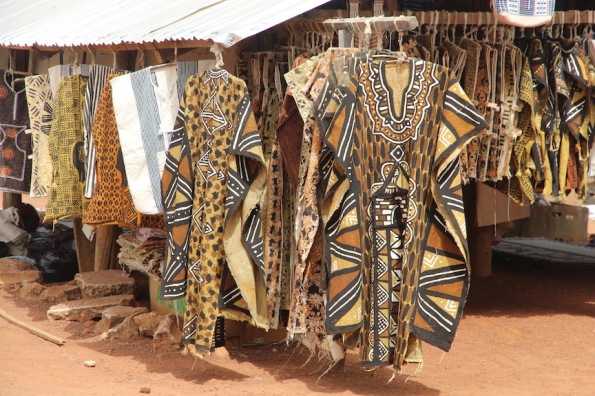
Korhogo cloth in the mud cloth style
Have a look
It hasn’t been easy to follow and comment on other blogs while we’ve been travelling, but every now and then I have a decent internet connection, and I check out as much as I can. I laughed myself silly when I read Ortensia’s post about taking her dog to the vet. As one of the commenters said it ‘was like a scene from a comedy film’. Check it out if you need a good laugh.
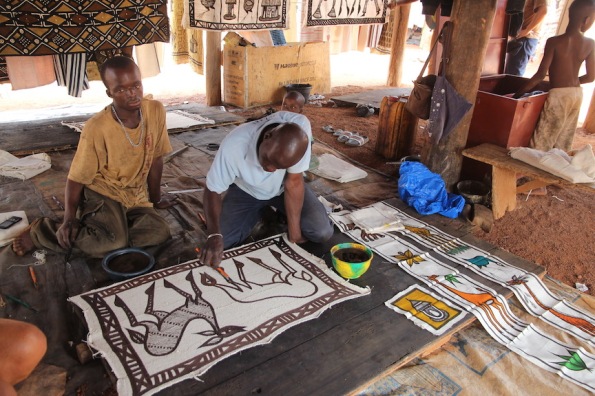
I got the impression that the young fellow on the left was an apprentice
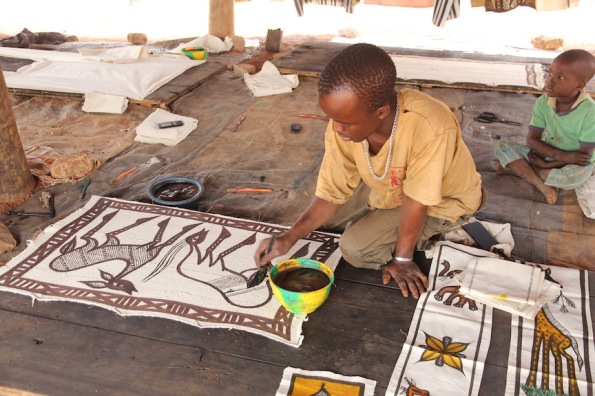
He gets a turn to paint

Laundry draped on rocks
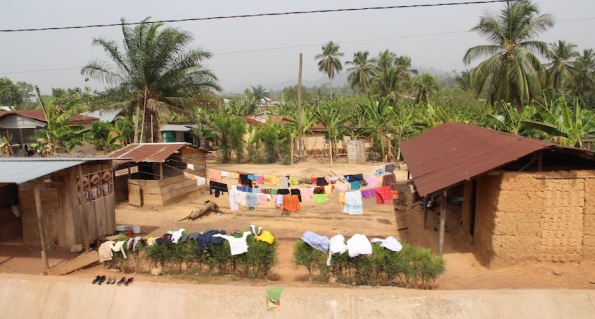
Laundry hung between buildings and draped on bushes
I love getting comments on my blog and a recent one (by Susan over at onesmallwalk)
Great market, such colorful displays. But it was the laundry in the breeze
that makes me want to visit—Susan.
has prompted me to do a post devoted to laundry in Africa.
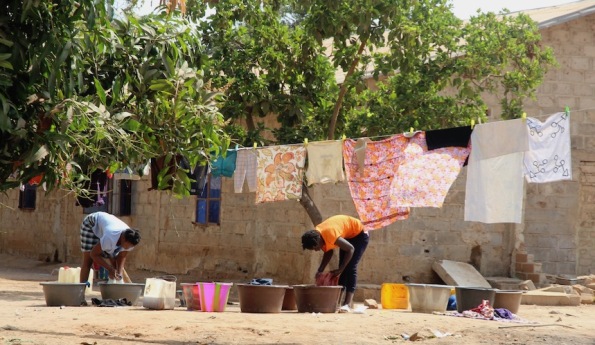
Frankly, I love seeing laundry being dried around the world. The colours, the fabrics, the breezes, the ingenuity.
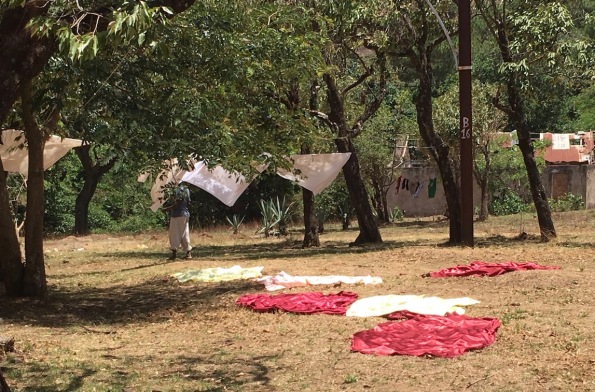
Hotel bedding spread on the ground and on a line
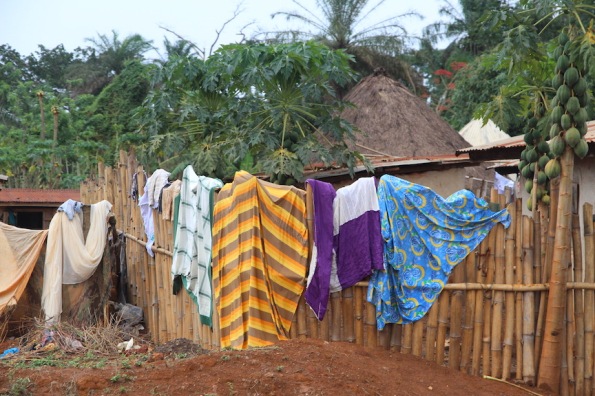
Laundry draped on a fence
The ingenuity? There’s plenty of ingenuity. It’s important to remember that not everyone in the world has a clothesline or a clothes dryer. In fact, not everyone can afford clothespins (pegs in Australia). So getting clothes washed and dried requires a certain amount of creativity.
We understand that. On camping trips—heck on almost all of our trips—we carry a bag with laundry soap, clothesline, pegs and a universal plug. It’s usually quite easy to find a sink but not always easy to find a plug. Trust me, a wadded up sock doesn’t keep water from oozing quickly down a drain.
Interesting to note that Liberia was the first time we saw clothespins (pegs) being widely used. The photos here are from several West African countries.
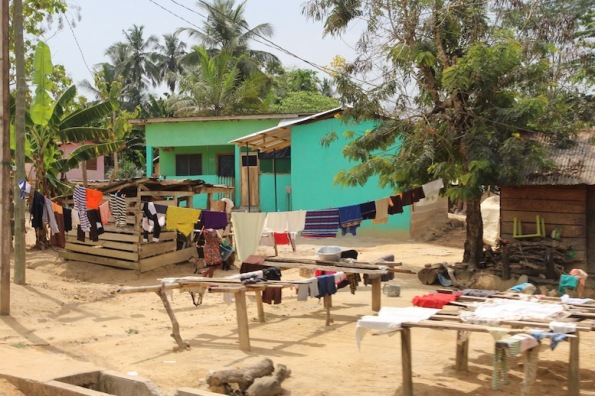
Laundry on bamboo poles and clotheslines
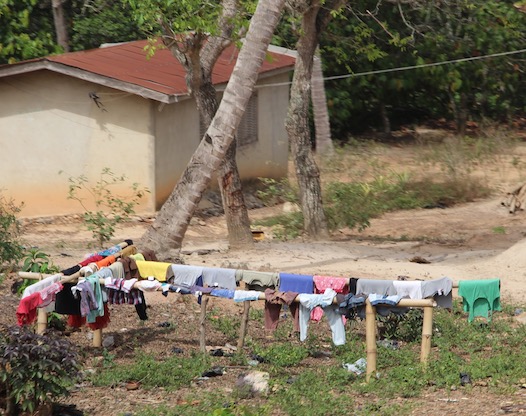
Laundry on bamboo poles
So here is a collection of pics that show how West Africans get clothes dried.
The rooftop and balcony pics at the bottom show clothes that belong to us and other people on our truck. I found these drying spaces quite by chance. Some of us camped in tents and others opted for cheap rooms. Most of us put in laundry—nice to have a break from doing your own washing.
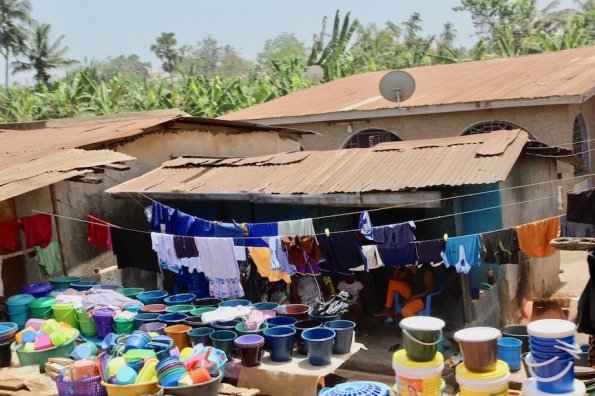
Laundry drying outside a shop
We were told that the upstairs was unfinished. They said the rooms weren’t complete or furnished. The snoop in me thought I’d go up and have look. The rooms were as described and the laundry was in full sight.
As an aside, I’ve written many posts about laundry and there will be more to come. Here’s one from Burkino Faso and another from India.
So how do you get your laundry dry?
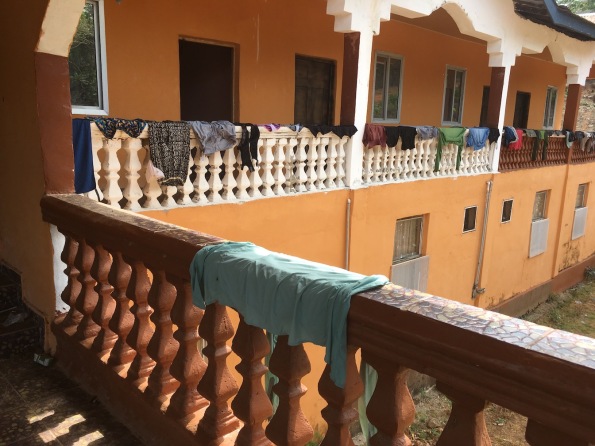
That’s my pale green shirt in the foreground
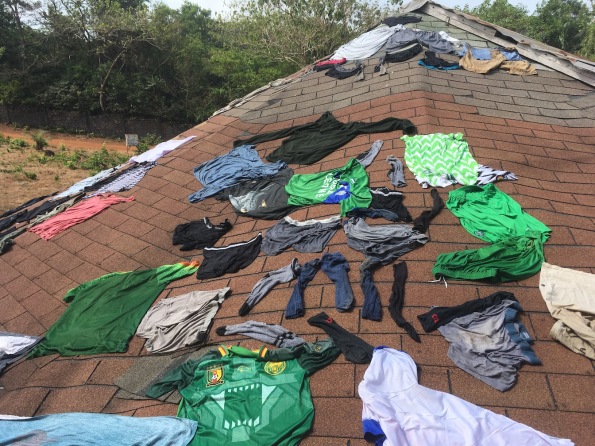
Plenty of clothes fit on a rooftop

A group of friends/colleagues pose at the sacred tree
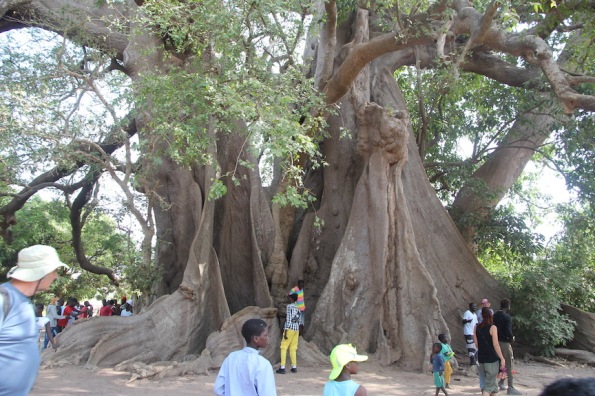
A six-in-one tree
Regular readers of this blog will know how much I love going to markets. So I was delighted when our stay at The Little Boabab in Abéné included a village walk. It would give us a chance to explore the local craft and food markets, and to visit the community’s amazing sacred tree.
We set out early in the morning with our guide, Saikou. Saikou is from The Gambia, but he has lived and worked in the Casamance (southern) region of Senegal for about five years. His English is great (The Gambia is English-speaking) and he knows Abéné well.

Welcome to craft market

Market welcome with the sacred tree
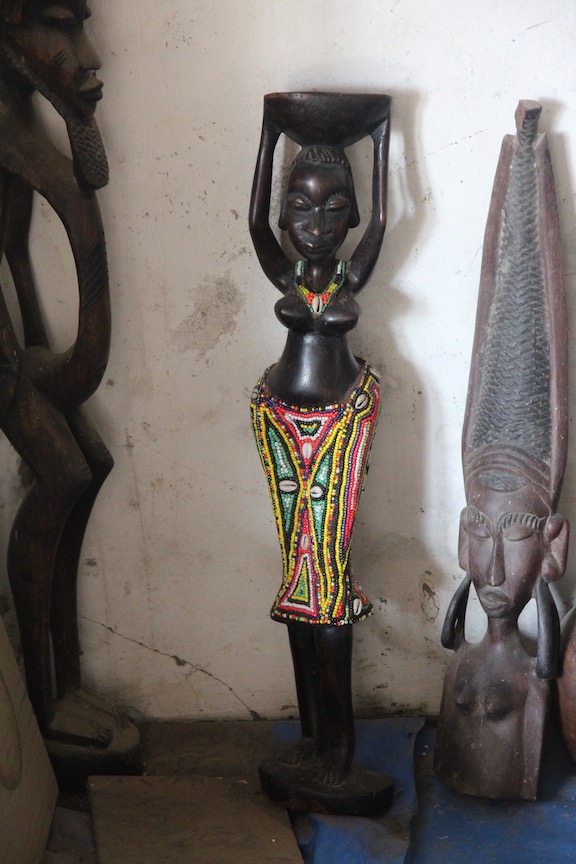
Beaded statue
Our first stop was the craft market. Because we arrived quite early in the morning only a few shops were open, but it was great to see the range of carvings, including plenty of masks. I’m not all that keen on masks. I love seeing them used in dance performances and other ceremonies, but I don’t need to see them hanging on my walls. Not sure where that attitude has come from.
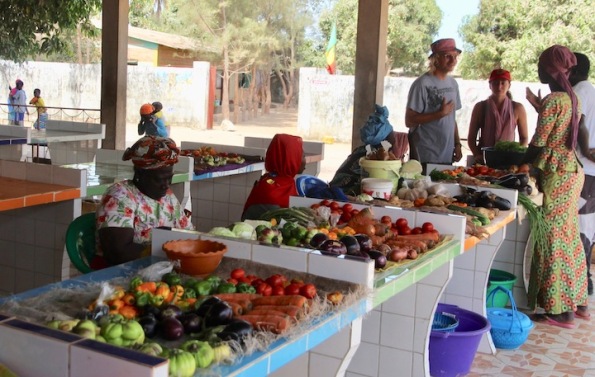
The actual food market was next. It was a special treat to visit with Saikou because he let us know that photos would be okay. This was a welcome change. The further north we have travelled in West Africa, the less likely people have been to be pleased to have their photos taken. You can’t imagine how many photos have been captured in my mind’s eye, but not on camera. Darn.


The final stop was at Abéné’s Bantam Wora, or sacred tree. It’s actually six huge kapok or cotton (fromager) trees that have fused together.
People in the Casamance believe fromagers are sacred. They are thought to be possessed by a genie that can bring good fortune if offered kola nuts, biscuits, milk, bread or other delicacies. For example, women with fertility problems or young men wishing to win an upcoming football match will go and make an offering.
Before arriving, we were told that we would have to make a financial offering to the women who spend their days around the tree. We dithered about that at first. Senegal has huge paper money notes, and none of us really knew how to contribute. Luckily Adam, one of our drivers, was with us and offered a blanket donation.
The tree is ginormous. It could easily be six, eight or 10 trees fused together. A youth group (maybe university students) was there when we arrived. A group shot of them shows just how large the base of the tree is.
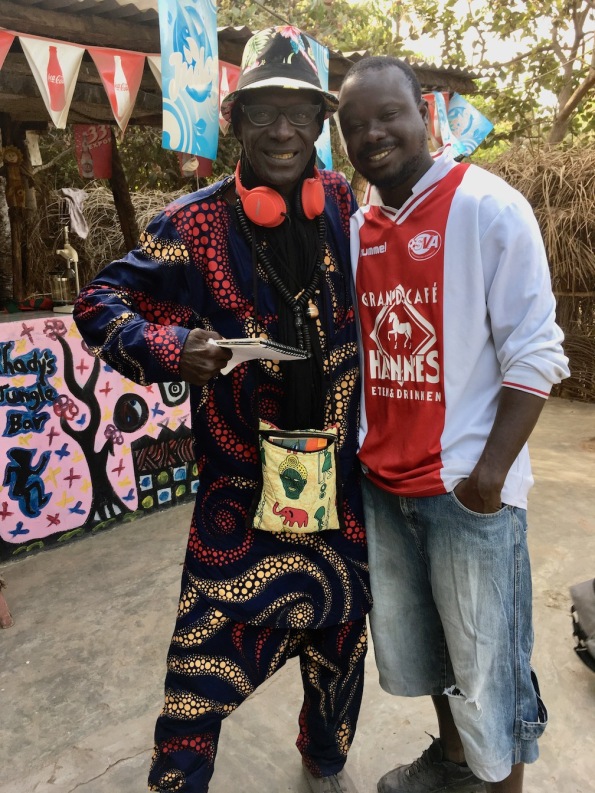
Taga (left) and Saikou
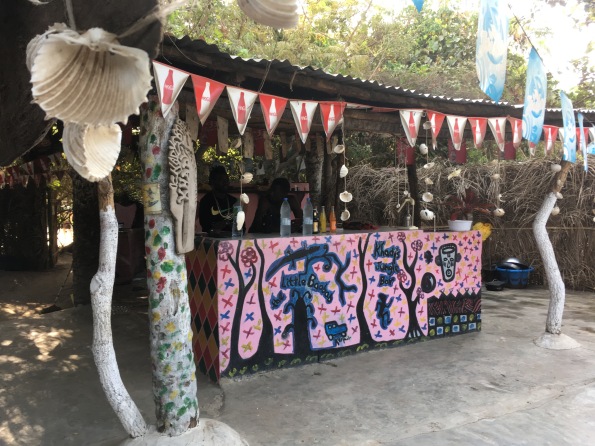
The colourful bar at The Little Boabab
The Little Boabab is the most heartwarming and welcoming place we’ve visited in West Africa. It also has a huge touch of sadness (read on). Nestled in the village of Abéné in the Casamance (southern) part of Sénégal, The Little Boabab is the love child of Simon and Khady.
Years ago, Simon Fenton, an English journalist, fell in love with West Africa and Khady, a Sénégalese woman, who spoke only faltering English back then. Together they realised a dream and started to build The Little Boabab.


Sadly, I wasn’t lucky enough to meet Simon. About 18 months ago, he was killed in a car accident when travelling between Abéné to Ziguinchor. The mere thought of it breaks my heart. My own father was killed in a car accident when I was 18. You can read about him here.
When we arrived at The Little Boabab and met Khady, I gave her a huge hug and said that I ‘sort of’ understood the grief she was going through. I lived through the loss of a father, but how could I possibly understand the loss of a husband, and especially in her circumstances? She has two gorgeous and energetic young boys—Gulliver and Alfie.
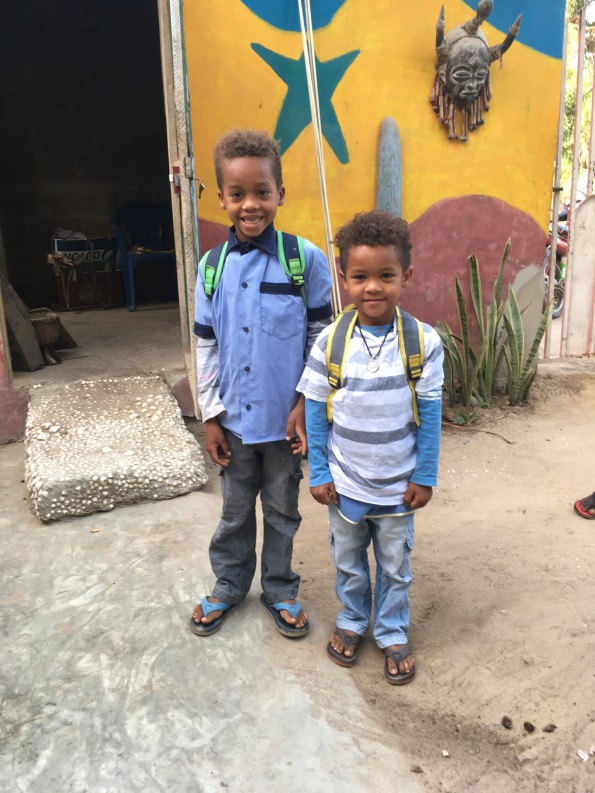
Gulliver (left) and Alfie are ready for school
We stayed two nights at The Little Boabab. We enjoyed delicious meals, a comfy bed with mosquito net, a guided village walk and an incredible dance performance. It’s also where the dancers managed to get Poor John on his feet.
Little Boabab is a full-service, solar-powered campground. They provided all meals, and I was lucky enough to barge my way into the kitchen to help on our second night. I learned how to stuff bone-in chicken thighs and drumsticks.
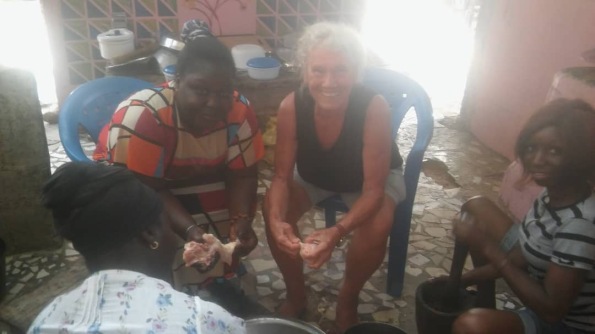
Helping in the kitchen at The Little Boabab
Expect more posts about Little Boabab and surrounds.
Simon wrote about his experiences. You can buy his books Squirting milk at chameleons: an accidental African and Chasing hornbills: up to my neck in Africa here. I was lucky enough to buy mine at The Little Boabab.

Poor John living it up at The Little Boabab. He looks like he is having fun
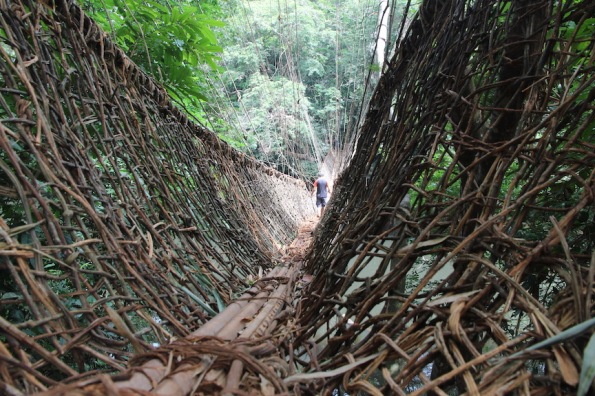
Richard crosses the bridge

Stephan climbs to the bridge entrance. There’s a similar entrance on each end
West Africa is a land of amazing contrasts! Bridges are a good example. You may remember that we ‘fell’ through a log bridge a few weeks back. That was a first for our co-drivers, Jason and Adam, as well as for all the passengers. We’ve also crossed plenty of modern concrete bridges—no risk of falling through those. And on occasion, we’ve detoured through a stream (it is the dry season) rather than cross a bridge that is being constructed or repaired.

One person crossing at a time
But we visited a very rustic bridge not far from Nzérékoré, in southeastern Guinea. It was made entirely of vines and bamboo. It was fascinating to see its construction up close, and to have the chance to cross on foot—one at a time.
The bridge is brilliantly sturdy and I’m sure it could carry more people at once, but we respected the villagers’ instructions. Our guide—the bridge is in a forest and was about a 45-minute walk from where we parked the truck—said the bridge is as old as anyone can remember. I’ve read accounts that say it was built more than 100 years ago.


In addition to providing safe passage across a river, the bridge has spiritual significance for the people. Two years back, it was closed for renovations and repairs. That year the overlanders weren’t even allowed to approach the bridge. I heard differing comments about why. Some say that repair work is done by spirits, while others say it is done by trusted elders who don’t want the secrets of construction shared. Keep in mind that my French is fairly sketchy, so the ‘real’ story could be something entirely different.


Word gets out when foreigners are around. By the time we got back to the truck there were several people selling avocados and other fruits. I bought 10 large avocados for about $3. They were nicer than any we’d seen in the markets. Too often the fruit we buy turns to mush within a day or two. These weren’t ripe yet and several cook groups managed to use them over the coming days.
I also got a fun pic of a woman’s toes. She’d painted them along the lines of the Guinean flag. Fashion in the forest!

Avocados for sale

Ellen is dwarfed by the sheer size of the bridge
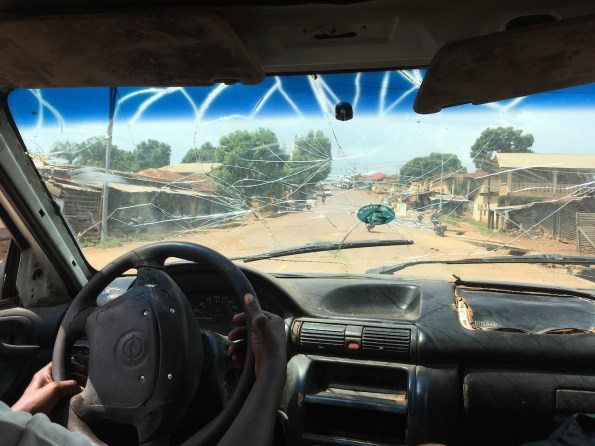
A typical African windscreen (windshield)

Poor John gets in the front
Not long ago in Nzérékoré, Guinea, West Africa, I was reminded of a lift we were given in Barnaul in the Altai district of Russia. Five years ago, Elena and her husband kindly offered to give us a ride to a bank so we could change Kazakh money to Russian roubles.
She explained in English that they had just come from the police station where they had been completing paperwork. She went on to say ‘Go ahead, get in the car. If you aren’t afraid!’
That phrase ‘if you aren’t afraid’ pops into my mind every time I get into an African taxi. Yesterday we rode in three taxis in Dakar, Sénégal. All three had cracked windscreens (windshields), at least one door that didn’t open from the outside or inside (scoot across), windows that didn’t open, and two of three drivers who had no idea where they were going.

Petrol cap and door missing
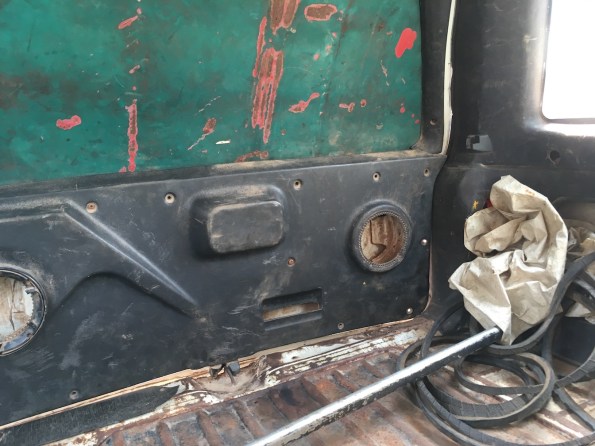
Back end of a station wagon taxi
The first driver couldn’t read and didn’t speak English or French, only Wolof (the local language). We didn’t realise all that until we reached our destination and even the fellow at the hotel (who spoke four languages) couldn’t communicate with him. He had to run up the road to find someone else who spoke Wolof.
But the most memorable taxi ride of this trip so far has been the one in Nzérékoré. Dee, Ellen, Poor John and I wanted to go to the large artisan complex on the edge of town. Of course, the taxi driver had no idea where it was, but we had a scribbled map. Hahaha
As with every African taxi I’ve ever ridden in, the windscreen was cracked. But there’s more.

Ellen scoots across and avoids the hole in floor
Doors worked on only one side of the car and had to be yanked open, there was a large hole in the back seat floor, the petrol door and cap were missing, The back end and car ceiling had lost their fabric coverings, and the taxi had to be pushed to get started.
Of course, we weren’t afraid, but we laughed ourselves silly and all got in. The driver made the mistake of turning off the engine when he dropped us off (yes we found the complex), and had to be pushed again to get started. The taxi home was about the same, but didn’t need to be pushed.
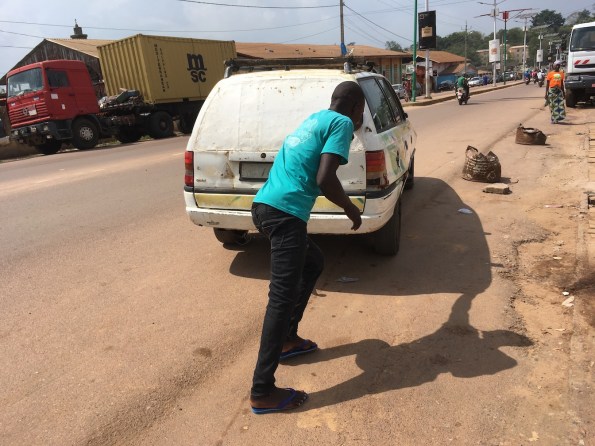
Getting a push after we get out
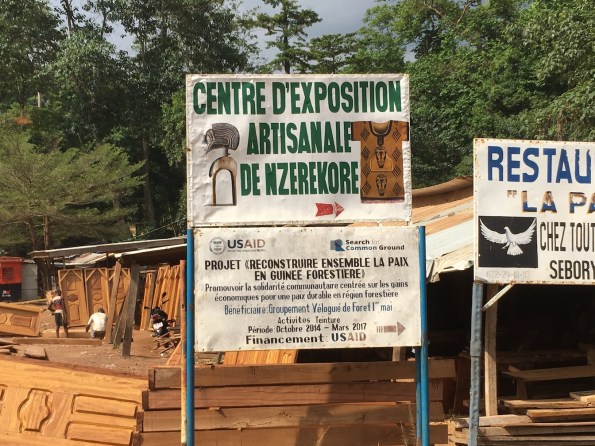
We found the artisan complex

Freetown, Sierra Leone—apartment building or house?
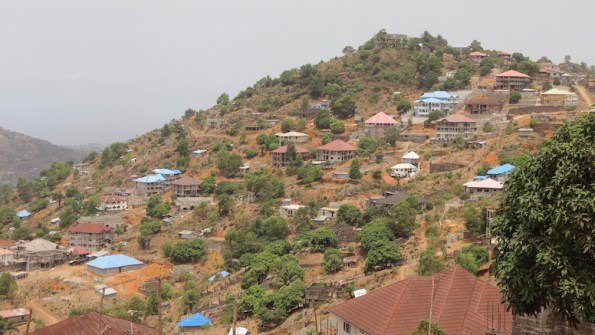
On the outskirts of Freetown, Sierra Leone
My last post focused on the simple thatched huts of West Africa, but I don’t want you to think that is the only housing available.
Thatched huts are common in villages, but towns, cities and even larger villages have all sorts of more modern and elaborate homes. Some are really over the top, with fabulous paint combinations or tiled exteriors. Poor John reckons the tile is to minimise mould in the rainy season. Makes sense to me.
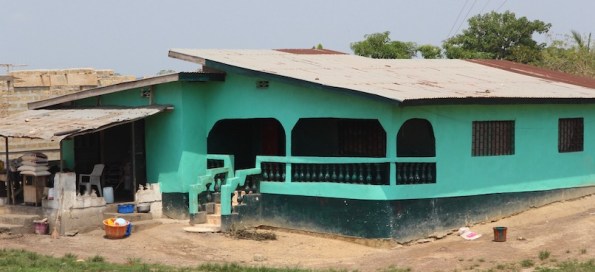
House with shop to the left


Some of the homes shown are built over shopfronts or other businesses. Others are apartment buildings.
I thought you’d like to see a variety of the accommodation I snapped from the truck window. We’ve seen a few presidential palaces, but photos weren’t allowed.
P.S. Not many captions.
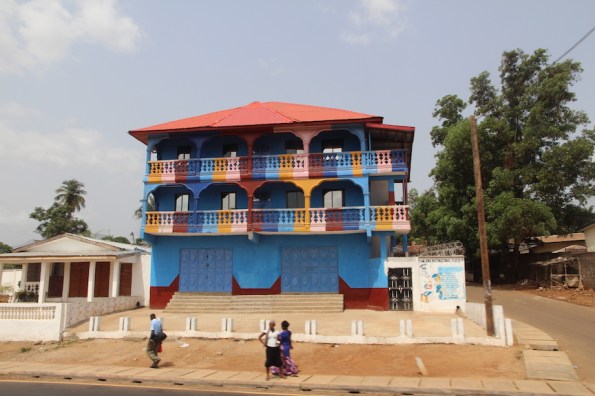
Shops below

Old-fashioned house in Sierra Leone
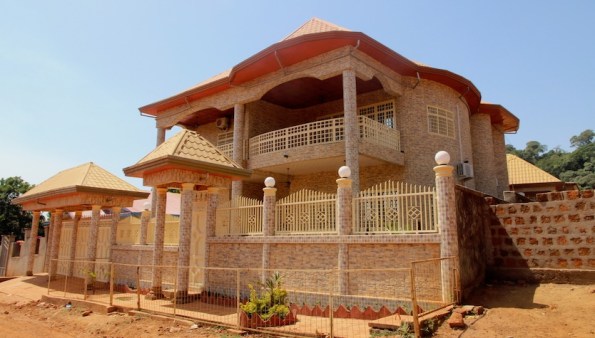
Tiled exterior in Labé, Guinea

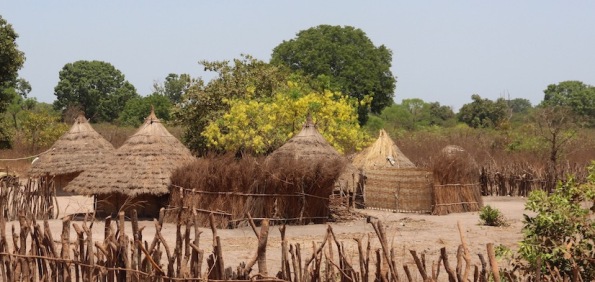
Bundles of grass in front and to the side of four huts

The roof is framed and the grass bundles are on the right
Overland travel gives us a great chance to observe daily life in towns, villages and the countryside.
As we’ve moved from country to country in West Africa, one of the most noticeable differences is the style of housing and construction. Some differences are slight while others are more varied. Northern Guinea and Guinea-Bissau were the first places where I saw simple roofs being repaired for the rainy season. Maybe this is now happening in all the countries we’ve already visited.
When I first saw the bundles of grass in the two Guineas, I assumed they might be feed for animals, but it didn’t take long to realise this was roofing material for buildings covered in thatch. I don’t know how much the grass costs or how much it takes to cover a roof.
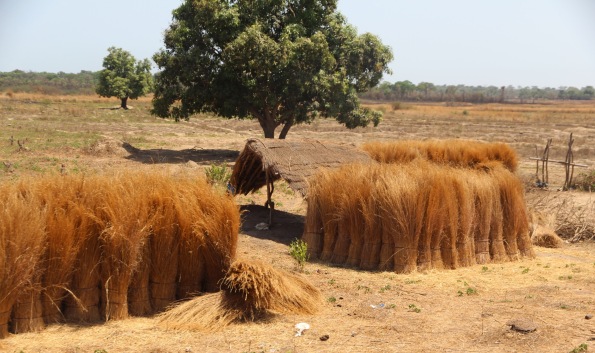
Grass for roofs
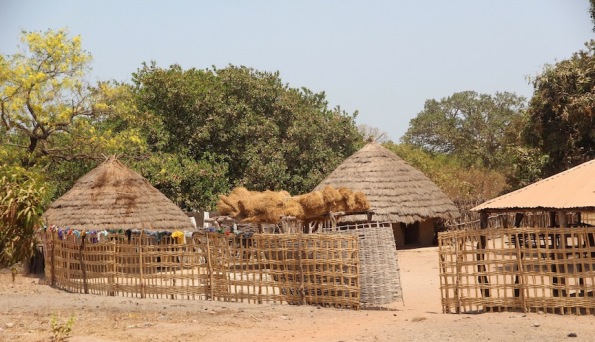
Roofing materials stored off the ground and a style of fencing I hadn’t seen before
I thought you might enjoy seeing the various stages in the process.
As an aside, we took a two-hour boat trip through extensive mangroves in The Gambia. Our guide, Omar, is rushing to get his house built (or at least enclosed) before the rains begin in June. He is using corrugated iron for the roof. He needs 10 packets of the stuff—I don’t know how big a packet is—at 1800 Gambian dalasis per packet. That’s equal to about 330 euros for all 10 packets. So far, he’s purchased four packets of new roofing material and hopes to find cheaper secondhand materials for the rest. We tipped him generously.

Roof in progress
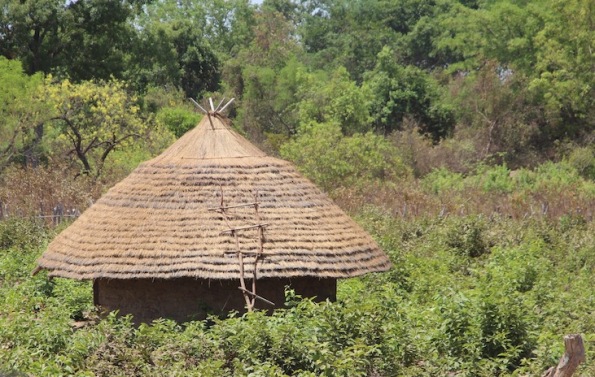
Finished roof

Just a quick post before we hit the road again. I don’t have many shots like this because we’re travelling at a speed that means my pics are out of focus.
Here are a couple to show you how many people (and their stuff) can fit in/on a single car. No captions needed.

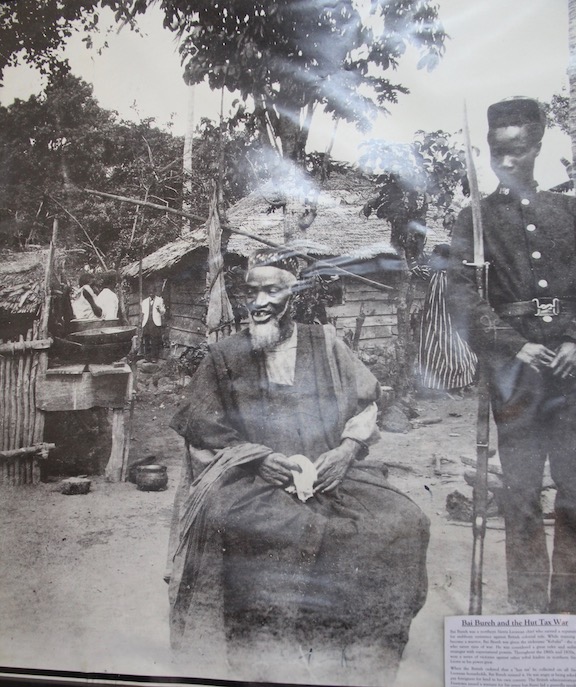
Bai Bureh, the Hut Tax rebel
We learned the story of Bai Bureh at Sierra Leone’s National Museum in Freetown. As a chief in the northern part of the country, he earned a reputation for stubborn resistance against British colonial rule. It’s not surprising.
When he trained as a warrior, Bai Bureh was given the nickname Kebalai—one who never tires of war. He was considered a great ruler and military strategist with supernatural powers. Throughout the 1860s and 70s, he won many battles against neighbouring tribal leaders.
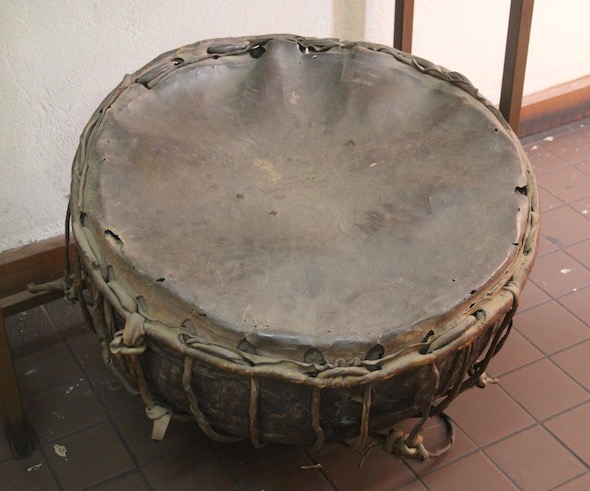
Perhaps this drum was used as a call to arms
His biggest fight began when the British ordered that a ‘hut tax’ be collected from every Sierra Leonean household. Bai Bureh was furious that a foreigner asked him to pay tax on his land in his own country. His refusal to pay caused the British to issue a warrant for his arrest. In 1898, Bai Bureh led a guerrilla revolt that became known at the Hut Tax War. Although his men held the advantage for some time, Bai Bureh was eventually captured and sent into exile. He returned in 1905 and reinstated himself as chief of Kasseh.
You have to love his style and attitude.
P.S. All pics were taken in Sierra Leone’s National Museum in Freetown. The main pic features Bai Bureh. The other two are of his possessions or those of his followers. Stay tuned for a post on more museum items.
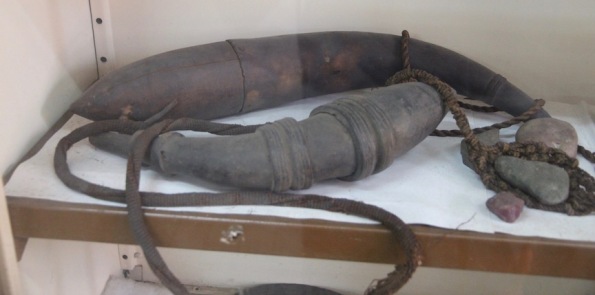
I think these were weapons
 Where to next?