

Dusting the dustbins in Baku.
We’re in Baku, capital of Azerbaijan, for a few days, and enjoying an overwhelming slice of civilisation. For a city of almost two million, Baku has to be the tidiest town in the world. It looks like one of the richest ones too.
Money and cleanliness just ooze out of this place. Poor John and I agree we have never seen the likes of it.
I have quite a few pics of Baku under the broom (but I’m having trouble getting them to load to the blog). This one is an indication of how orderly things are. Baku is the only place I’ve ever seen someone wiping down the outdoor bins. She was at work in the park running alongside the Caspian Sea. Another pic (which won’t load) shows a toy shop in one of the many underground walkways that allow people to ‘cross’ the street safely. Nary a tissue or cigarette butt in sight—usually you’d find such spots harbouring half of a major city’s weekly rubbish. Pity I didn’t get a picture of the spotless Bentley car dealership.
By the way, big name shops are everywhere—Dior, Cartier, Bvlgari, Tommy Hilfiger—all spread out in well kept, brightly lit and beautifully designed pedestrian areas. We and thousands of Azeris strolled through Fountain Square last night. Armies of street sweepers with brooms and dustpans were out, too, making sure the leaves that fell didn’t linger long on the ground. In spite of the fact that much of the city is under construction, they even manage to keep their dust clean. The whole place was spotless when we arrived yesterday morning and it seems to stay that way. The only place I saw litter was in window and stairwells, which must be deemed the responsibility of the dweller.
We are about to head to Turkmenistan—on a ferry across the Caspian Sea. I wonder how tidy that will be? Our last major ferry ride was in 2009 from the Sudan to Egypt. We slept on the deck—along with hundreds of Egyptians and Sudanese—and it was like living in a giant ashtray.
After I had my rant about the beggars of Tbilisi, I realised I hadn’t mentioned my views on buskers. In case you don’t use the term, buskers are the musicians who play on street corners, in shopping malls and really anywhere with lots of pedestrians.
My policy is to tip buskers (sometimes generously), unless they are so bad I can’t bring myself to encourage them. Poor John’s sister, Ann, who is a muso herself, says she always tips buskers. It’s fair—they do something for her, so it makes sense to repay them for their efforts. I haven’t seen a lot of buskers since we left Germany. There have been a few at touristic sights, but otherwise none. Until last night, when the midnight serenade came to us.
We were camping in Azerbaijan, near the border with Georgia. To be honest, it was about 10 p.m. Dinner was over and everything was packed away. Some people were heading to their tents. Suddenly a carload of tipsy Azerbaijani (Azeri) youths turned up. They started unloading musical equipment. It was too dark to tell exactly what they had, but we assumed they planned to amuse themselves.
Instead they planned to entertain us—not with actual instruments, but with a boom box on full volume. The first tune thumped out and received polite applause. We were in our tent, which just happened to be the tent closest to the noise. Head-bangy music is all they had and it’s the only genre I can’t listen to. It makes my head hurt.
I’ll spare you a bang-by-bang account, but say that the bad-behaviour boys played another four or five ‘tunes’ despite requests to stop. In the end, they got rather stroppy. They wanted ‘money, money, money’ for delivering a concert. They followed people to their tents and prowled around tents that were already occupied. One crawled into the tent alcove beside me and demanded ‘money, money, money). I shouted ‘no’ and ‘go away’, which he did.
But the group hung around for about 90 minutes, repeating calls for money (most likely the only English they know) and being a general nuisance. Finally, they got tired or thirsty and piled in the car and drove away.
They never returned, but we were going to be serenaded one way or another. Every dog in Azerbaijan barked for the rest of the night to let us know they were protecting us.
P.S.I have a nice pic of a busker in Mtskheta, Georgia, but it won’t load today. 😦 Will post when I have a decent connection, which may be a while.
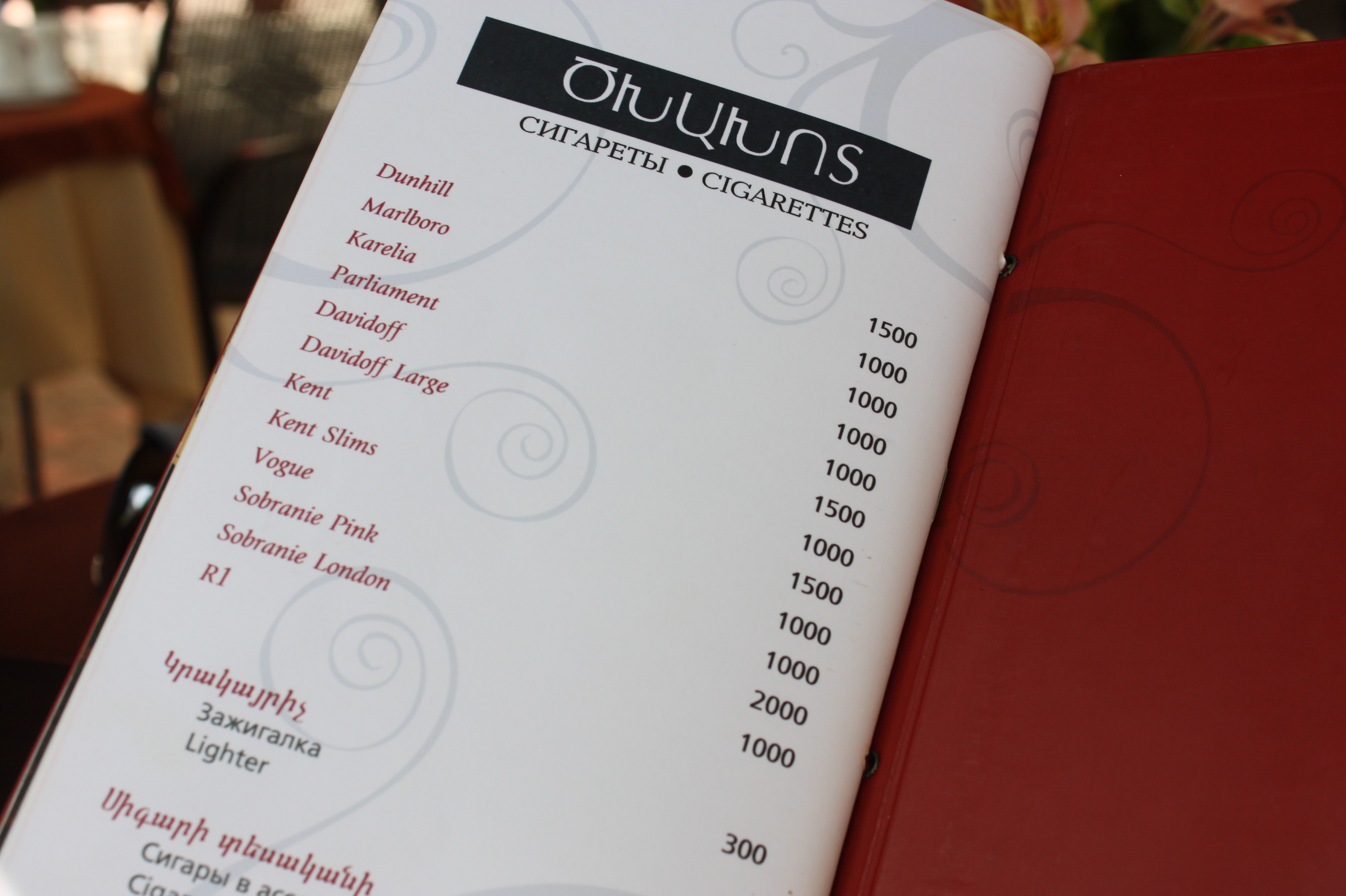
Cigarettes and lighters on the menu.
Before leaving Tbilisi, I’d better give you the latest news on the kitchen drama. Unfortunately, there’s still no movement on Eamon’s missing camera. That becomes an unbeaten dead horse.
No one really knows exactly why the Iranians are here. They say they paid some Iranian woman about US$3000 to arrange a tour of Georgia, Turkey and Bulgaria for them. She deposited them at the hostel about two weeks ago and has not been seen or heard from since.
The brawl that broke out two days ago had nothing to do with a vacant double room. It started because the wife of the couple told the other fellows to stop smoking in the common/communal room. Obviously, Iranian women still aren’t supposed to tell men what to do! Never mind that ‘no smoking’ signs are plastered all over the hostel.
But the outcome has been just as warped. The group of men refused to stay if the couple stayed and vice versa. The men fill more beds in a new hostel that’s trying to get off the ground and make money, so the couple have gone to stay at the home of the hostel’s laundry woman. They pop in every day and everything seems cordial. Who knows what will happen after we leave.
The men continue to smoke in the common room, which has become one of their ‘bedrooms’ because the hostel is so full. They also have the ‘red room’ and are smoking in it too.
Lu has told the owner about the smoking, but he makes cooing noises, shrugs his shoulders and hopes everyone will stop fussing and keep paying.
We really shouldn’t be surprised about the indoor smoking. It’s still a popular sport all over the region. A pack of smokes costs less than US$2, there are ashtrays on every restaurant table and plenty of establishments have cigarettes and lighters on the menu.
As for Eamon, he decided not to let the police conduct a search. The cops prepared an official statement that will let him collect on his insurance and many of us have offered to take pics for him.
The truck rolls on today, heading to Azerbaijan. Stay tuned.
We’re heading to Azerbaijan later this morning where, we hear, it’s hotter than Georgia, but not as hot as Turkmenistan. We’ll be bushcamping for at least two nights, so I expect to be offline for a couple of days. But I’ll try to get some more entries written so they are ready to post when we reach the capital, Baku.
Stay tuned.
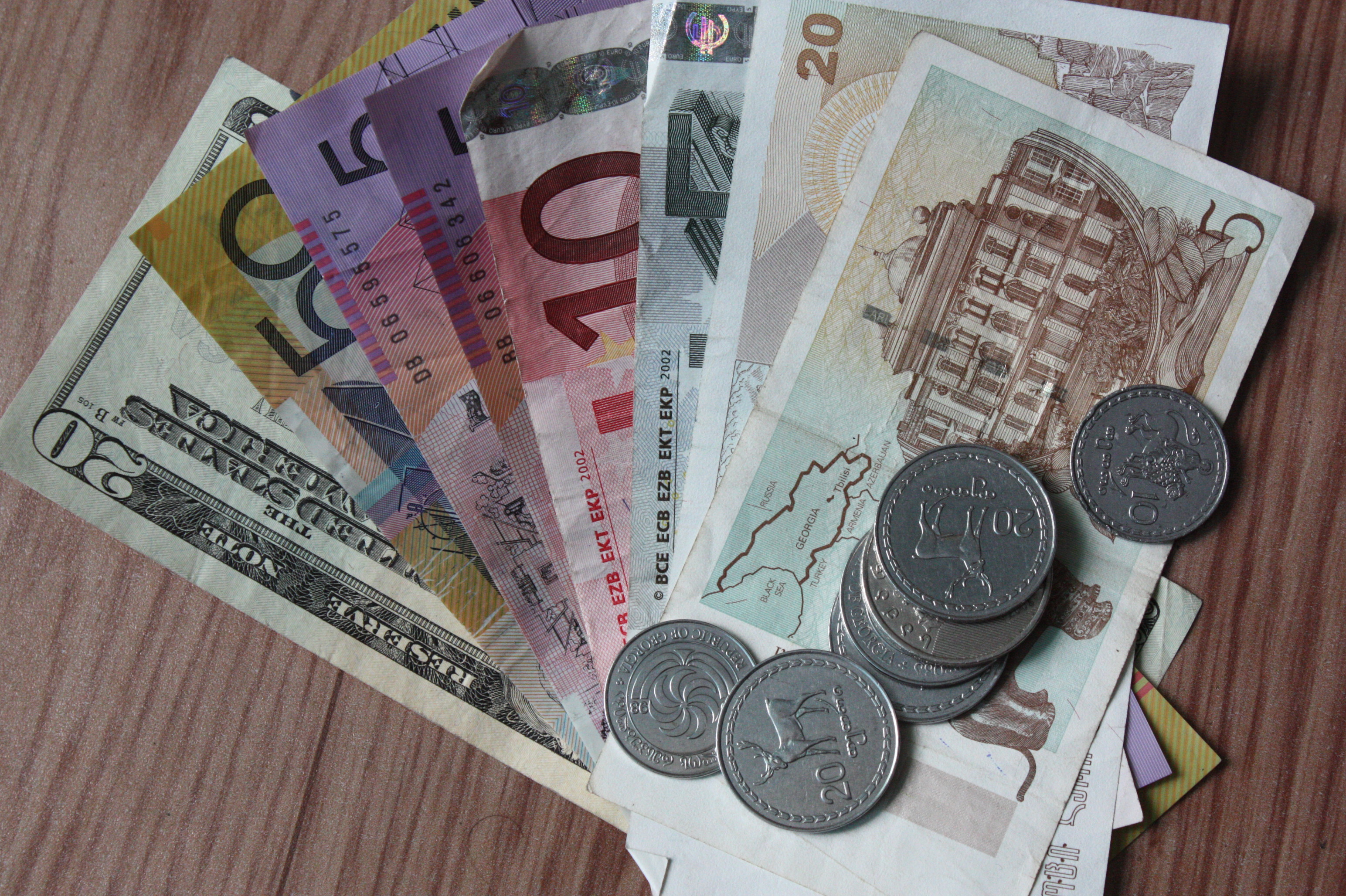
What was in my wallet earlier today. From left a US 20, an Aussie 50 and two 5s, a euro 10 and 5, and a Georgian 20 and 5 plus a range of local change.
Sy, a friend in New York, asked what we are doing about money—what currency do we use, how do we change money, do we have credit cards and such?
Managing money isn’t really a big concern, but we do have to plan. We seem to have everything. We’ve spent all our British pounds, but we are also carrying a supply of euros, American dollars and Australian dollars. Plus we have a MasterCard and I wish we had a Visa card.
We tried to get a Visa in 2009 before we left for Africa because it’s the only card accepted in West Africa, but the bank (which bank—the Commonwealth) had just done a deal which meant they would issue only MasterCards. We found this out the day before we left. G-r-r-r! It was a pain in the neck all the way to South Africa, when MasterCard suddenly became acceptable.
But we’ve brought enough cash this time that we probably won’t have to use the credit card until we reach Southeast Asia or Australia. We already know that MasterCard works fine in both locations.
So far we’ve used a medley of currencies. We’ve spent all our British pounds and most of our euros in Europe. Other countries and their currencies have been Czech, koruna (crown); Hungary, forint; Romania, lei; Bulgaria, lev; Turkey, lira; Georgia, lari; and Armenia, dram.
Most countries have money changers everywhere, so we can use them or pop into a bank. We had a nice victory in a small Turkish town. All the money changers wanted to give us 1.5 liras or less for a US dollar. But we tracked down the only bank in town and they gave Poor John 1.6 for a dollar.
We head to Azerbaijan tomorrow and they use the manat. Their cents are called qəpik. It’s a good thing we are moving on. I have NO Georgian currency—we spent the lot on dinner tonight and the makings for breakfast and lunch tomorrow.
Anyway, stay tuned and I’ll explain how everyone keeps their money safe in the truck. But shh-h-h, you mustn’t tell a soul.

Detail over the entrance to the church we were shooed out of today because we were wearing shorts.
We leave Georgia tomorrow—heading for Azerbaijan. We’ve had a delightful stay here and the only thing I won’t miss is the squadron of beggars lurking at every corner of Tbilisi, the national capital.
They’re all ages and they’re everywhere. Standing outside every supermarket or shopping centre, stationed in front of every church, parked outside most hotels and restaurants, or casually waiting for a likely victim to pass. It’s like a job. I guess it is a job.
I saw two women, dressed better than me, flanking the path by the church with their hands outstretched and asking for money. Soon after that the priest kicked us out of the church because we were wearing shorts.
Speaking of priests, there was one sitting on a bench in front of Parliament with a cardboard charity box. The woman who has been on duty outside the local supermarket for the last two days wasn’t there this morning, but a ring-in was. The regular was back after lunchtime and the interloper was long gone.
We had a tour of the old city this morning. Some young girls were playing in the street and as we approached, one suddenly stepped forward with her hand out and said, ‘Money, money, money’. Frankly I might have given her some if she had sung it. You know the tune.
Late this afternoon I must have just missed a miracle cure. There was a vacant wheelchair with two crutches propped beside it. Or perhaps the chair just sits there overnight.
Ethiopia is the only place I’ve seen worse begging. Lalibela even has signs posted throughout town asking tourists NOT to give money or any other items to begging children. The signs say the community knows who needs help and it will help them. Most hotels have a charity box that says, more or less, ‘put your donation here and we’ll make sure it goes to the right places’.
P.S. I’d love to post a relevant photo, but I’d have had to pay to take one. I’m not above doing that, nor am I opposed to donating to certain beggars. I gave away plenty in Africa. It’s just such a business here, that I’ve decided not to give anything to anyone.
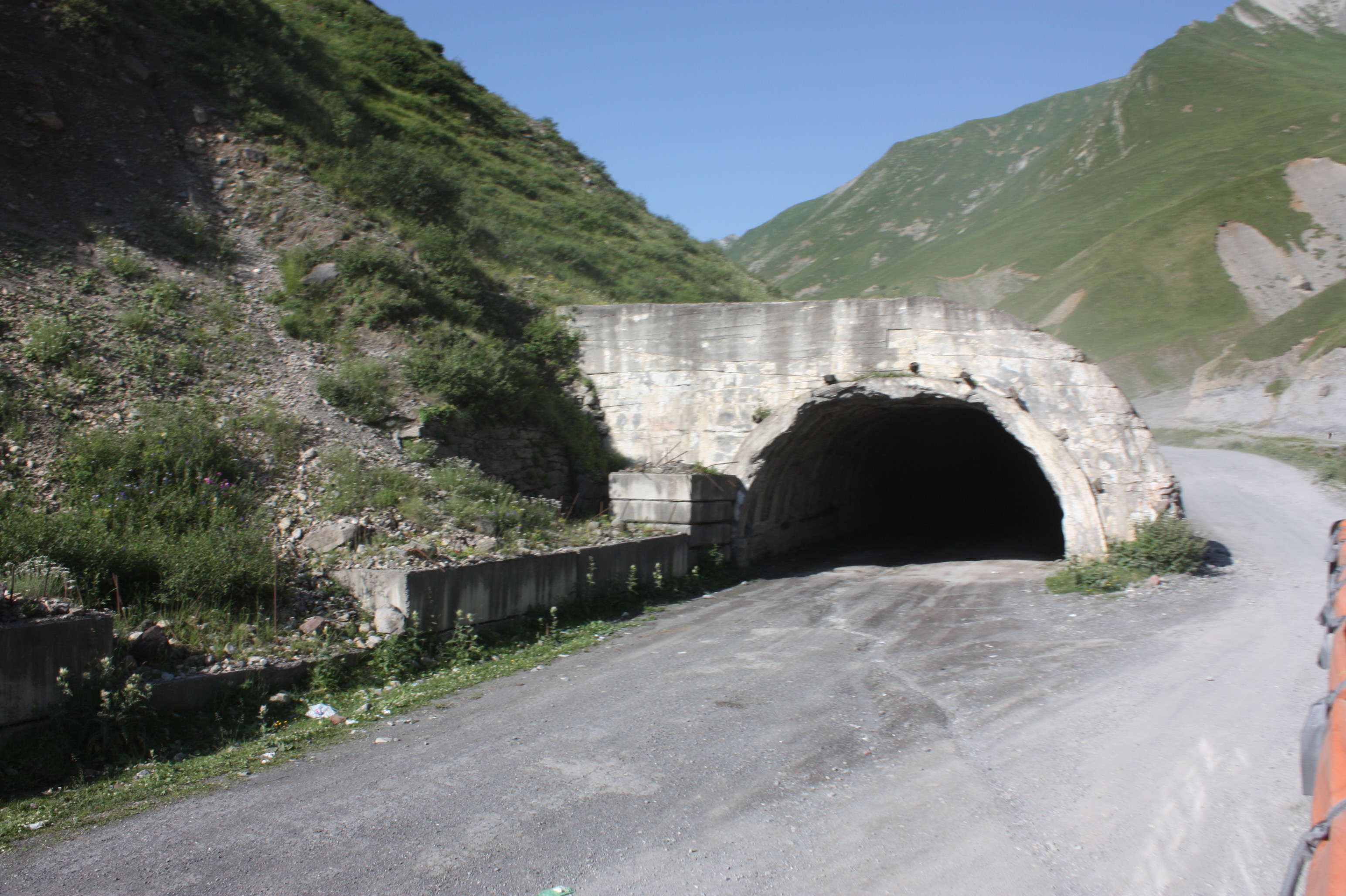
Entrance to a concrete gallery on the Georgian Military Highway.
From the comfort of my air-conditioned, 14-bed dorm room in Tbilisi, the capital of Georgia, it’s hard to recall the couple of bone-crushing drive days we had recently in Georgia and Armenia.
About a week ago, we left Kazbegi to drive south to Armenia. This meant another trip on the Georgian Military Highway. The road was professionally engineered about 100 years ago and it’s easy to believe that no maintenance has been carried out since then.
I’m usually sitting over the truck’s rear wheels and, let me tell you, on all those rough roads, I ricochet around my seat like a fart in a pickle jar (thanks Dru, I’ve always wanted to share that line in print). I wear my seatbelt and I really believe that several times it has kept me from being bounced onto the floor (or perhaps shot out an open window).
It’s not that there are so many potholes, but that the entire tarmac surface has broken up so badly over time. Not surprising given the harsh winter conditions in the Caucasus Mountains. Nevertheless, we encountered the same kind of terrible roads in Africa and, Chris, our driver there, always said he’d rather have no surface on the road than partial tarmac.
But in Georgia, you get some ricochet relief once you reach the ski resort village of Gudauri. I’m guessing that every winter enough local politicians drive from Tbilisi to Gudauri to go skiing, that they insist on the road being in reasonable condition.
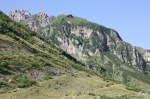
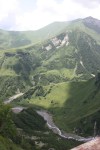
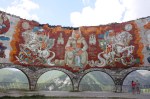
But in spite of the miserable road, the scenery is fantastic and so interesting. I especially liked seeing the concrete galleries, built to protect certain sections of the road from avalanches. There were seven or eight such galleries—all two-lanes wide. All the galleries but one have an uncovered summer road running alongside. The pics here show several of the gallery entrances and some of the scenery.
The colourful religious artworks are part of a huge viewing platform that lies just a bit south of the Jvari Pass, which is at 2196 meters or 7200 feet.
P.S. Some of the roads in Armenia are just as bad.

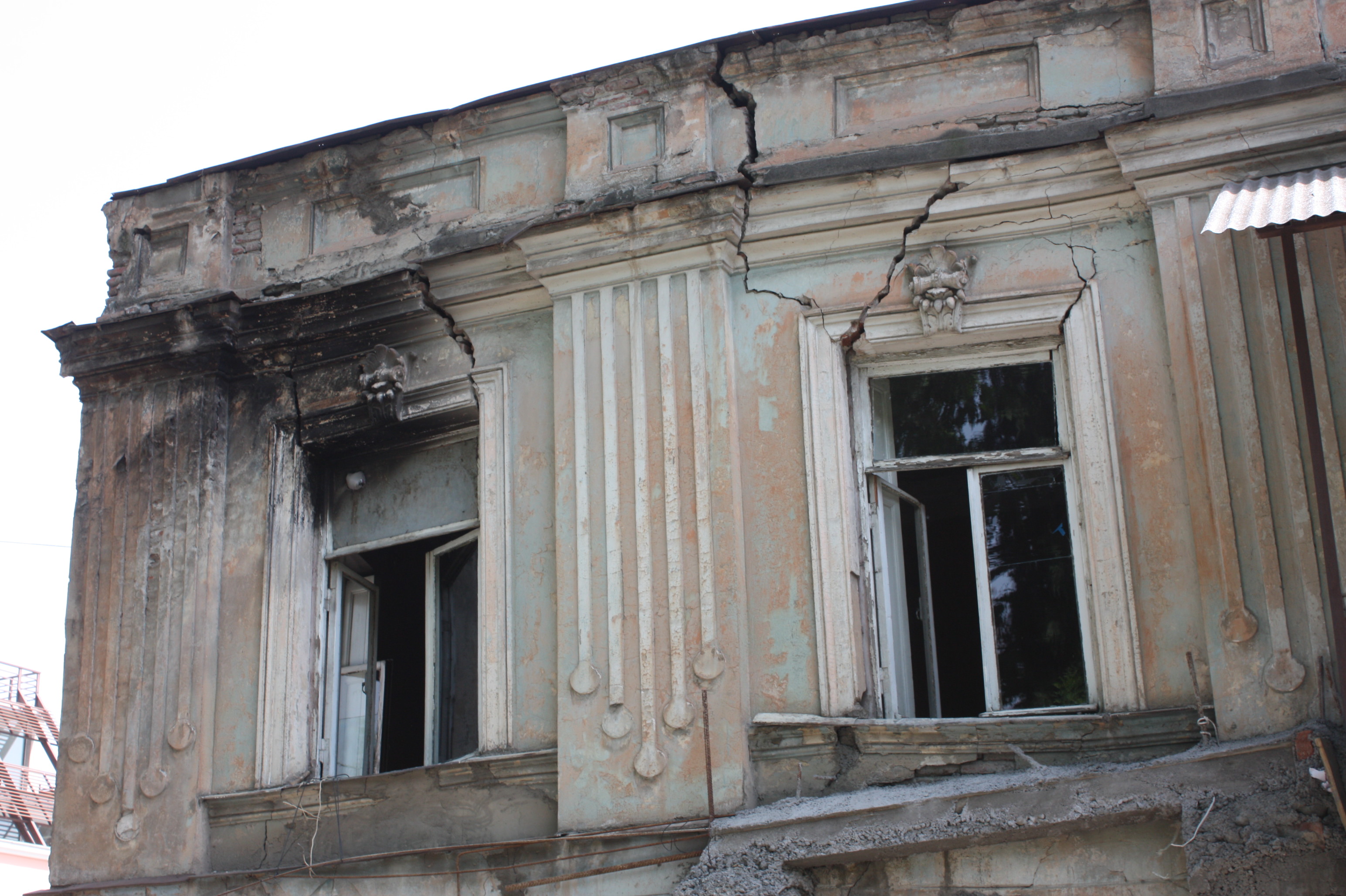
Not our hostel, but a sign of some cracks in the system.
What an afternoon! Last night I posted that I chatted with a bunch of Georgian men in our hostel in Tbilisi.
Turns out they aren’t Georgian, but Iranian. There about 10 of them, including a couple with an 11-year-old boy. No one has enough English or Arabic to explain why they have been in Georgian for a month. Job hunting? Seeking to immigrate? I know they aren’t happy in Iran.
But all hell broke loose in the kitchen this afternoon. We’re not sure exactly what happened, but this is a best guess. A double room was freed-up in the hostel. The couple started for it, but a few of the fellows had their eyes on it too.
In no time there were near fisticuffs. They all seemed to arrive in the kitchen at once. Flinging around packed suitcases, shouting, pushing, shoving, crying, swearing and accusing (I’m sure).
My truck mates and I sat in stunned, but mesmerised, silence while the woman running the hostel tried to calm the situation. ‘Go outside,’ she ordered, but they ignored her.
In the end, our tour leader Lu raced outside and managed to summon the cops (almost a story in its own right). That was hours ago.
We’re not sure what’s going on now. The Iranian couple are sitting in the kitchen. They may be moving to another place. The Iranian men are nowhere to be seen. The cops are still here—taking a statement from Eamon, our newest truck companion, regarding his missing camera.
The cops want to search the place and everyone’s belongings. Eamon doesn’t want to hurt anyone’s feelings. We’ve all told him he doesn’t owe anyone anything, but someone owes him his camera.
He’s wavering. The hostel manager fully supports having a complete investigation. She said, more or less, ‘everyone wants to know who did it’.
With apologies to Megan, this is way better than Truck Cluedo. I’ll keep you posted.
News flash
I hear more cops will be here soon to carry out a thorough investigation.
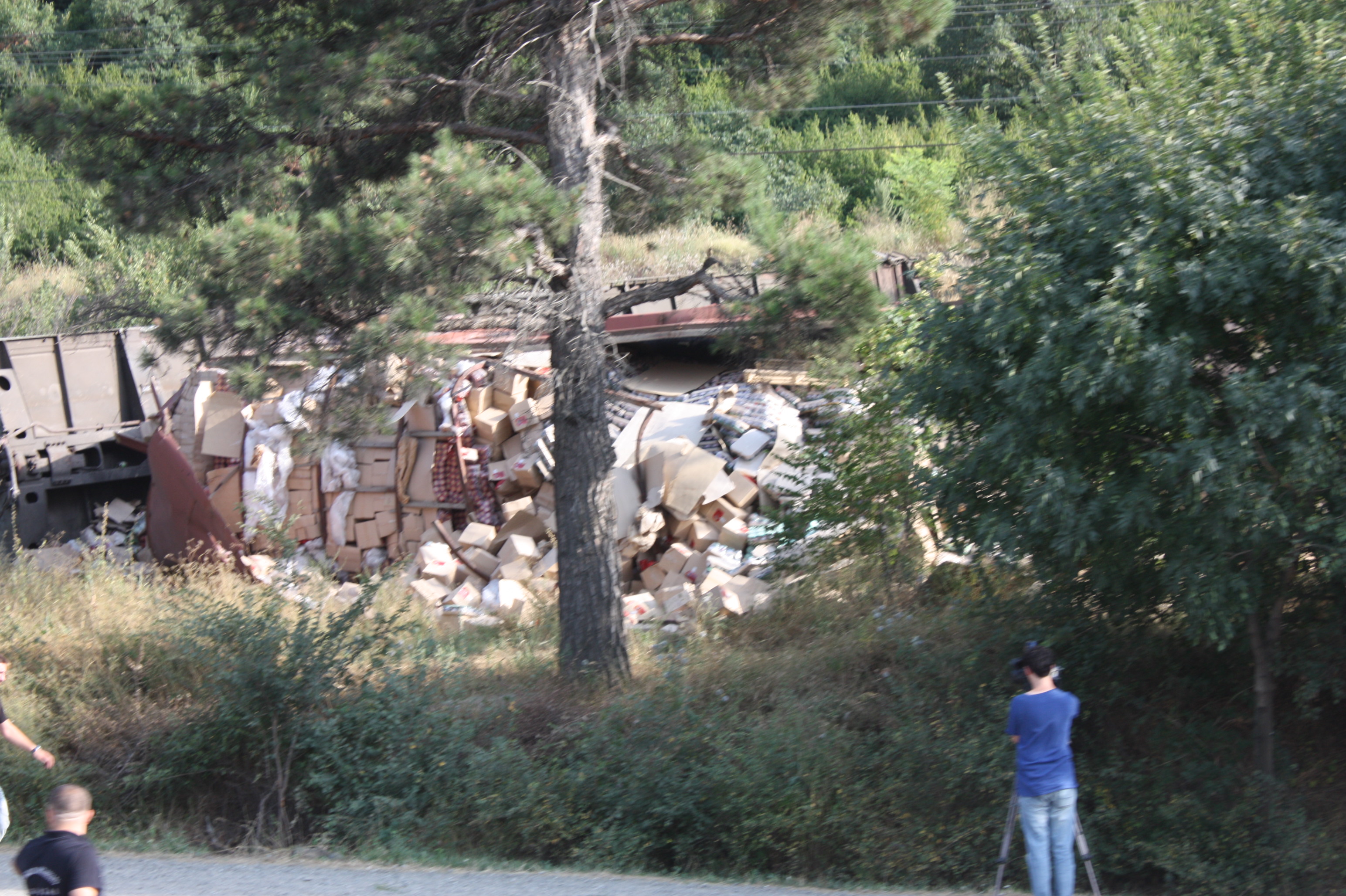
Spilled goods from Georgia, Azerbaijan and Kazakhstan.
There was more than a bit of a mess on the highway Saturday as we travelled from Armenia back to Georgia.
About 10 cars of a freight train, carrying fuel and other products, derailed not far from Mtskheta and Tbilisi, the national capital. The news said the accident occurred because one of the cars was ‘technically faulty’—whatever that means.
The highway, which runs along side the railway tracks, was closed for several hours while special crews cleaned up spilt fuel. Fortunately, nobody was hurt.
Our side of the road was open, so we weren’t held up for too long. I managed to get a few pictures of the mayhem as we passed by the centre of the action. The top pic is from Saturday (30 July) and the bottom pic is from Sunday when we returned from our bush camp outside of town.

Cleaning up—a day after the fact.
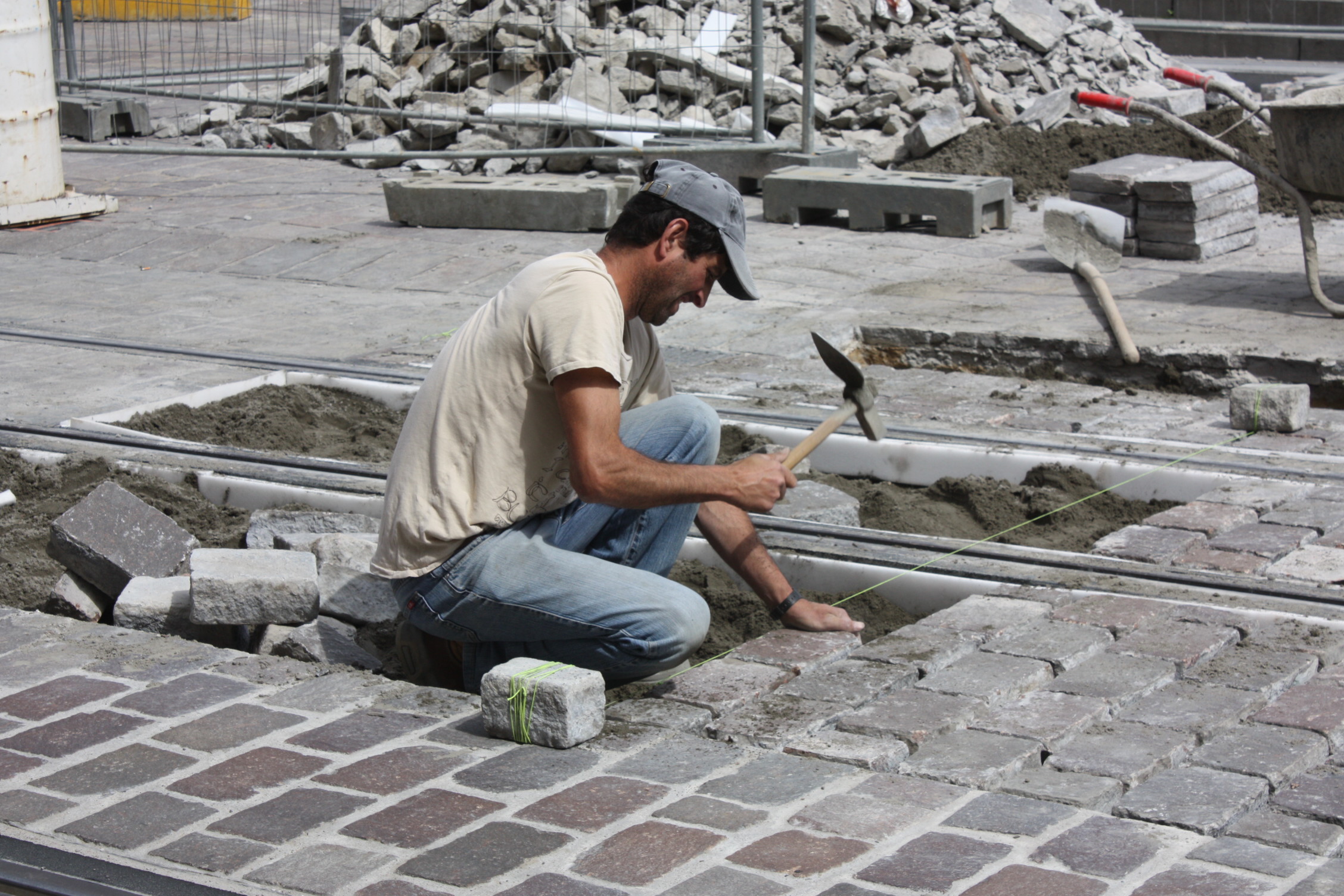
A smooth-ish trap being set for stiletto wearers.
How do these women do it? All across Europe and now in Central Asia, women—and not just the young’uns—are trundling along in the most incredibly high and spindly stilettos. It makes my feet and back hurt just to look at them.
It wouldn’t be so bad, but so many roads and footpaths (where they exist at all) are terrible. Pavers are broken or missing, manhole covers are never to be seen again, potholes are huge and dog turds are abundant.
Plus, many community’s have starting using even more cobblestones for roads and paths. They look quaint and stylish, but they are rugged and deadly. I have enough trouble navigating in tennis shoes or thongs (just so you know I’m not talking about skimpy underwear—in Australia we say thongs instead of flipflops).
Historical sites are just as bad. Their paving is usually a few hundred years old. Imagine trying to cruise through the various levels of stone slabs with surfaces and edges that are sharp and chipped or smooth and slippery. Or both at the same time.
In Germany, I saw a woman coming out of church after attending a wedding. She had a distinct hobble, swollen feet, a death-grip on her hubby’s arm and the regulation stilettos. Julia, one of our former German exchange students, said she was having a good whinge (complaint) to her hubby about the deplorable state of the road, as well as her shoes and her feet.
As I wobble my way back to Australia in my flat shoes, I keep chanting to myself—don’t break anything, don’t break anything! A broken ankle in a plaster cast would make it plenty hard to get on and off the truck.
 Where to next?