
I love breakfast in Europe. No boring dry cereal and tasteless white toast.
This first meal of the day is a serious matter. There’s plenty of choice—and it’s all my kind of food. Most selections are savoury and can include cheeses, cold cuts, fish, raw veggies such as carrots and cucumbers, pickles, pates, hard or soft-boiled eggs, butter, jams, marmalades, honey and the BREAD. Europeans understand and revere bread. Most of the loaves seem to be sourdough—it can be light or dark, plain or laced with nuts or seeds.
There are sensational pastries and decadent croissants too. A favourite was the special sweet Hamburg pastry. I could almost move to Hamburg for a delicacy this good. We tried two kinds—one with chocolate bits and one without. There’s a pic in the slideshow of two chocolate ones in a basket.
A German friend jokingly said their economy relies on the A, B, C shops—Apothekes (pharmacies), Bakeries and Cafés.
Poor John was official bakery shopper in a few places. He’d pop out in the morning—especially in Berlin—to buy a half a loaf of organic sourdough walnut bread. A whole loaf is a fixed price, but part of a loaf is weighed and then priced. Some bakeries even sell by the slice.
I have quite a few bread/baking cookbooks—including German and French ones. So I’ve promised myself and Poor John that I’ll go back to bread-making when we get home. During the 1980s, I made most of the bread we ate. That started in Syria and was out of necessity, after I bought a few loaves that had black streaks running through them. But I was lucky enough to have a mother who made bread three times a week, so the thought of bread-making wasn’t too daunting.
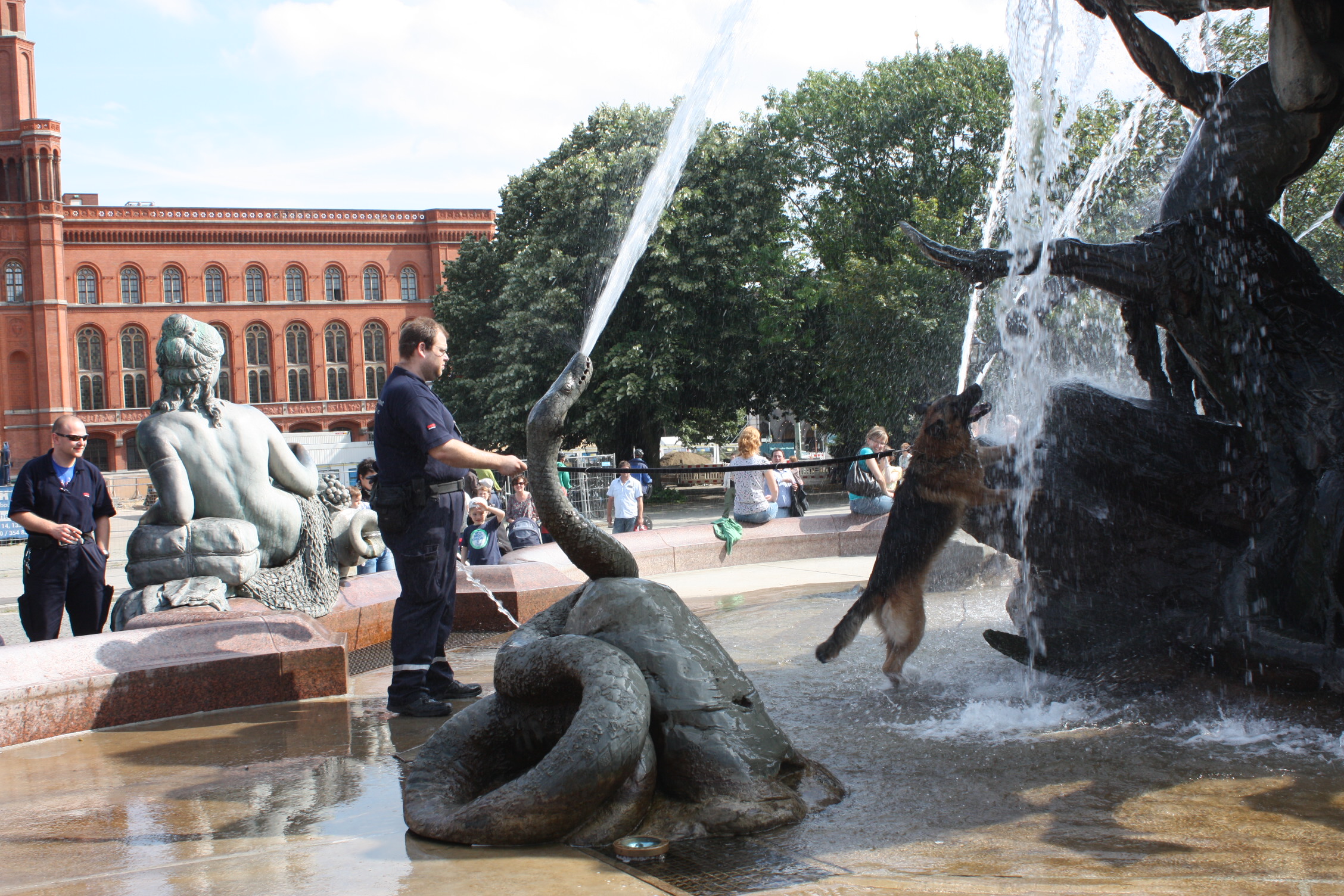
Transport security dog enjoying a Berlin fountain.
Berlin has plenty of fountains. On a hot day its’s not uncommon to see someone enjoying the cool water. It was a surprise and a pleasure to see this enthusiastic Alsatian (German Shepherd) taking break from his role as a member of the city’s transport security force. We regularly saw these dogs and their handlers patrolling the underground train stations. This is the only time we saw them goofing off.
The other day I took a ‘swipe’ at Poor John for forgetting his polar fleecy on the train from Prague to Salzburg. I should learn not to throw stones.
Late yesterday afternoon, not long after we joined the truck, I was hit by a rebounding stone. Not literally, but I did break my glasses. The right arm just snapped off. And it snapped in a way that made it completely impossible to repair. G-r-r-r! Poor John was very sympathetic and didn’t chuckle even once. He may have smirked or rolled his eyes when I wasn’t looking.
Luckily, the truck was staying in Salzburg for another day, so this morning we headed to a shopping centre outlet by the airport (Flughafen) in search of new glasses and camping chairs.
In about an hour, my old lenses were trimmed down a bit and fitted into a new pair of reddish-brown Versace frames—I can hear you all swooning—that cost only 129 euros. I really don’t know what they look like on. I tried on three pairs that the saleswoman said would be suitable for trimming, and then accepted everyone’s ‘word’ that the Versace looked best.
The chairs proved the greater challenge. We cruised the entire shopping complex (spread out over several blocks), but it was too fashionable a place to have camping equipment. The closest we came were kiddie chairs at a Toys R’us. But the woman in the eyeglass shop (Optik) sent us to SportEybl, and two bus rides later we found chairs for 14.99 euros each. Bargain, or now that Poor John is learning some useful German—Angebot!
I’ll post photos later. 🙂
P.S. Poor John is delighted with his birthday present—a new polar fleecy. He says it’s soft, warm and makes a great towel. He says thanks for the birthday wishes too.
I’ve been to Bruges three or four times, but never ventured into the Basilica of the Holy Blood, which is located on the village square. I’m glad I did this time—it’s intimate, colourful and very important within the Roman Catholic Church. That’s because it house a venerated relic of Holy Blood. The relic was supposedly collected by Joseph of Arimathea and brought from the Holy Land by Thierry of Alsace, Count of Flanders. Built between 1134 and 1157, the church was promoted to minor basilica in 1923.
It has two chapels. The lower one, dedicated to St. Basil the Great, is a dark Romanesque structure that remains virtually unchanged. The relic is in the upper chapel, which was rebuilt in the Gothic style during the 16th century and renovated many times during the 19th century in Gothic revival style.
The slideshow displays the exterior and interior of the upper chapel, including a pic of what I assumed was the bishop giving individual audiences to people—perhaps offering a blessing.

Poor John, Malou and Rudy inspecting the wall of beer in Bruges, Belgium.
Today is Poor John’s birthday. I’m buying him a polar fleecy to replace the one he left on the train yesterday.
Can you believe it? The day before we join the truck, he loses/forgets his jacket/towel. Yes, he uses the polar fleecy as a towel. He reckons you dry yourself with it, then put it on and let it dry out in the course of the day.
Like I said before—he’s Australia’s biggest dag.
From now on, I have no idea how often I’ll have internet access, but I’ll post as often as I can. So stay tuned and check regularly. Depending on the internet gods, you might see something daily or a swag of entries in one hit.
By the way, I’d hoped to post a bunch of items last night, but the hotel’s internet gods were not cooperating—two hours of hassle and still no joy. It’s a little better this morning but not great, and now it’s time to check out. 😦
If the campground has wifi, I’ll be back later this evening.
We’ve eaten very, very well in Europe. Too well really! In the last six weeks, there a few extra kilos following me around and they aren’t in my bag. I’m hoping truck life corrects that.
Almost all of our meals have featured European cuisine—and we’ve tried a lot of local dishes too.
On our first night in Berlin, four of us tried the neighbourhood Italian. We had a fantastic antipasto platter and I ordered something I’d never seen before as my main dish. Of course, now I can’t remember the name of it, but I remember the cooking technique.
The pasta dish was made at the table and meant to be an attention-getter. The chef first scraped cheese from a huge wheel of parmesan. To this, he added alcohol and lit it, He finally added tagliatelle and the remaining ingredients (including cream and thinly sliced truffles) that he stirred through until it all was heated. Most impressive, and very tasty.
Our dining companions were Lutz and Maren, our wonderful hosts in Berlin. And check out that wall of wine behind them.
As part of making this blog reasonably accurate and newsy, I gather information. Tourist Offices usually have free maps and at least some brochures in English. Tourist destinations often have plaques with explanations. I photograph the lengthy ones and take notes from the others. I never seem to have a scrap of paper, so I often scribble cryptic messages on the palm of my hand. You’d be surprised how much you can fit on one hand. (Note to self: Wash hands AFTER recording the details elsewhere.)
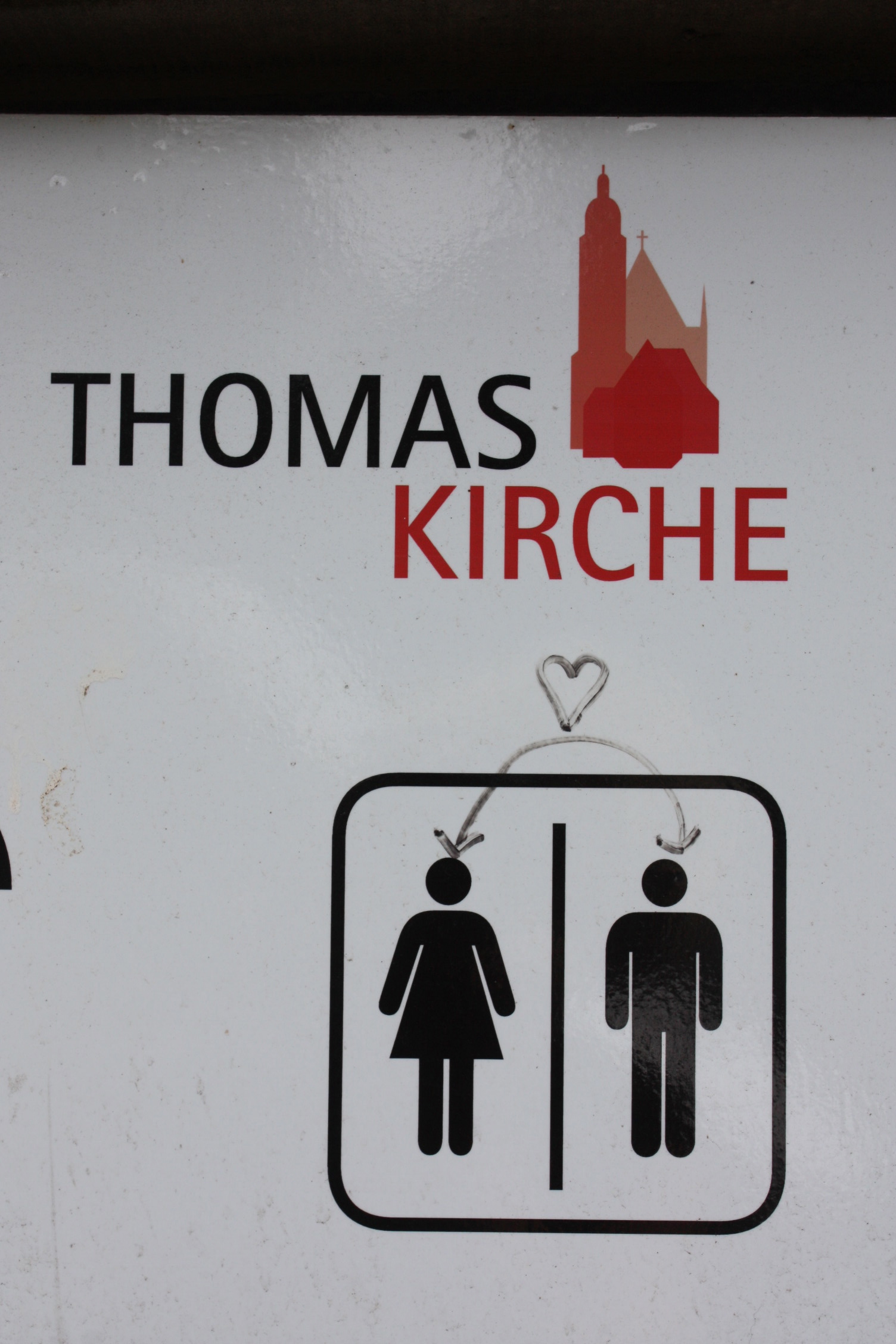
Love is alive in Leipzig, Germany.
Some brochures and signs are sprinkled with amusing pigeon English and misspellings, and others are letter-perfect. Some have been engineered by a new-age marketing guru who is determined to deliver the news in gibberish. I won’t name names, but here’s an excerpt from a brochure I was taking notes from today.
‘The architect met these challenges by brilliantly anchoring the main body of the museum in the architectural language of the present day. The resplendent richness of ArchitectA’s late classicism and historicism is now brought into a charming dialogue with ArchitectB’s own strict language of forms.
For heaven’s sake, what rubbish! ‘Architectural language’ and ‘charming dialogue’. Spare me!
But I love this sign posted outside the Thomas Church in Leipzig. Clever and stylish — and a charming dialogue to boot! If you can’t see the added sketch, click on the picture to enlarge it. 🙂
I forgot to tell you that on Tuesday we got the last of the visas we need to start trucking.
Cambodia, China, Laos and Vietnam have embassies in Australia, so we got those visas at home—months ago. It was Poor John’s responsibility to run around Canberra with passports, applications and photos. He loves that sort of thing and was especially pleased to often get a visa that lasted twice as long as usually given. The diplomat in him still knows how to sweet talk a consular officer.
The greater challenge was to get visas for Central Asia—namely Azerbaijan, Kazakhstan, Kyrgyzstan, Turkmenistan and Uzbekistan. We had a few options. We could have sent our passports to the UK and had a passport agency get them for us. With a service fee of more than 32 pounds per person per visa plus couriers, we decided there had to be a better (and more enjoyable) way to spend our money.
We could have gone to England ourselves, but given that once our passports were with an embassy, it might be hard to travel outside the UK. So we settled on spending the time and money in Germany. It was a brilliant choice. We’ve been able to travel all over Germany and Belgium, visiting dear friends and family (meaning many of our former exchange students).
It all started on 16 May when we landed in Frankfurt at 6 a.m. That morning we had our Kyrgyzstan visa within 10 minutes. It cost only 55 euros each—the cheapest of all and it turned out to be another visa that is good for twice the normal period of time. All the other visas took longer (from three days to two weeks) and cost more—up to 92 euros each.
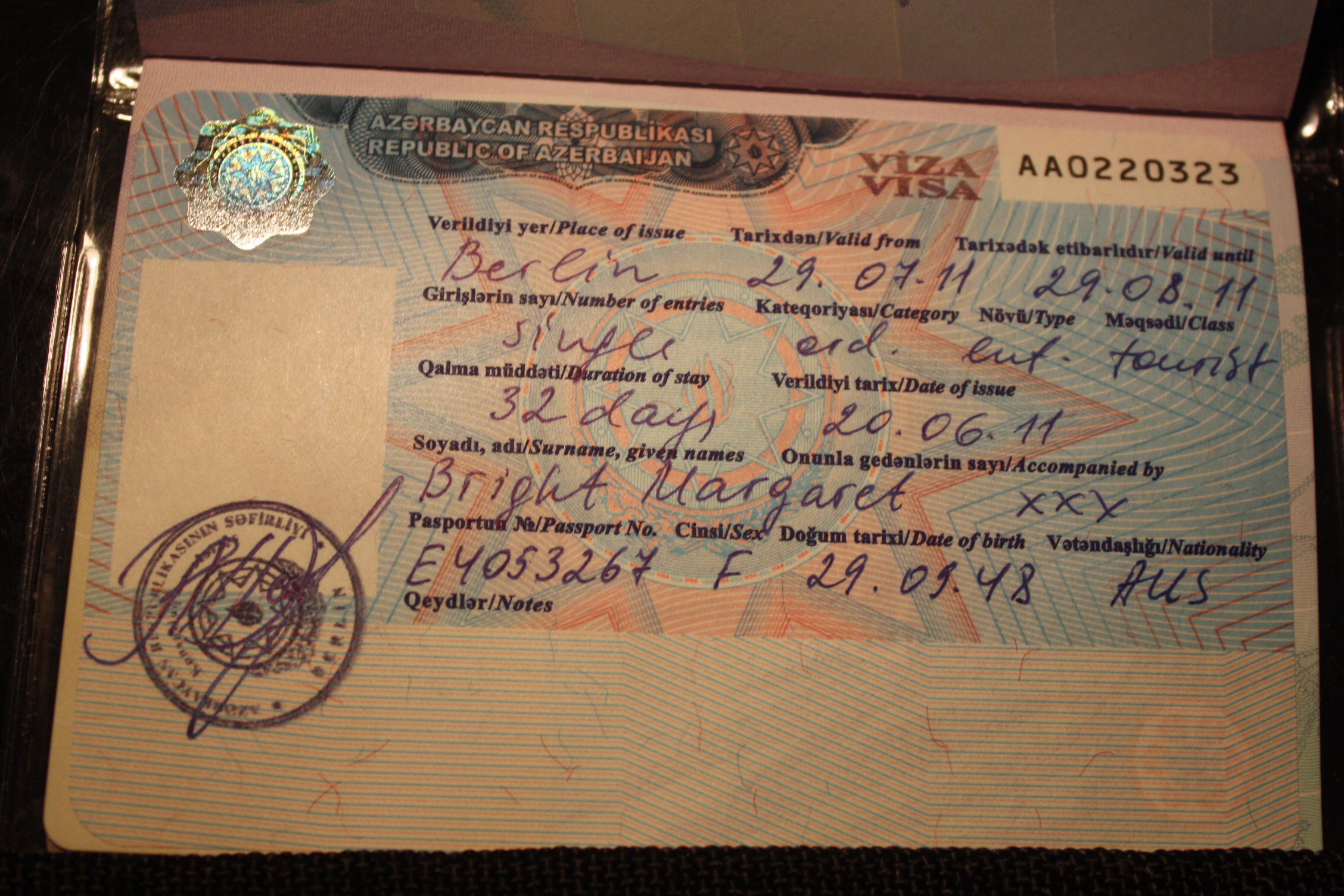
My go pass for Azerbaijan.
Azerbaijan proved to be the most challenging. Not sure why, but their visa procedures changed while we were travelling. Suddenly it was necessary to use an agent—and only an agent. Perhaps it was because Azerbaijan and Germany had a football (soccer) match in Azerbaijan on 7 June, and their embassy in Berlin was bombarded with 5000 visa applications in May.
We went to the embassy on spec, but the fellow there confirmed the need for an agent. He gave us a phone number, but the guy who answered spoke only Russian and German. We found another agent online (SerVisum) and they were excellent.
We join the truck on Tuesday in Salzburg, and here’s one of our travelling documents.
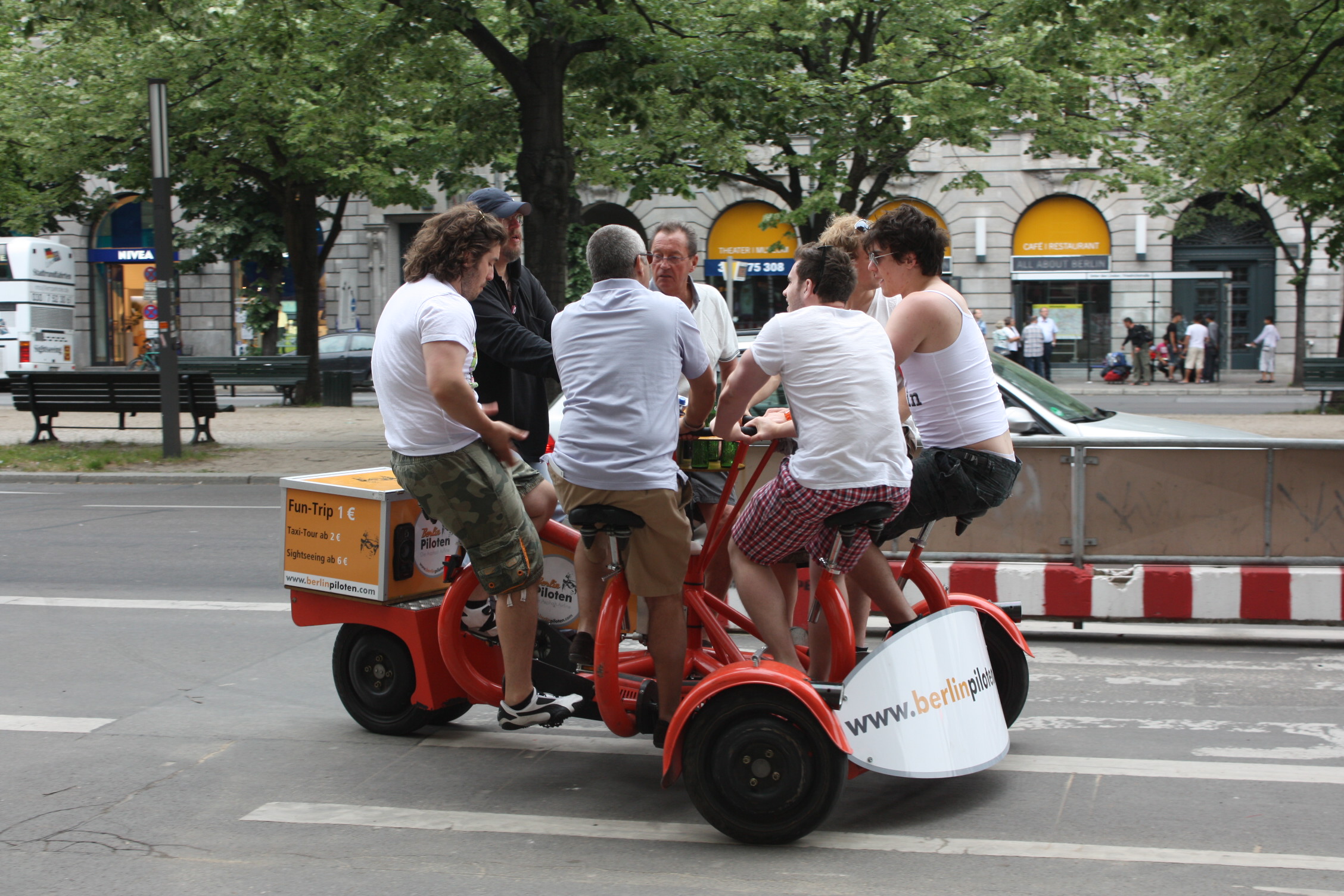
A full-loaded conference bike.
I’ve wanted to post this photo for ages, but it has taken me all those ‘ages’ to discover that it is actually called a ‘conference’ bike. It’s round, seats seven (including the main operator) and is very popular in the tourist areas of Berlin. Everyone sits around the little conference table in the middle and pedals like mad. The pleasure of attending this meeting costs a euro per person, and I assume that is for some defined period of time—such as 15 minutes.
Conference bikes (also called team bikes) seem to be very popular all over the city, and are really meant to have full attendance. You should see the main operator struggle to pedal when no one else is on board. Poor John reckons it must be a part-time job for soccer players who want to keep their calves in shape.
There’s more detail at http://www.conferencebike-berlin.de/8.html and there are a few video clips on YouTube. Just search for conference bike.

An honest-to-goodness German schnauzer.
You might be German after all—or maybe Czech.
It was our last day in Germany. We were in a Deutsche Bahn (German Rail) office, waiting in the queue to buy tickets to Prague WHEN one of your relos pranced in with her family. She is most likely a long-lost little sister or cousin because she also has a birthmark on her tongue. I wasn’t quick enough to get a photo of that tongue (or properly catch her name either), but here SHE is. Isn’t she cute? And she’s a standard schnauzer—not a mini. Her mum says she is five years old and loves rolling on her back in her bed like you do. She also loves bum rubs, which I established all by myself. I think her mum was a little surprised by the enthusiastic response the bum rub got, so perhaps they hadn’t tried that before.
Unlike you, she doesn’t seem to mind being brushed. Hint, hint. She also has all of her tail which curls neatly over her bum.
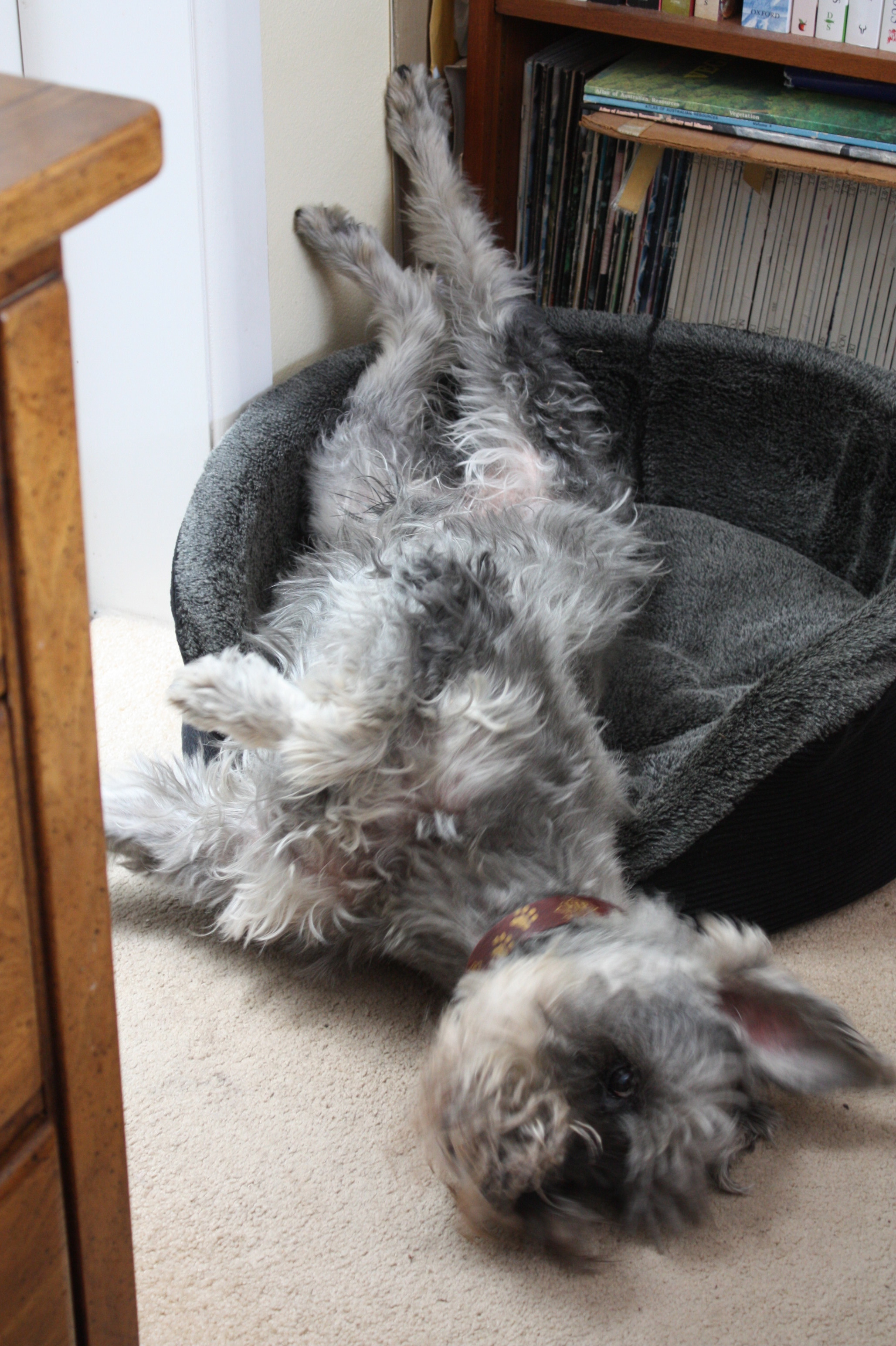
Aggie rubbing his own back.
Her mum, sister and brother admired a few pictures of you on my camera and we all agreed there aren’t enough schnauzers in the world. Her mum was also perplexed as to why there are so few schnauzers in Germany.
But here’s the even bigger surprise. Later that afternoon in Prague, we went for a walk with Tom (remember Tom who was on exchange with us in 2008?). On the way back from our stroll we encountered ANOTHER standard schnauzer. This one was rather crabby (rather like you in your younger days when you never slept so were constantly grumpy) so we didn’t get close enough for a conversation.
But there you go. Two standard schnauzers in one day—one in Germany and one in Czech. I can stop searching now.
A sad footnote: Aggie, who was 15, had to be put down recently. I still miss him and always will.
 Where to next?