

A row of Fuggerei apartments. Each dwelling has a small garden and most residents have little sheds.
The Fuggerei in Augsburg is the world’s oldest social settlement. It has been around continuously since 1521, when it was founded by Jakob Fugger the Rich—wouldn’t you love to be referred to as So-and-So The Rich? Fugger made his money as a banker, and Poor John is drawn to the theory that he learned double-entry bookkeeping in Venice.
The concept for the Fuggerei was groundbreaking when the settlement was first created, and it remains an exceptional and outstanding effort. From the outset, Fugger insisted that residents, although needy, not be allowed to become paupers. For example, to minimise the sense of poverty, each apartment has its own entrance. The bell pull at each entrance is individually designed—allegedly so that at night, on the unlit lanes, residents could ‘feel’ their way home to the right doorway.
The Fuggerei was heavily damaged during the bombing of Augsburg in World War II, and rebuilding began quite promptly. An air-raid shelter that was built there soon after the war began now houses a permanent exhibition, The Fuggerei in WWII—Destruction and Reconstruction.
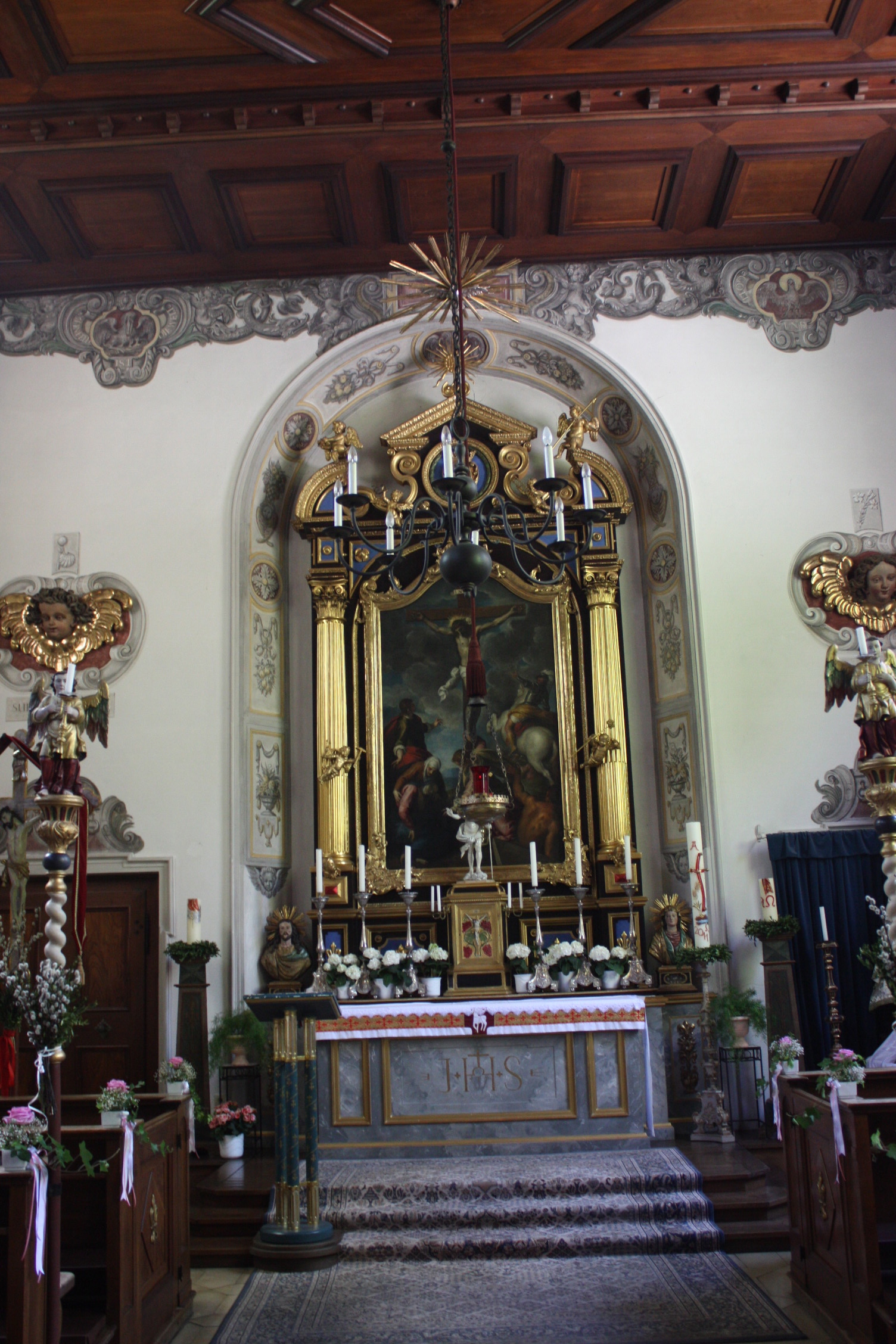
Inside the St Markus Catholic Church at the Fuggerei.
Today, the Fuggerei remains a collection of eight lanes and seven gates. It is a city within and city, and has its own church and city walls. At present, 150 people live in the 140 apartments in 67 buildings. The settlement is financed exclusively through endowment. Annual rent was—and still is—the equivalent of one Rhine guilder (or about 88 euro cents). Residents are also expected to offer three daily prayers, including an Ava Maria, for the founder and the Fugger family.
The most prominent resident ever has been master builder Franz Mozart, great-grandfather of the composer, Wolfgang Amadeus Mozart.
See www.fugger.de/ for more details. The website has a variety of translations available.
I love markets—I love the colours, the variety, the fresh food, and especially all the temptations. So I’m going to indulge myself here by sharing some of my favourite pictures from the weekly market in Augsburg, Bavaria, in the south of Germany. You’ll recognise most everything, but I was especially drawn to the heirloom tomatoes, the multi-coloured radishes, the purple potatoes, the stuffed baby capsicums (bell peppers) and the flattened peaches.
This is one of the hardest aspects about travelling. I am tempted by all this beautiful produce. I hope you enjoy this little wander through the market.
I get a lot of requests for more information on how John came by the Poor tag.
Of course it’s because he’s neglected, hen-pecked, down-trodden, misunderstood, never fed, chained to the ironing board and has to take out the rubbish.
Yeah right!
Actually it’s because he’s none of those things—oh, wait he does have to take out the rubbish and the recycling too.
But the Poor surfaced in early 2009 when we breezed by Texas to visit Gary AKA Pot Scrubber AKA Potsie. Potsie figured I’d coerced Poor John into going on an overland camping trip through Africa on the back of a truck. He imagined John was pining for five-star accommodation and lurid cocktails by a shimmering Olympic pool. As our trip through Africa progressed, Potsie would cautiously inquire ‘And how is Poor John doing?’ Oh for heaven’s sake. Poor John did his original African overland in 1973. I did one in 1977. We decided to do it again together when we could.
Poor John is the biggest dag in Australia—surely some online Australian slang dictionary will define dag for you. If his trouser hem comes undone, he staples it. A shirt’s not worth buying unless it has a collar and a breast pocket (zippered ones are preferable) for his wallet. Keys should be made of aluminium so they are light—can’t go weighing down your pockets. Try not to carry change—it’s too heavy too. Good haircuts should cost $2 or less (he’s hanging out for his next cut in Turkey).
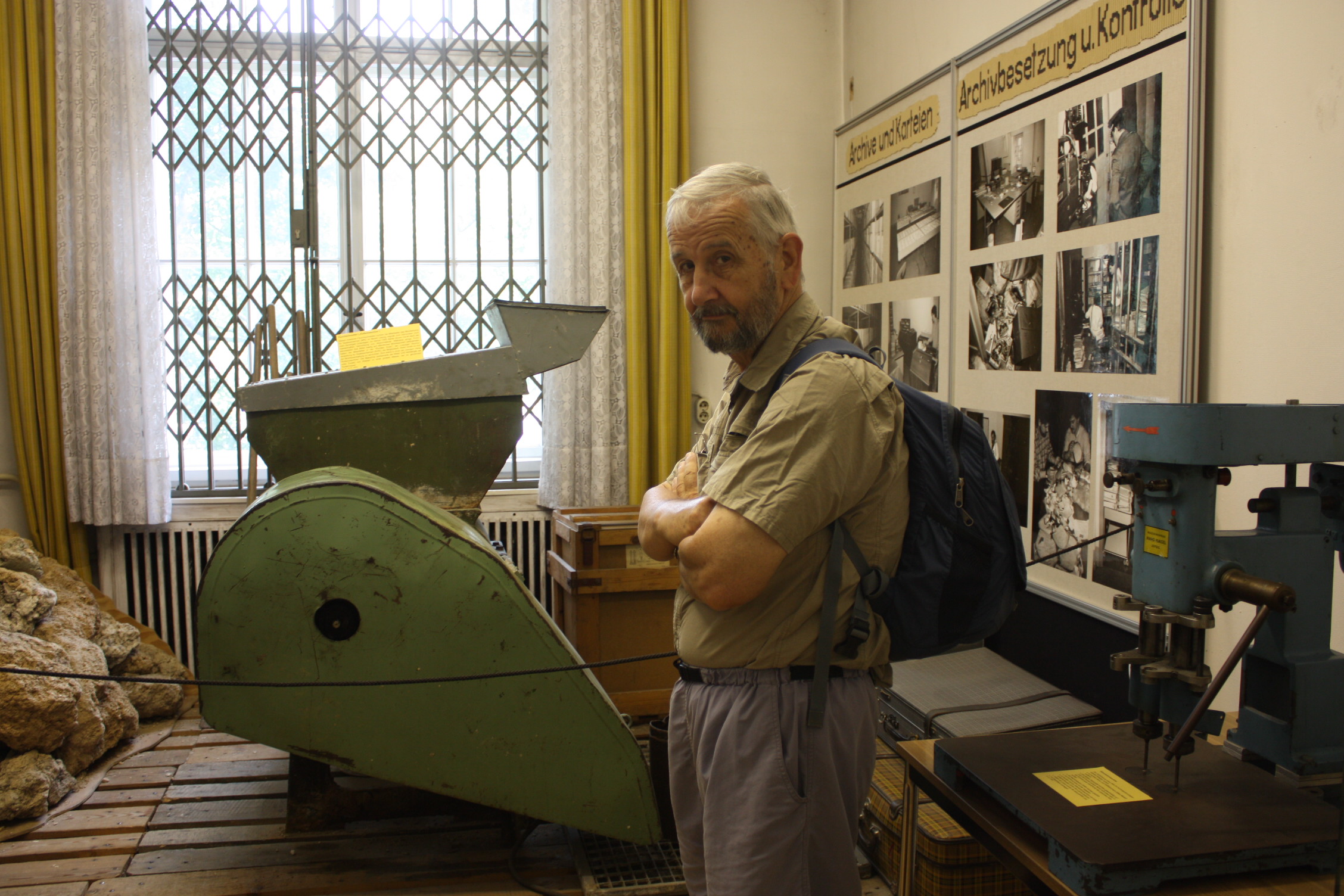
Poor John wondering how to get a paper shredder home
So that sort of sums up my Poor John. But I will admit that he does suffer a bit on these overland trips. For starters, there’s no reliable daily newspaper and the coffee can be pretty grim. Sometimes he has to help cook, or clean the kettle or lug jerry cans of water. And there’s a great shot of him hauling water in Mauritania. I’ll post it when I find it.
In the meantime, here’s a pic of him trying to figure out how he could possibly get this gigantic paper shredder home to Australia, so he can dispose of my personal Mt Everest of paper including my stamp collection, the ancient contents of the filing cabinet, university notes, old newspapers and magazines, recipes on bits of napkin and way too many cookbooks.
P.S. For my sister Susan. Don’t go thinking you are entirely without blame on the issue of naming Poor John. I can’t find the email now, but I definitely recall a message from you asking how Poor John was after he and I had gone sky-diving in Namibia. I will remind you that I did NOT make him do it.
Also: Don’t forget to pick a number by 29 February 2012.

Nifty car finder. The perfect solution to the question -- Where's the car?
Julia’s family has the best idea for keeping track of their car. They live near the centre of Augsburg and don’t have their own parking place. This means they have to cruise the neighbourhood to find a parking place. But with only one car in the family and multiple drivers, how do they keep track of the car’s whereabouts?
With a map, of course. They bought this nifty magnetic map online. It has a plan of their neighbourhood, a little magnetic car to show where the real car is parked and a place to hang the keys.
This is a brilliant idea, but Poor John wants to know whether I’d actually remember to use it. He always has to ask these difficult questions.

Plump white asparagus from the Augsburg market.
In an earlier post, I wrote that the German asparagus season ends on 17 June. Now I know why.
My dear friend Malou, who lives in Ghent Belgium and whose father raised asparagus, has explained that growers always stop cutting new spears at that time so the plants have a chance to recover/regenerate for the next season.
Her father tended 3000 plants, so he knew his stuff. Her brother grows it now. Malou also said that Belgium’s cutoff date is a little later than Germany’s—23 June. So I enjoyed some white asparagus yesterday. Am not expecting to indulge in it again until 2012.
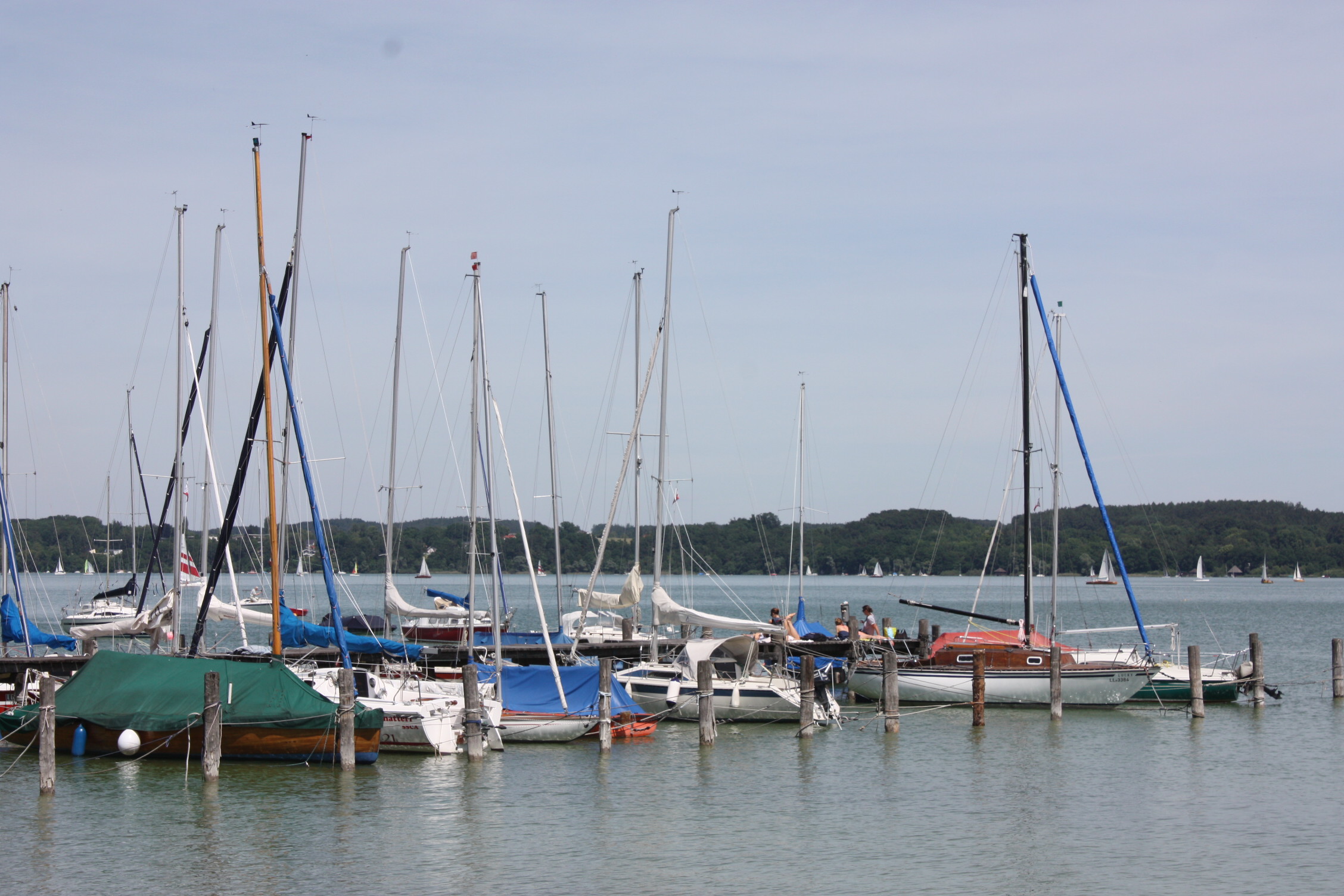
Boats on the Ammersee
After Landsberg (see the Beyond the guide book entry), we drove on to Schondorf, a village on Lake Ammersee. This is Germany’s sixth largest lake and, like most Bavarian lakes, was created by the melting of ice-age glaciers. It is fed by the River Ammer, which is called the River Amper when it flows out of the lake.
Ammersee is a popular location for water sports and plenty of people were taking advantage of the sunny, warm weather. We saw a private resort for the people of Augsburg. We thought about ‘gatecrashing’, but it was probably best we didn’t. Julia’s father explained later that it is for Augsburg’s public servants.
The word Ammer is a 13th century Celtic word for water, and Wikipedia says that Ammersee and Amper were part of the ancient amber trading route leading to the Brenner Pass.

Kids playing in the Ammersee (the two semi-submerged figures on the left are statues).
On the way back to Augsburg, we stopped at a roadside strawberry hut (it’s built and painted to look like a giant strawberry) to buy plump, fresh berries. We got an amazing deal—three kilos for 10 euros or A$13.50. We demolished the lot within two or three days. Yum, yum!
Tourists are often slaves to their guide book, so it is especially interesting to visit places that don’t get a mention.
While we were in Augsburg, Julia (the gorgeous redhead and our fourth exchange student) drove us to one such place—Landsberg. Given its place in history, I was surprised that it was not noted as a touristic site.
Formally known as Landsberg am Lech (Lech being the local river), the village has the prison where Adolf Hitler was incarcerated in 1924. While there, he wrote/dictated his book, Mein Kampf, with Rudolf Hess. His cell, number 7, became part of Nazi culture and many followers visited it during the German–Nazi period. Following World War II, Landsberg had a large displaced persons camp for Jewish refugees. After 1945, more than 150 war criminals were executed in Landsberg.

Although it is interesting to see, it is clearly a place of death and sorrow. Landsberg is only 35 kilometres for Augsburg. Soon after leaving Julia’s, we encountered an ever-growing traffic jam. There’d been an accident. Ambulances and fire trucks were arriving. Only later did we learn that a motorcyclist had swerved/skidded into a roadside barrier and been killed. Another life lost. So sad. We turned around and went the wrong way up a side ramp before the emergency workers came along to let people know it was time to exit the highway.
I’ll take this opportunity to let everyone know that Julia has become an excellent driver. It’s always odd to ride with one of our former students, because it is completely forbidden for them to drive while they are on exchange in Australia. We let one of them have a little go down at the coast, but their name shall remain a secret for evermore. But they know who they are.
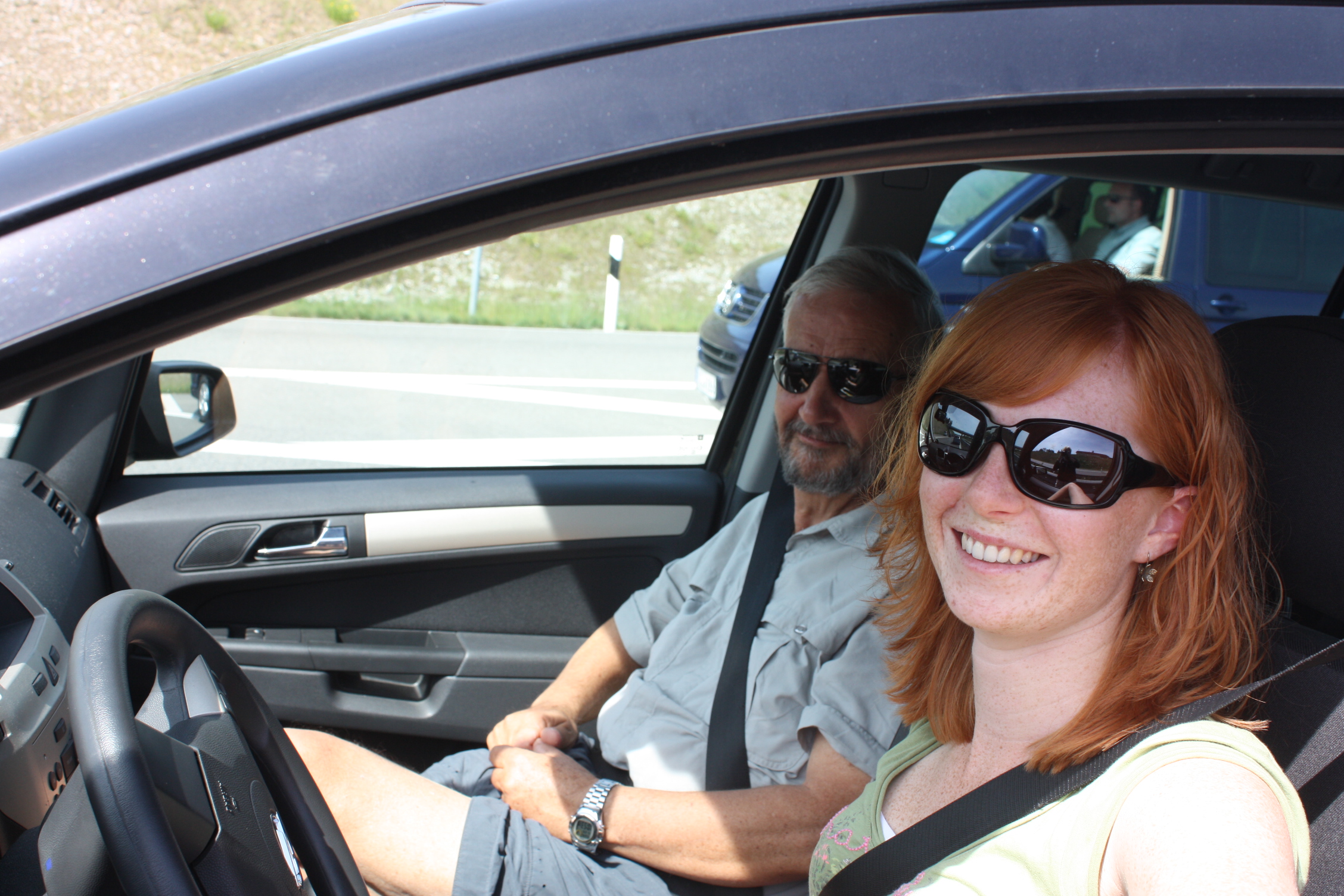
Julia and Poor John.
But I digress. We visited the local museum (see the pic in my posting on mobile phones in 1904) and the Heilig-Kreuzkirche (Heilig-Kreuz Church).
The slideshow gives you an overview of what we saw.
Remember the Kingston Trio song about the man caught forever on the Boston underground? The song is called Charlie on the MTA and the chorus is
Did he ever return,
No he never returned
And his fate is still unlearn’d
He may ride forever
‘neath the streets of Boston
He’s the man who never returned.
He needed an extra nickel in order to exit the train, and although his wife came to the station every day and handed him a sandwich as the train rumbled by, she never handed him a nickel. Hmm! Well, we won’t dwell on that.
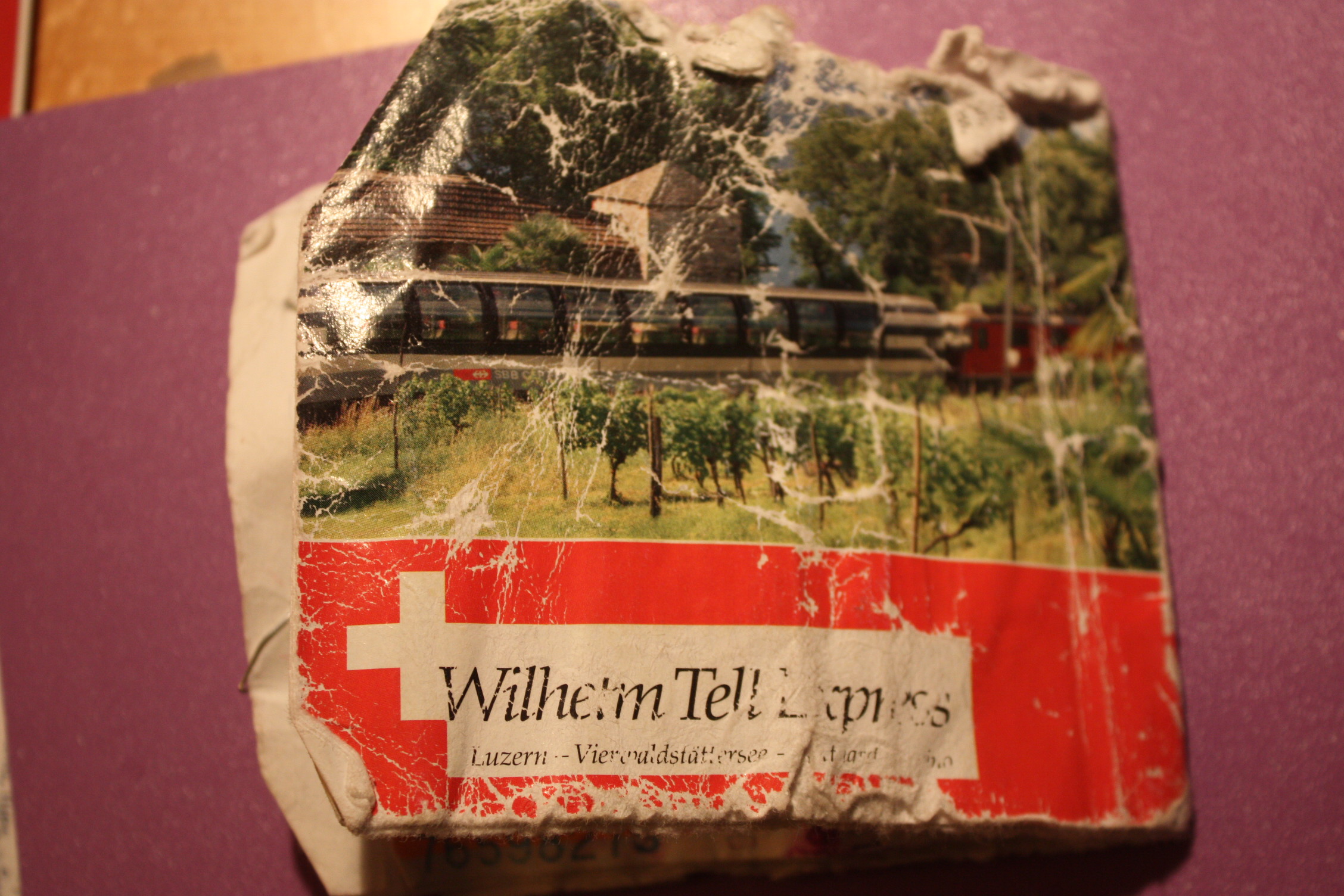
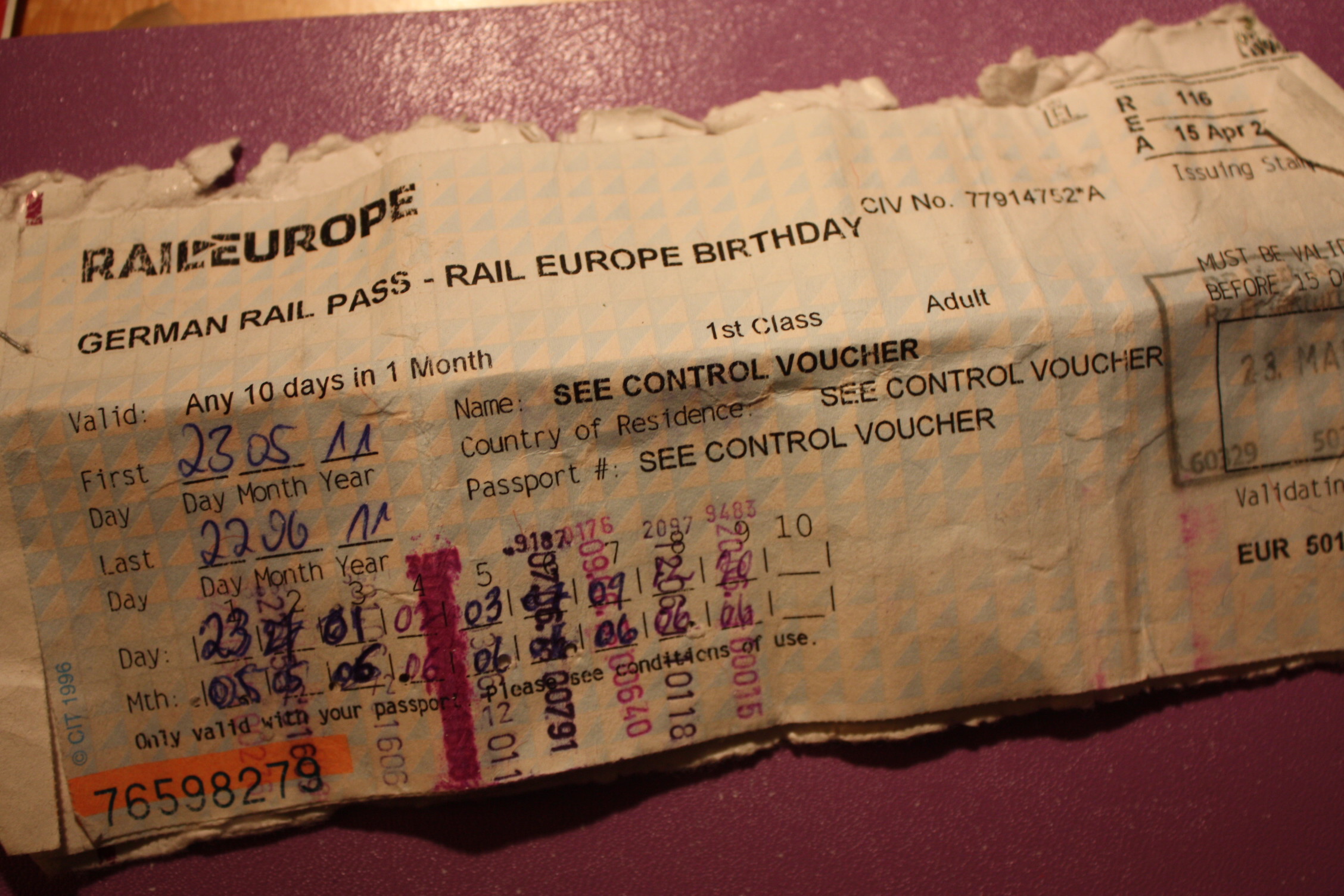
German rail pass after a trip through the washing machine.
But I think of the song almost every time we travel on an inner city train or underground in Germany or Belgium? Why? Because about a third of the time, Poor John and I are riding without paying. I bought day passes religiously the first few days we were here, but no one ever checks. Then you get complacent. Our German rail pass works everywhere for the whole day when we travel between cities. Our Belgian rail pass was the same.
Apparently there are plainclothes inspectors who materialise from nowhere and want to see your ticket. If you don’t have one, it’s a 40-euro fine per person. We haven’t seen a single inspector…until today. We had just returned from Brussels to Berlin and were heading to Nollendorfplatz when a plainclothes inspector breezed through our carriage. Oh my gosh, thank goodness we were legal today! But he stopped just short of us when he caught his perpetrator—a very well-dressed woman who didn’t seem the least bit concerned. He bundled her off the train, the doors closed and off we went.
The pics here are of our German rail pass. Poor John got us a discount Deutsche Bahn (German Rail) birthday sale price of A$770 for the two of us for 10 days of travel anywhere in the country within 30 days. This is a rock bottom price (available only to non-residents of Europe) and unbelievable value. We have zigzagged all over Germany on this pass, and today’s single trip from Brussels back to Berlin alone would have cost almost A$600.
If you are wondering why the ticket looks so tatty, it’s not from overuse. It’s because Poor John forgot to take it out of his pocket before it had a trip through the washing machine. Fortunately, the conductors are amused.
One more ride left.
Robert—Thought you’d like to know that Tupperware sales are big in Antwerp, Belgium.

Tupperware in Belgium.
A few days ago, Poor John and I popped into a Grand Bazaar (GB) shopping centre in Antwerp. Much of the centre was in chaos because at least two floors were being renovated, but the Tupperware kiosk was colourful, brightly lit and OPEN! Sorry, but I didn’t have time to compare prices.
For those who don’t know but can probably guess, Robert is a Tupperware representative in Australia.
Johann Wolfgang von Goethe was a legend in his own time. As an author, he wrote novels, fairy tales, essays, literary criticisms, philosophical treatises, scientific articles, travelogues, poetry and plays. He also tried his hand at politics, architecture, town planning, landscaping and social reform. His most famous work is Faust, a lyrical retelling of the classic legend about a man who sells his soul for knowledge. Goethe took most of his life to complete it to his satisfaction, and it is still probably the most-performed piece of theatre in Germany today.
Goethe was born in Frankfurt am Main in 1749, and his house there is open to the public. We were keen to see it for its literary importance, but also because our daughter, Petra, won the Goethe award as the best first-year German language student while she was attending the Australian National University in Canberra (go ahead and blush Petra).
We didn’t look at the map when we headed to Goethe Haus, assuming it would be located on Frankfurt’s Goethestraße. Wrong! That street is home to every designer-brand shop in Frankfurt—Rolex, Armani, Gucci, Versace and scores more. We sure looked out of place in our tourist gear of shorts and T-shirts. But the map set us straight and we found the house a few streets away.
The interior is beautiful and very well kept. There’s colourful and detailed wallpapers, elaborate furniture (some reproductions, some originals), a magnificent timber and wrought iron staircase, plenty of art on the walls and a simple kitchen. The slideshow features the exterior, a few rooms and a sampling of special items (including a lovely clock that still chimes). Of course, Poor John had to steal a scene. He’s in the dining room, looking especially relieved that he doesn’t have to dust that chandelier.
By the way, there is also a Goethe Haus in Weimar in the ‘green heart’ of Germany. We didn’t make it to that house, which was his residence for more than 50 years and where he studied, researched and wrote many of his works. Apparently each room there is painted a different shade, according to Goethe’s own theories about the correlation between mood and colour.
 Where to next?