
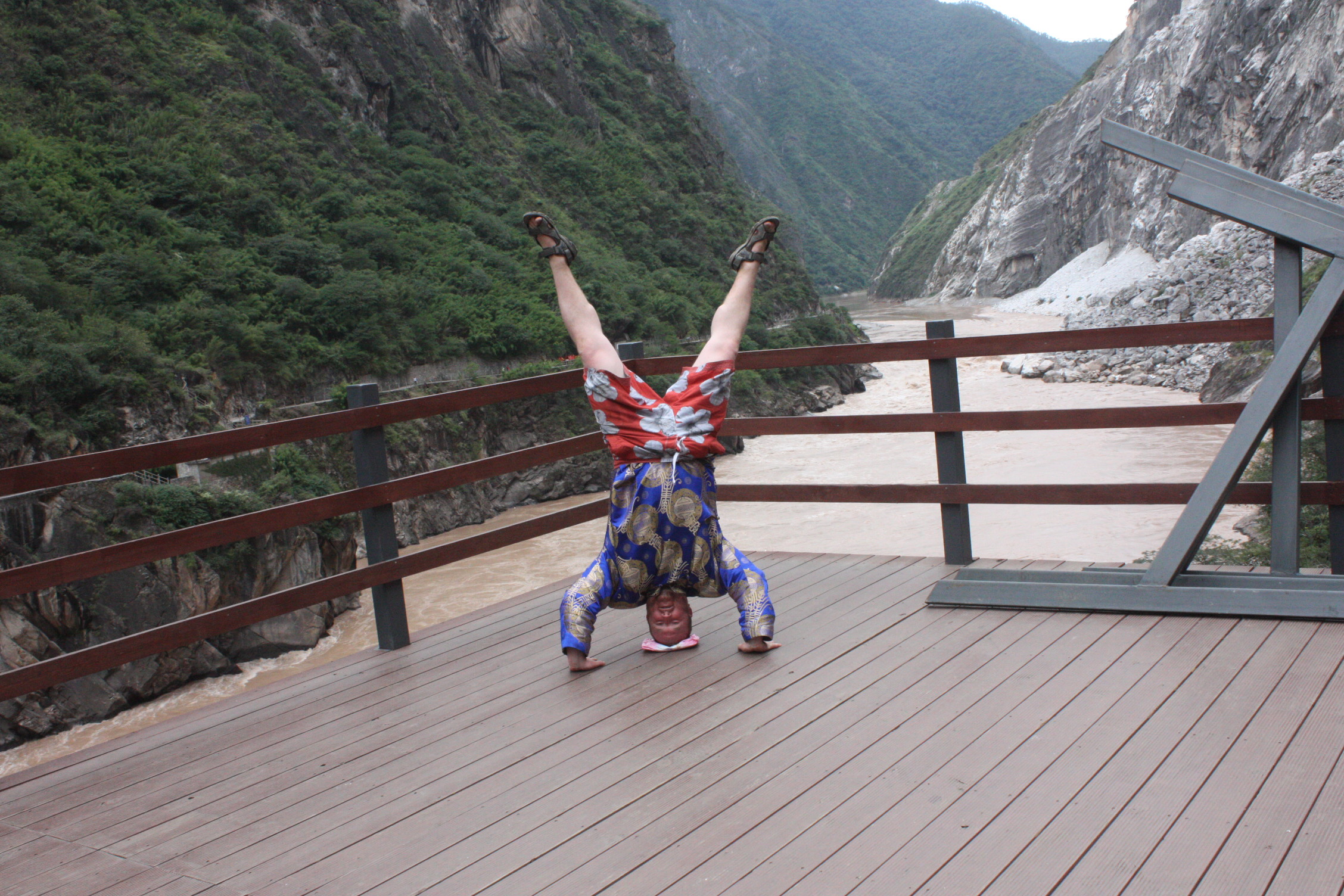
Another handstand for Terry. This one at TIger Leaping Gorge near Lijiang, China.
After introducing Terry as our own Burger King—with a goal of eating a burger for every day of the overland trip—I can report that his mission is more than accomplished.
The trip lasts for 169 days and we reach Sydney, and the end of the road, in about two weeks.
Terry ate his 169th burger a few weeks ago in southeast Asia. He made it a bit of a ceremony and some of the group was there to witness this finale. Of course, he’s had a few burgers since then, but admits that he’s glad to be back to his favourite snack of tinned tuna.
He’s thinking of another overland trip and figures his next daily challenge should be a slightly healthier one. That said, we planning on buying him an Aussie burger with THE LOT. In addition to all the usual burger toppings, one of those includes beetroot, pineapple, a fried egg. He’ll love it.
Also don’t forget to pick a number before 29 February 2012.
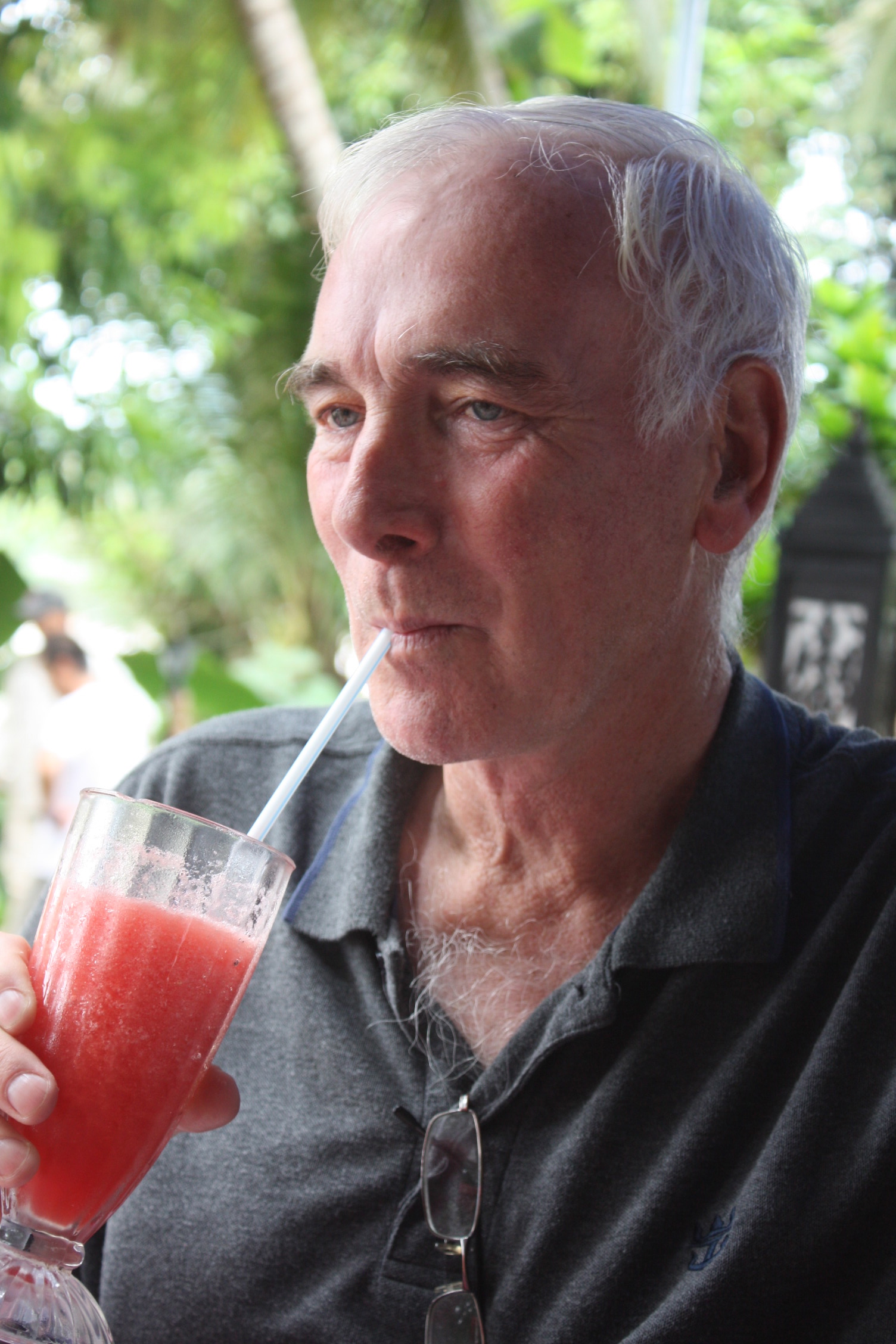
Eamon enjoys a fresh watermelon juice in Luang Prabang, Laos.
Our London to Sydney overland trip goes for 24 weeks, but no one is obliged to do the entire trip.
Eamon, who is on the trip without his wife, Mary, didn’t want to be away from home for almost six months so joined in Tbilisi, the capital of Georgia. He was an identity from the start, and had a few annoying—for him—hiccups at the beginning.
It all started when someone stole his camera from his bag in the hostel. This happened before we arrived, but most of us are meddlers (me especially) and we all urged him to let the police ransack all the bags in the hostel. He was too nice to allow this, so we’ll never know whether the perpetrator was a Pole, an Iranian or someone else.
Not long afterwards, in Sheki, Azerbaijan, Eamon had a nasty encounter with a ditch and twisted an already problematic knee. For a short while he toyed with the idea of going home, but we talked him out of it, assuring him that as long as he could hoist himself into the truck, he’d be fine. The knee is still wonky, but Eamon is quite good at working around the issue.
Eamon is especially pleased with himself for becoming adept at using chopsticks while on the trip. He’s also looking forward to spending Christmas with his son, who lives in Melbourne. Thanks to badgering from her ‘Aussie’ son, Mary will be joining Eamon in Australia for Christmas. We’re blessed that before heading to Melbourne, they’ll be stopping in Rosedale (our coast house) and Canberra.
I may be missing for the next day or two, or forever.
In about an hour, we head for Mount Bromo, a still active volcano on the island of Java in Indonesia. Then tomorrow at 3:30 we’ll be setting out to see her up-close at sunrise. Poor John and I visited Mount Bromo last year and are looking forward to this next viewing and climb.
About three months after we scaled part of Mount Bromo, one of her not-too-distant neighbours, Mount Merapi, blew its stack, with terrifying and deadly results. The signs of Merapi’s fury are still evident at Borobudur (I’ll be writing about that) and the areas surrounding Yogyakarta (I got a few so-so pics and will post those too).
Then the day after tomorrow we head for the Ijen Plateau with its acidic crater lakes and incredible sulphur miners. It’ll be another early morning start—3:30, but it is oh-so worth it. We’re the only ones from the group doing this side trip, but after seeing it last year, we wouldn’t miss an opportunity to do it again. So watch for more posts and pics.
We’ll reach Bali, and catch up with the group again, on Friday night. That’s assuming that Mount Bromo and all her burly neighbours don’t misbehave.
In the meantime—a very Happy Thanksgiving to all my USA family and friends. Have a bite of turkey for me. 🙂
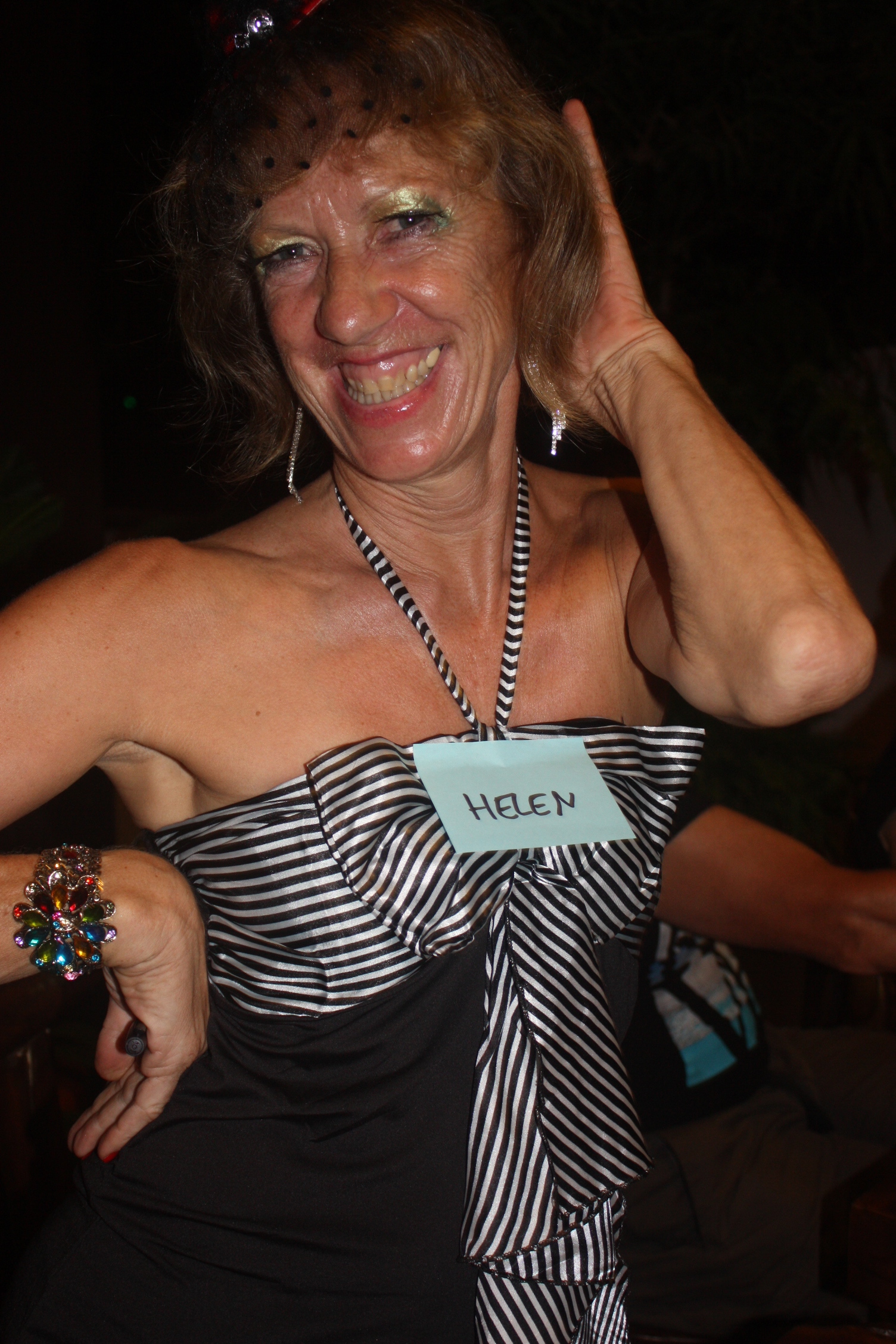
Best dressed—Lily as Helen.
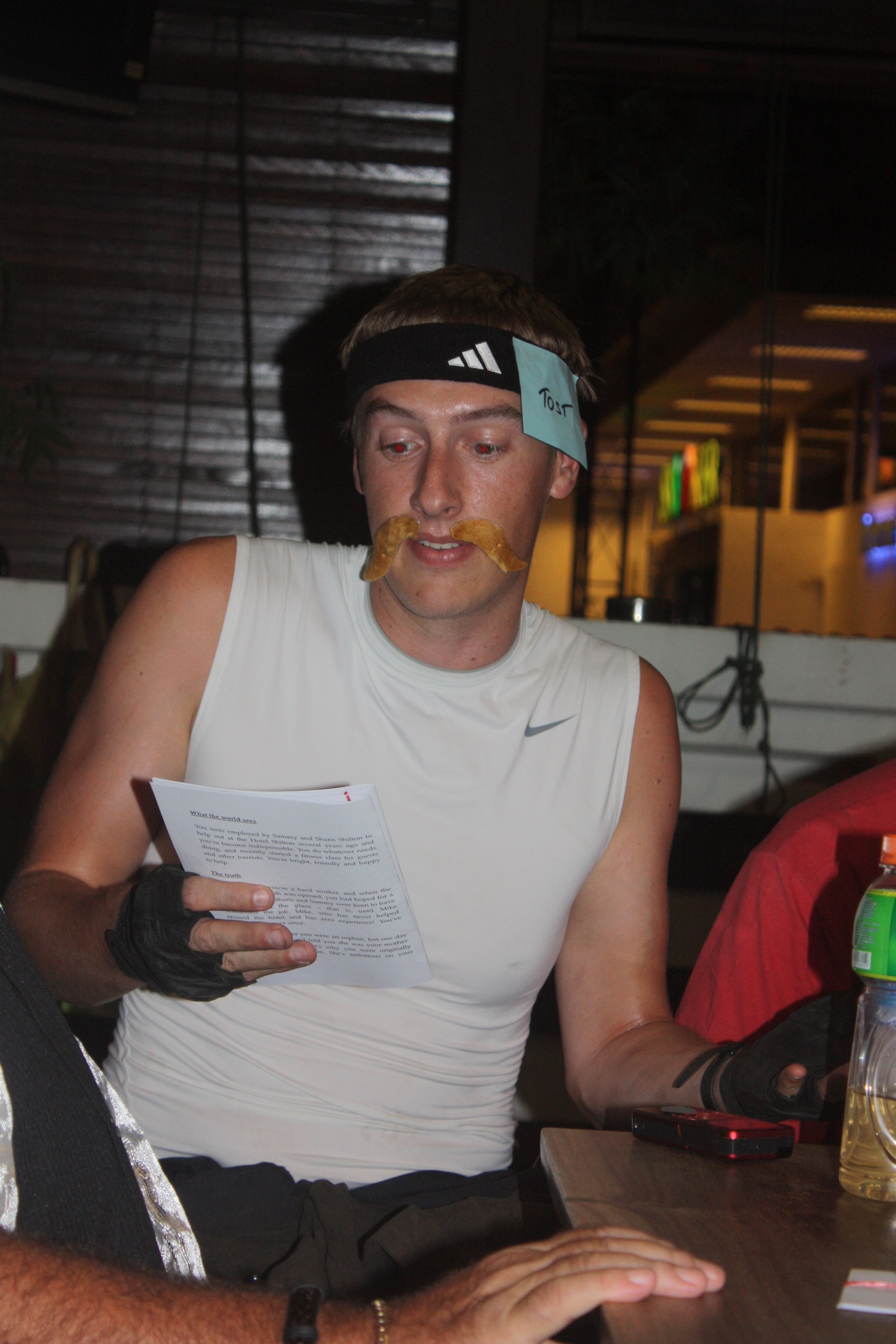
Best actor—Glen as Tost.
Ever since Turkmenistan—that was way back in early August—Megan has been working on the script and intricate details for a Murder Mystery Night, involving everyone from the truck who wanted to play a part.
The task was plenty of fun, but not without it challenges. People dropped in and dropped out, so Megan had to rewrite parts of the play as she went along. In the end, she produced 112 pages of character descriptions, script, clues, plot hints, cryptic notes, maps, news clippings and the like.
Then it took quite a few countries before we reached a place where characters were not off doing side trips and where the hostel/hotel could accommodate the crowd. That place was finally Kuala Lumpur in Malaysia with 17 people playing parts and a corpse roaming around acting very undead.
Some of the character names were hilarious. Megan was detective Herculia Pourout. Then there was Shoelace, the thug; Fifi Flankelflost, the brash and eccentric American (that was me); Dr Bill, my accompanying psychiatrist; Jon Bovi, the famous muso; Emile Escargot (see the clue with his signature), the gifted wine critic; and all the rest. Poor John was owner of the inn where the murder took place and father of Mike, the victim.
There were four rounds of role-playing with clues and pieces of evidence being revealed along the way. And motives—good grief, it seemed that virtually everyone wanted Mike dead, even his distraught girlfriend who planned to run off with another fella. Add to that blackmail, clandestine liaisons, secret organisations, bad debts, bad blood, falsified credentials, ancient family feuds, murderous streaks and the demon drink, and we had a whole room full of likely perpetrators.
At the end of the night, Herculia asked us all to vote on who we thought had been the best actors and who had been best dressed for their part. She also asked us to vote on who we thought had Dunnit. Not even the murderer knew! But not one of us got it right! Perhaps that was because most of us had been hitting the booze throughout the evening—to drown our sorrow over Mike’s death, no doubt. Luckily Herculia’s grey matter came to the rescue and she explained how XXXX and only XXXX could have done it. So XXXX didn’t get away with murder.
So who is XXXX? Before I wrote this blog item, I asked Megan, who is a playwright in her own right, if she had any other plans for this literary effort and if she cared, either way, whether I revealed the name of the murderer. That set her to thinking and she decided she might do something more with the storyline. So you’ll just have to see the play when it hits the stage. When you hear all the evidence, you’ll agree that XXXX and only XXXX could have done it.
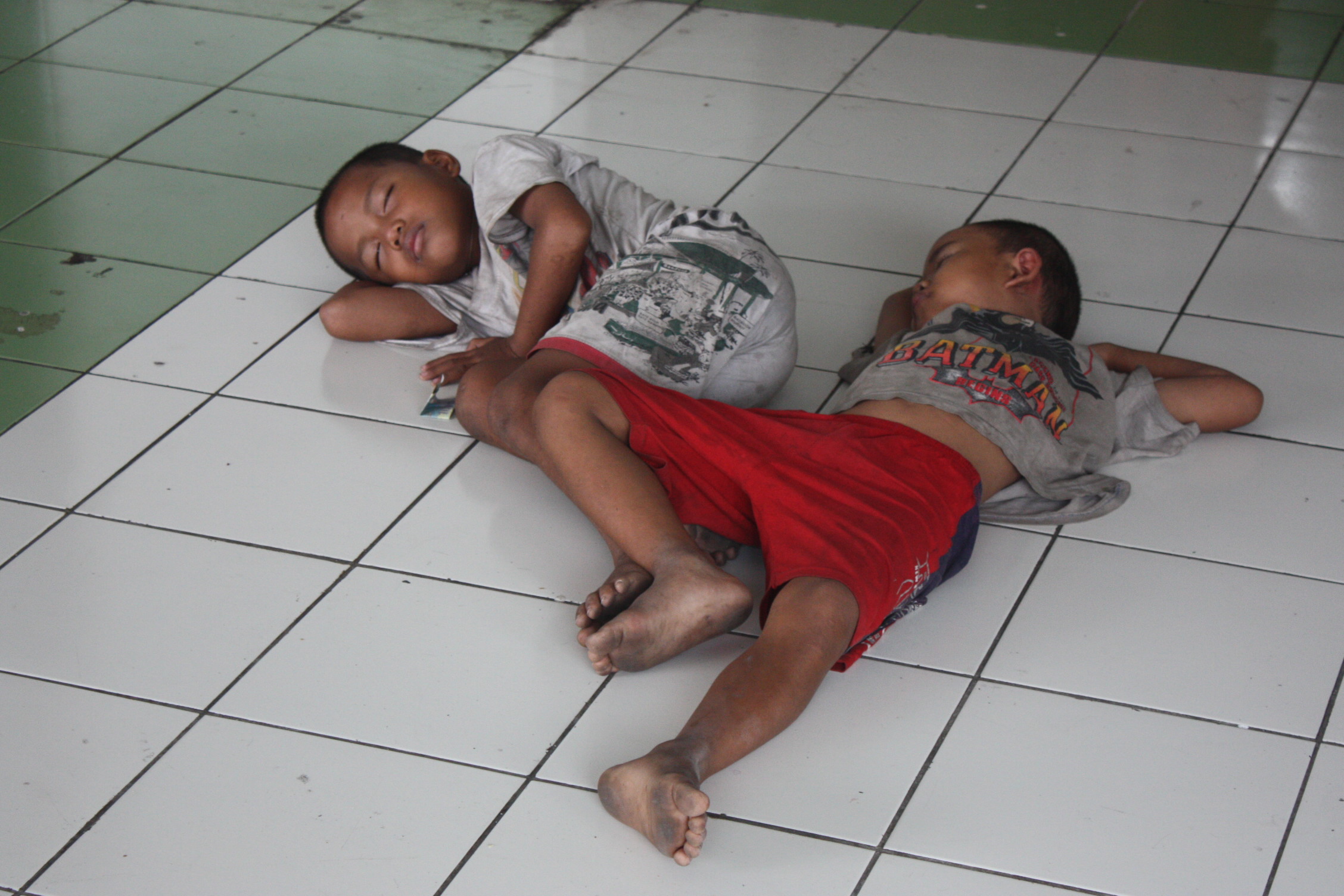
Two urchins asleep on the floor in the Jakarta Railway Station. Orphans or con artists? When it comes to kids like this, does it matter?
Yesterday the group travelled by train from Jakarta to Yogyakarta. It was our first train ride of the overland trip and, of course, our ‘chariot’ was delayed—by two hours.
But that gave us plenty of opportunity to people-watch in the station.
Some sights were heartwarming, while others were heartbreaking.
We saw quite a few urchins sleeping in the terminal. So very sad, so eye-opening. Were they orphans or con artists? We’ll never know, but they slept soundly and two of them scored some contributions from the group.
There were plenty of people catching a free ride on the top of the commuter trains. Amazing how they manage to get up there. One train roof was packed with several hundred freebie riders, while others had 20 or fewer. Sorry these two pics aren’t better, but it happened so quickly that I barely had time to react.
It was fun to see a train driver getting his meal and water delivered.
Then there were the cleaners—dashing to hop on the train as it rolled into the station. There were 20 or 30 of them and I could have watched them for hours, but won’t bore you with the many pics I took. Thanks goodness a few turned out okay.

Phil and Marina check out an old Citroen in Luang Prabang in Laos. They resisted driving away in it.
As we travelled across Eastern Europe and Central Asia, we often stayed in hotels instead of camping. Those places almost always had rooms for three or four people, but never just two. That meant people had to share a room. On these occasions, Marina and Phil were our roomies. It worked so well. We woke up early, got showered and dressed, and were on our way at sparrow’s fart. They liked to sleep-in. At the other end of the day, we retired early and were conked out long before they got ‘home’. Too easy.
Marina and Phil are both retired, but it wouldn’t surprise me if either one of them went back to work if something interesting came up. They like to be busy. On our travels, they are the people most likely to be seen on hired bicycles or zooming along on a motorbike.
In a previous life, Phil was an engineer in the Royal Air Force, a job that had him travelling the world to make things work right. Everyone on the truck was grateful for his tinkering skills. He’s a whiz at splitting firewood into kindling, plus he fixed the inverter and other cigarette lighter chargers so we could keep our computers, iPods, and other electronic goodies powered up.
In preparing to come on this trip, Marina left her job in payroll. But more importantly, she had to make arrangements for Frank, the other man in her life, to be looked after during her absence. Frank is a handsome horse who is, no doubt, waiting for mum to get home to England.
When they return home—through New Zealand and most likely by way of the Trans-Siberian Railway—they hope to downsize on their living space and upsize on paddock and gardening space. Frank will be pleased.
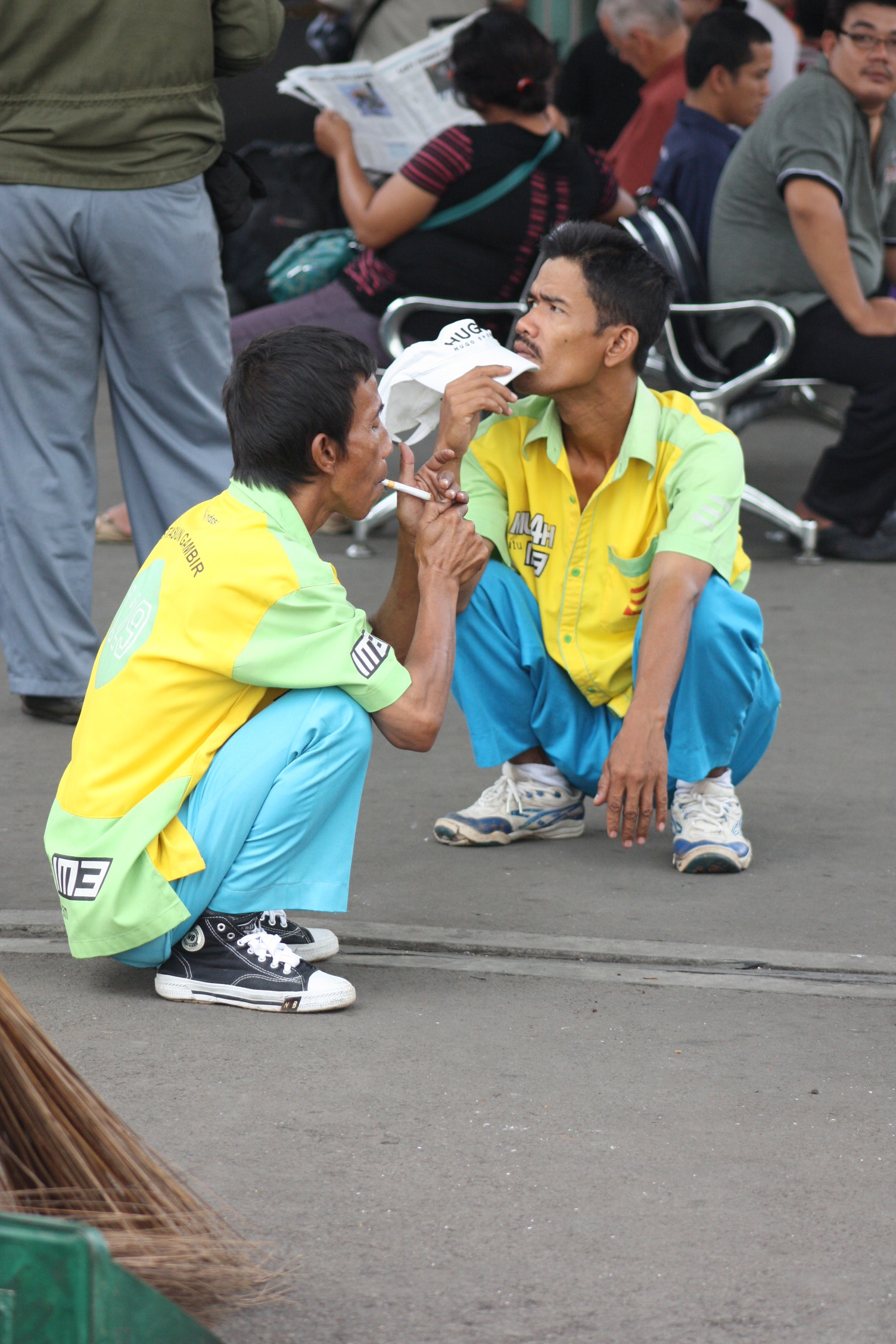
Two cleaners taking a break at the railway station in Jakarta.
Across Asia, especially southeast Asia, people sit on their haunches with their feet flat on the ground. It’s the norm, and they manage it with complete ease and aplomb. Time for a smoke—down on the haunches. Ready for a chat—down on the haunches. Having a snack—down on the haunches. It really is a convenient way to ‘sit’ when chairs are scarce and the ground might be wet, rocky or buggy.
This skill is common to men, women and children. All the people who worked in our house when we lived in Burma in the 1980s could do it.
I can easily do it—for about three minutes, which is most useful in the land of squat toilets. Which prompts me to reiterate that you can only do an overland if your knees work. Oh wait, I take that back. Our driver in Africa once had a 73-year-old passenger who brought along her own toilet seat with legs.
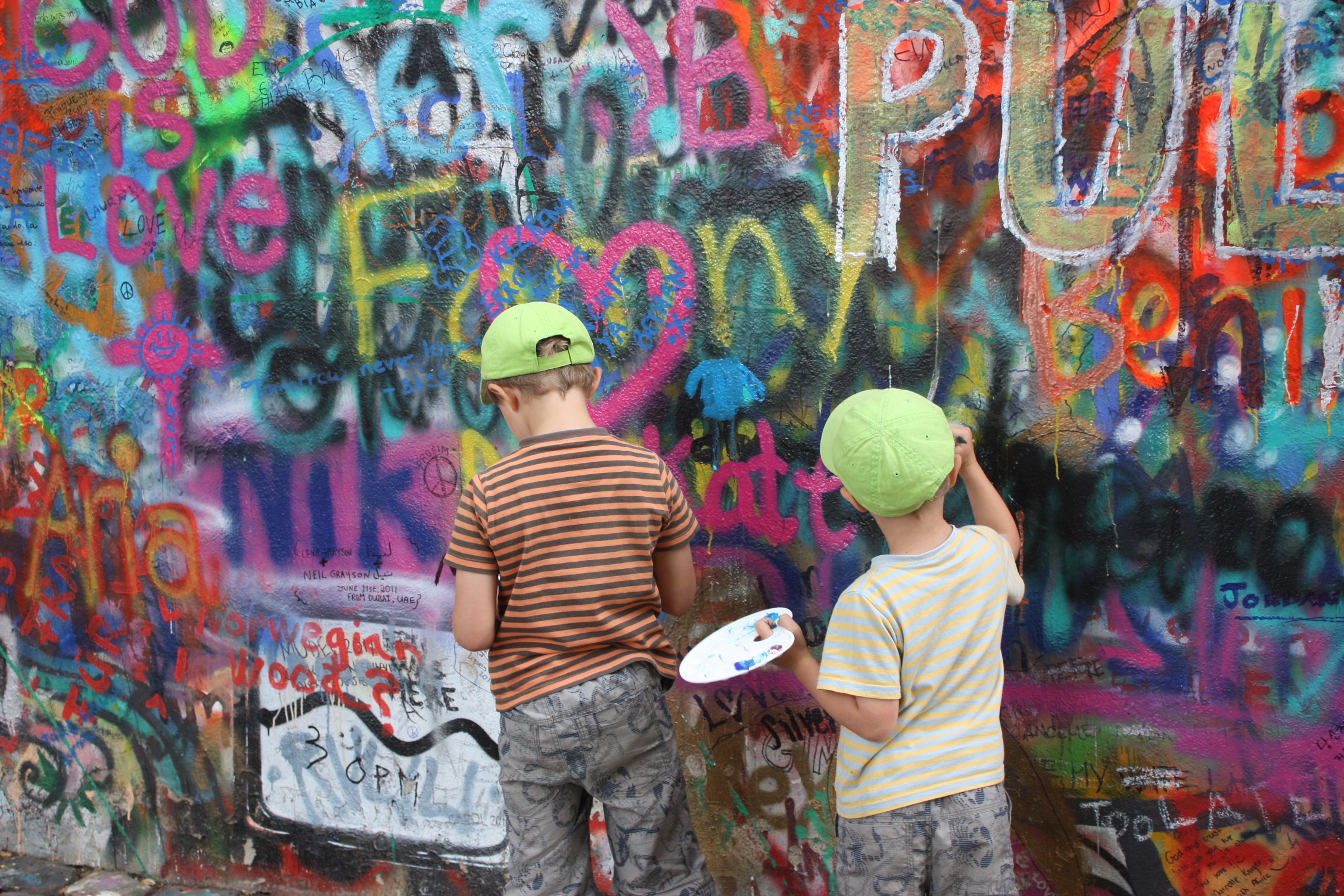
Two young artists add their creative flair to the John Lennon Peace Wall.
I was surprised to encounter John Lennon earlier this year in the Czech Republic. His presence there is huge—on a long graffiti-covered wall near the Charles Bridge in Prague.
During the totalitarian era, John Lennon was a hero and source of inspiration to the pacifist youth of Central and Eastern Europe. After Lennon was murdered in 1980, his portrait was painted on this wall, and young Czechs began adding their grievances too.
These writings became a source of irritation to the then Communist regime of Gustáv Husák, and led to clashes between students and security police. Ironically, the students’ movement was referred to as ‘Lennonism’, and the Czech authorities described the followers as alcoholics, mentally deranged, sociopathic and agents of western capitalism. At that time, Czechs had little scope to voice opinions about their lack of freedom, but the wall provided a public place for young people to share their feelings and dreams, to honour the memory of John Lennon and to share lyrics by the Beatles.
Although the Communist police repeatedly whitewashed the wall, they never really succeeded in keeping it clean. Within a day it was again full of poems and images that represented freedom, peace and love.
The wall belongs to the Knights of the Maltese Cross, and they allow the graffiti to continue. In 1998, work was carried out to restore the wall’s crumbling facade was reconstructed in 1998. The original portrait of John Lennon is now buried beneath layers of paint, but each day the wall acquires new images and messages, and Lennon can be seen in many places. Sometimes referred to as the John Lennon Peace Wall, it remains a popular tourist destination but, more importantly, a symbol of free speech and non-violent rebellion by Czech youths.
Here’s a slideshow of some aspects of the wall.


A glimpse of the people in the front with the driver.
Having had the very back row on the hot and steamy bus from Batam Island to Padang, Poor John and I scored the front row for Padang to Bandar Lampung. Aside from the increased risk of going through the windscreen in case of an accident—there were no seatbelts—the front seats gave us a chance to observe, first-hand, the life of the bus driver.
As I mentioned in On the road again, we had two drivers who swapped every nine hours or so. When not driving, the driver tucked himself into a bed at the very back of the bus and pulled a curtain so he could sleep. Both drivers were excellent and it was amazing to see how they dealt with the many challenges. Sometimes the road surface is just so crap that the main challenge is to navigate the potholes and keep the bus upright.
But most of the problems stem from everyone else wanting some real estate on an already crowded and usually narrow two-lane road—trucks, cars, other buses, motorbikes and scooters, pushbikes, food stalls on wheels, pushcarts, pedestrians of all ages, dogs and cats, chickens and more.
Lots of our previous bus drivers have hardly taken their hands off the horn—hooting continuously at real and imagined people and vehicles, as well as the wind and rice paddies—but these fellows used the horn judiciously and with differing intensities. You could almost hear the horn speak. Pay attention! DON’T step into the road. Don’t pull out of that driveway. DON’T cross the road! Scoot over a bit so I can pass. GET OUTTA THE WAY! You stupid dog! Run chicken, RUN! Fortunately, I never saw anything get splatted.
Drivers also have their own signals to ‘speak’ to one another. Like Australians, Indonesians drive on the left side of the road, so when a truck or bus driver flicks on their right-turn indicator, it conveys one main message, namely, don’t pass me now. They might be about to turn right, but it’s much more likely that they are about to swing out to pass something such as a motorbike in front of them or that they see something ahead that means passing is dangerous.
I’m guessing drivers also have their own perks when it comes to the passenger list. Poor John and I were in Row 1, just behind the driver. There are three seats in his row—his own and two others. He seems to have two helpers riding with him—not quite conductors, but still people with some responsibility. At the roadhouses, they cleaned out the bus by dumping the contents of the rubbish bin on the ground outside the bus doorway. Sometimes they’d hop off the bus to speak to someone flagging down a ride. That flagging down meant there were often up to seven people sitting with the driver. Poor John reckons the driver can sell that space without having to account for it to the company. A couple with two children boarded early on and held that forward position for the whole trip. The seventh spot rotated among people who got on for an hour, several hours or even a day.
I noticed one especially touching scene in the dark of our second night. One helper, who looked 12 but who chain-smoked and wore what might have been a wedding ring, sat on a box beside the driver. Perhaps he was the driver’s son. Before long he rested his head on the driver’s shoulder and slept for quite some time. The driver never flinched and never brushed him away.
In fact, I think the only thing that phased the driver was the daughter with the couple sitting in his space. She was maybe 3 and had perfected the art of the bloodcurdling scream to ensure that she got exactly what she wanted from her parents.

Kieran and Glen pretending to be Japanese tourists at the Mogao Caves in western China.
Given that this overland trip travels from London to Sydney, we expected to have a lot of young Australians on board with us—heading home after other adventures. But Glen and Kieran have been the only other Aussies, and they’re excited about going home. They’ve spent the last five years living and working in London, and this year they finally decided to once again call Australia home. Oh boy, will their family and friends be overjoyed to have them back.
That said, they’ve been back home once already this year for a big event. After about 10 years of courtship—they met as teenagers when they both worked at Target in Liverpool in New South Wales—they came home to get married in March.
This time around, and if things go according to plan, both of them will have jobs BEFORE they get home.
Glen works in e-learning. As we have got closer to Australia, he has applied for a few jobs, one of which is ‘made for him’. We’re all hoping some good news comes through soon. Let’s hope that whatever job he gets requires that he wear a suit—he had three custom-made in Hoi An in Vietnam. Glen’s also been the only person with passport problems—he ran out of pages and had to get a new passport in southeast Asia.
Keiran is a nurse and also qualified as a midwife, which is her passion. In London, she was a practice nurse, but she hopes to return to work at the hospital in Liverpool. Her skills have been needed a few times on the trip and it’s been a comfort to have someone who knows what they’re doing with a first aid kit. Her talents have also scored her a Skilled Migrant Visa for the UK, but we’re hoping they don’t go back anytime soon. Plus we’re looking forward to seeing them in Canberra.
 Where to next?