
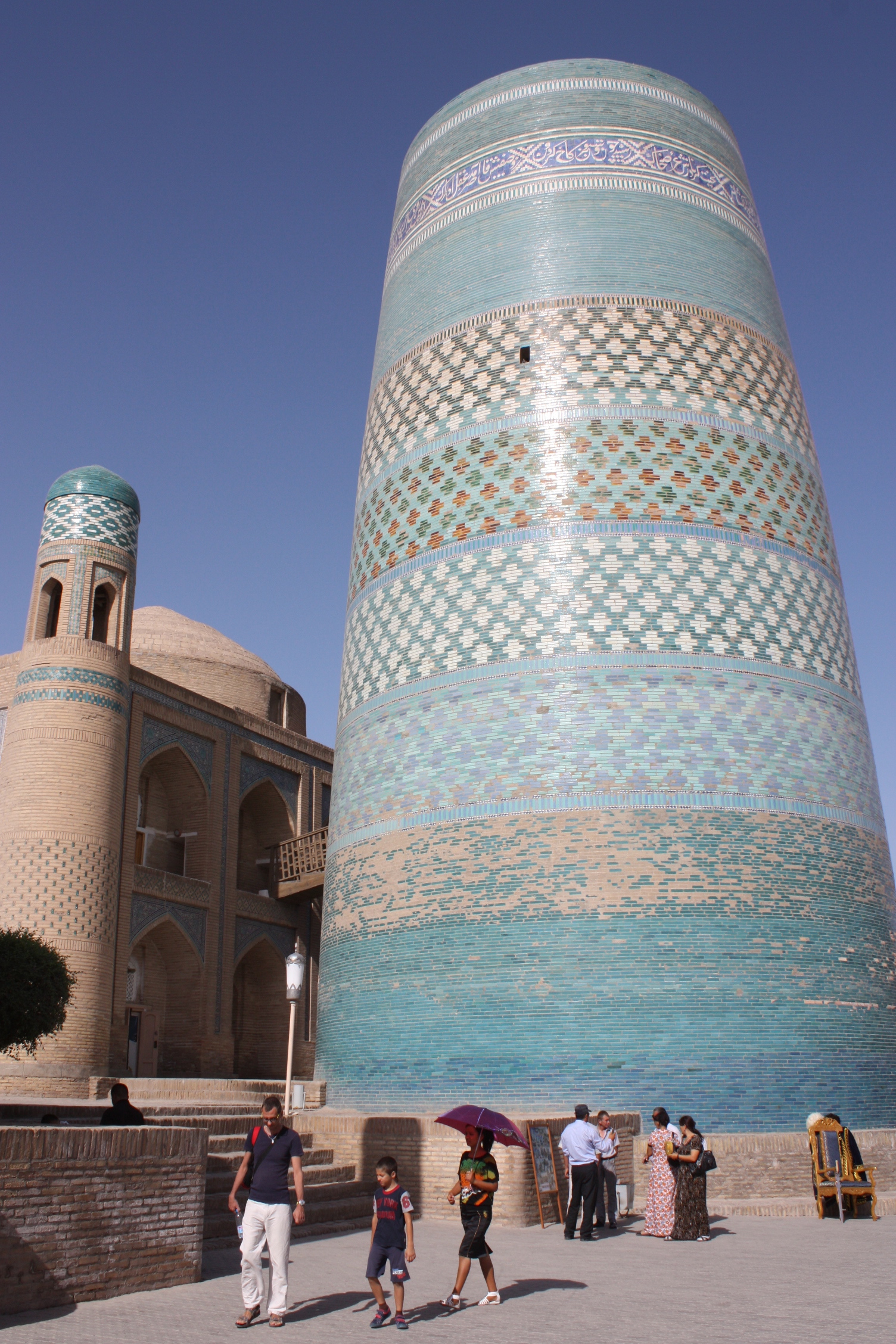
Minaret Kalta-Miner
Khiva was our first stop in Uzbekistan and what a treat it was. In fact, everyone on the truck thought Khiva was one of Uzbekistan’s highlights.
In the 1970s and 80s, the Russians did a wholesale rebuild of virtually all of Khiva’s historic heart, making it the best preserved stop on the old Silk Road. Granted the city seems a bit too clean and sterile as a result, but it is a fascinating must-see destination.
Many of the old structures have been turned into individual museums, and there are even museums within museums. You can buy a single ticket that gives you entry to them all. In fact, if I recall correctly, you have to buy the package deal at the tourist centre.
Khiva is split into two parts—the outer town, called Dichan Kala (Dishon-Qala), and the inner town, called Itchan Kala (Ichon-Qala), which covers about one square kilometre. The latter is surrounded by crenellated brick walls, whose foundations are believed to have been laid in the 10th century.
This old, inner town has more than 50 historic buildings and 250 old houses, most dating from the 18th or 19th centuries.
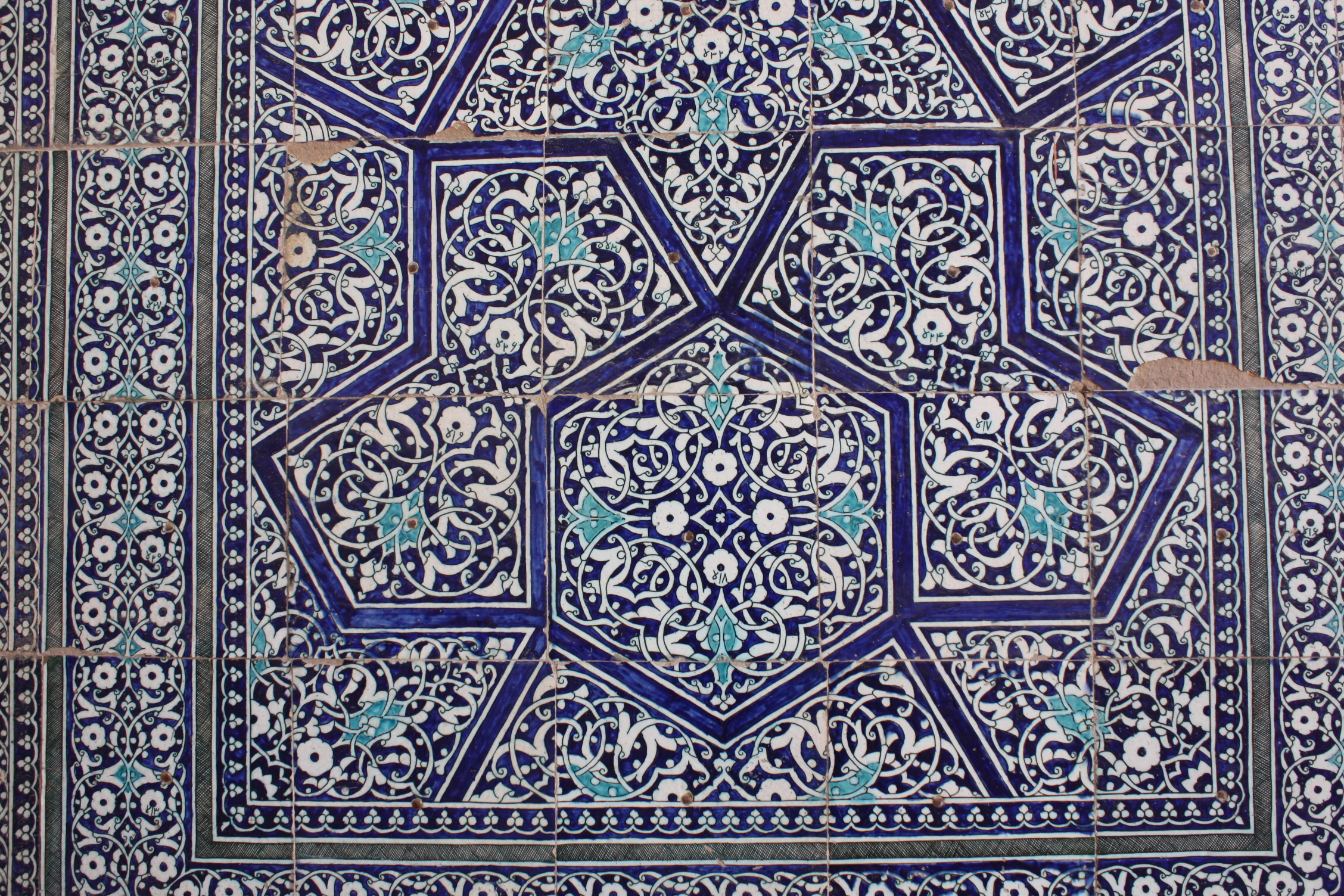
Tile detail
Poor John and I had a good shot at exploring all things old, and I took way too many photos. Again! We managed to get great views of the inner city by climbing the city walls and having a meal on the third-floor of a restaurant near the city walls.
Khiva’s architecture is blessed with an abundance of turquoise tiles. Samarkand’s tiles tend to be blue, while Bukhara’s are brown.
The turquoise is especially evident on the Minaret Kalta-Miner, the large blue tower in the central city square. The structure was supposed to be the largest minaret in Muslim Asia, with a base of 14 metres and a height of 70–80 metres, but the ruling Khan died in 1855 and the succeeding Khan stopped construction. One theory is that he thought the minaret would overlook his harem and the muezzin would be able to look down on his wives. Another theory, which I prefer, is that the Emir of Bukhara also wanted such a minaret and negotiated with the master builder to do a second one in Bukhara. The Khan of Khiva was supposedly outraged by this deal and ordered that the builder be killed when the first minaret was completed. The builder heard of this and skedaddled. Good builder, smart man.
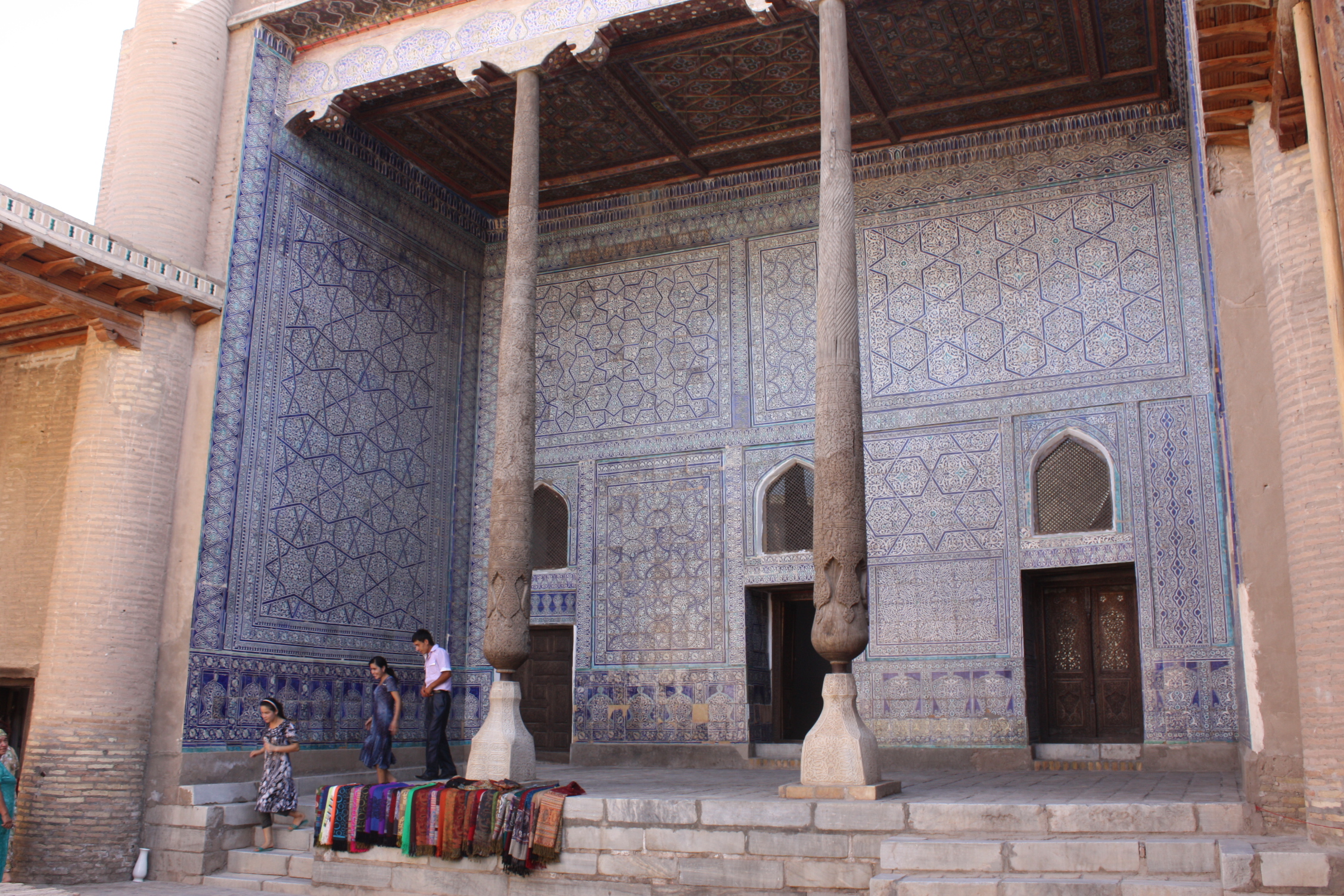
A small corner of the Tash-Hauli Palace Complex
The Tash-Hauli Palace Complex is a stunning example of 19th century Asian secular architecture. Its collection of premises—offices, reception halls, the harem, living areas, courtyards—is lavishly decorated with colourful tiles in a seemingly endless array of patterns. The facade of the palace and the surface of the walls surrounding inner courtyards are trimmed with ornamental majolica, with blue and ultramarine colours being dominant. The ancient masters knew the secret of making coloured ceramic glaze called ishkor, the dyes of which keep their original colors for centuries.
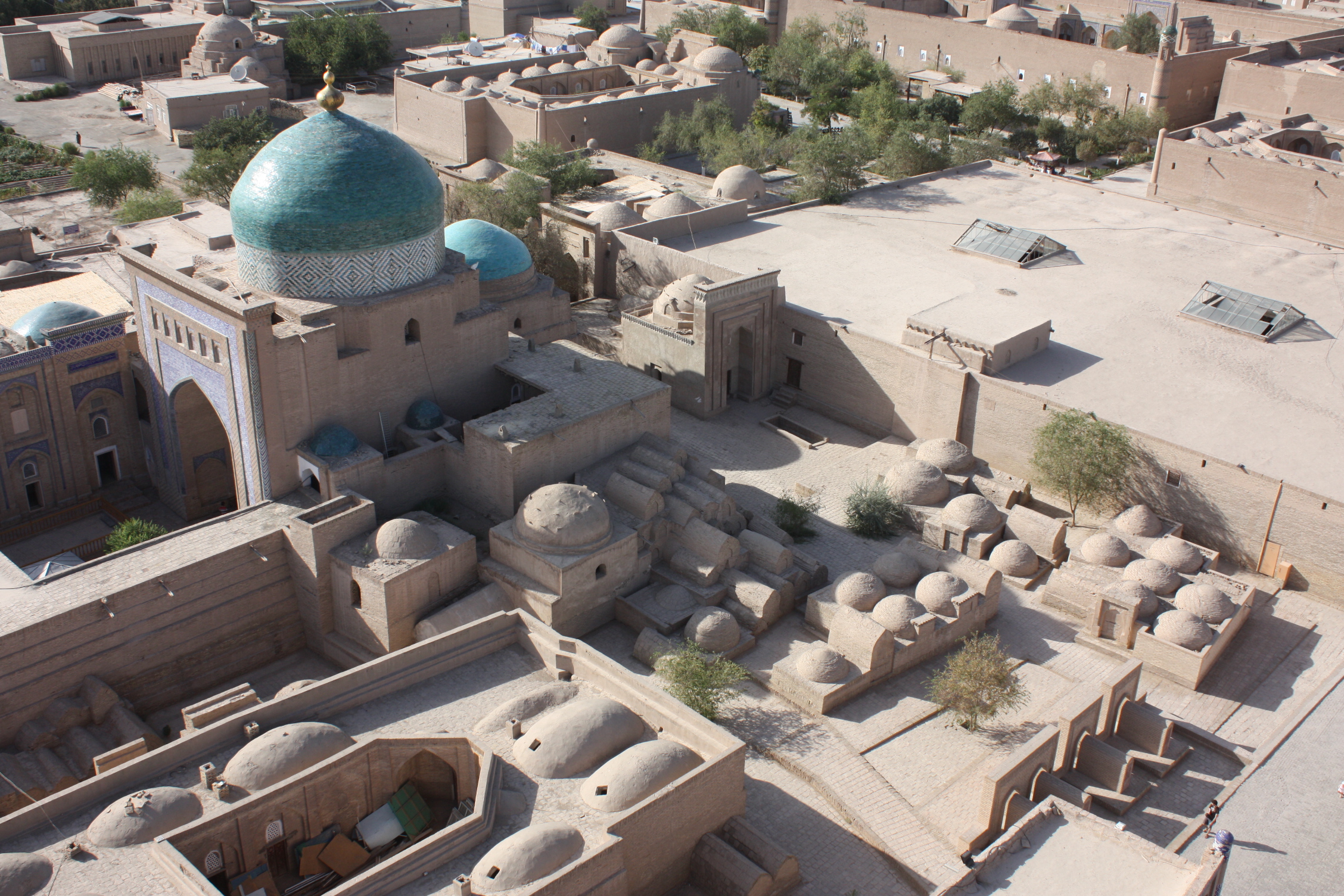
The Pakhlavan Mahmoud Mausoleum and its colourful dome.
We got a bird’s eye view of the Pakhlavan Mahmoud Mausoleum. Built in the early 1800s, it commemorates a personality who died in 1325. Pakhlavan Mahmoud was a Persian Sufi teacher, as well as a gymnast and wrestler known as the Hercules of Asia. He was considered a patron saint of Khiva and made the protector of his descendants, who ruled Khiva as the Kungrad Dynasty of the 19th century.
Another impressive stop was the Juma (Jumma) mosque. Rebuilt at the end of the 18th century, it has a big hall with a flat roof resting on 213 wooden carved columns. It is just these columns, varied in shape and form, that are of special value in this mosque. Scientists believe this mosque reflects the old mosques of Arabia.
I could go on an on about the delights of Khiva, and I might just do that in additional posts, starting with the majolica tiles.
Don’t forget to pick a number.
I have an idea for a new blog. No, this blog isn’t ending. My idea is for an additional blog. But to make it work I need a number between 1 and 100.
I’m no good at deciding and Poor John just wants to choose his age. Actually, I do have a number, but the other day I learned that it’s already been taken by another blogger and for another purpose. 😦 Please help me out.
So submit your preferred number from 1 to 100, and tell me why you want it.
The number with the most nominations and/or the best reason for being nominated will be chosen as the main component of the blog title and become the very core of how the blog operates. And you (or multiple yous) will get the credit for naming the blog. I’ve thought of a fun prize. Interested? Excited? I am.
So what’s your number? Nominations close 29 February—my grandmother’s birthday. If she was alive she’d be turning 132, which wouldn’t be a valid number.
Update
Here are the numbers picked as of 19 February. Ten days to go.
3 — Steve Favinger — gears on the manual car I learned to drive
3 — Your (my) darling daughter — in honour of a hat trick she took
7 — Louie Scrivener — a bit off centre, a bit uneven, a whole lotta cool
11 — John Miller — bingo call of Legs 11
11 — Kelly (Wildflour) — two 1s are never lonely
12 — Joy B. — started the new blog in 2012
14 — Sy S. — people in the trip pic plus Aggie (a fall-back number of 23)
17 — Martin D. Hash — prime number and a teenage
22 — Wanda Raab — uniform number (and favourite number too)
23 — Helen Ellison — met her hubby that day
28 — Riverside Len — wife’s birthday and favourite number
32 — Emma Bickley — my grandmother’s number of actual birthdays
37 — Keith Hutchison — good age
37 — aussierodney — because
38 — Kate — fortunate number in Chinese culture
39 — Gary Walker — a ticket winner
39 — Sylvia Oliver — 39 and holding + the 39 steps
42 — Lin Stockley — the answer to the universe
42 — Sharon Smith — the answer to the universe
60 — Louise M Oliver — next birthday (a fall-back number of 99)
77 — Carrie / flower 7 — a life filled with 7s
88 — Lutz Kuester — same upside-down and reversed
98 — Melissa L. — a high and neglected number
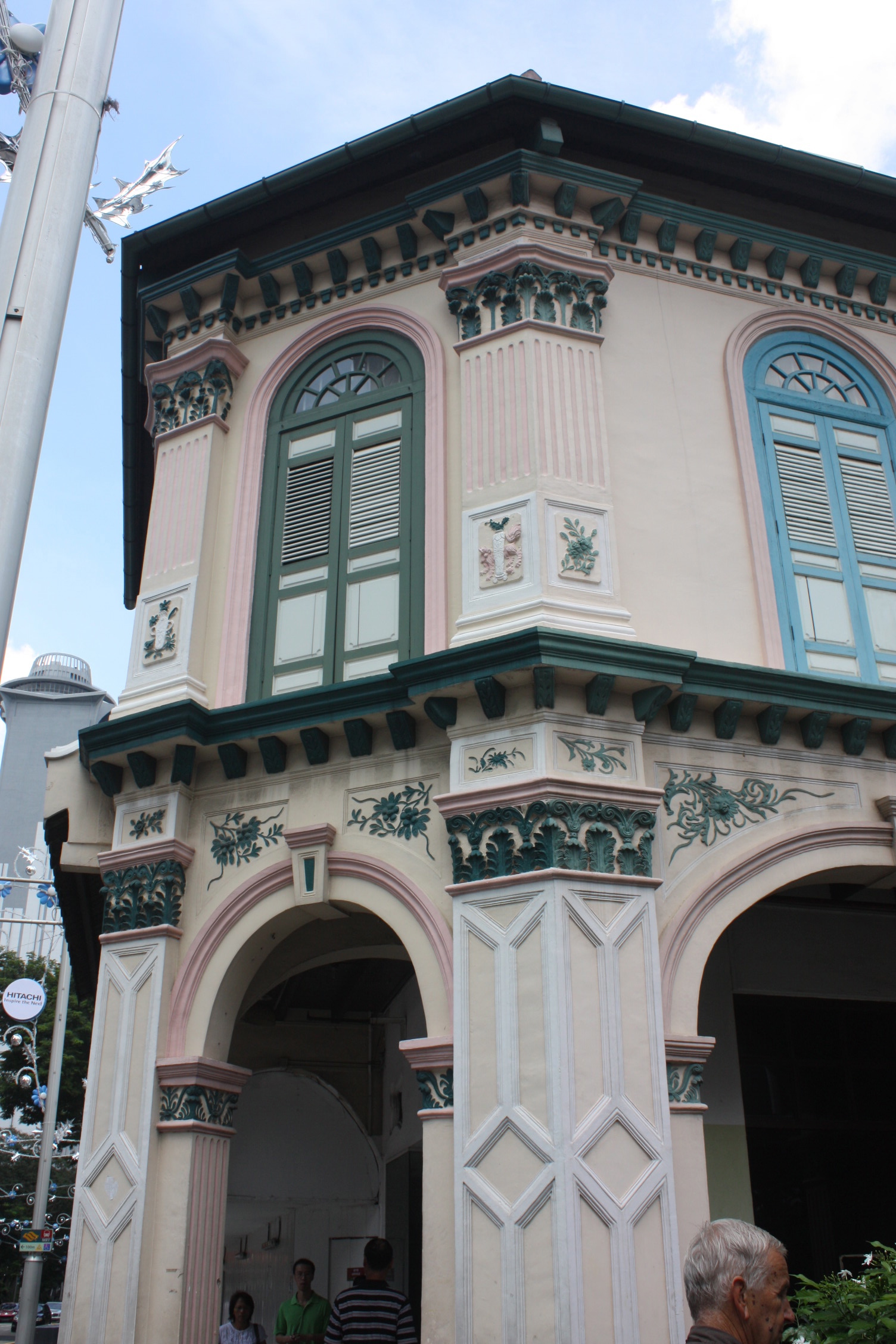
Fine paintwork on one of Singapore's grand old ladies.
Over the years, many of Singapore’s grand old buildings have been torn down to make way for modern high-rise apartment blocks, office buildings and shopping malls.
By grand, I don’t necessarily mean huge or opulent, just interesting and eye-catching. I noticed a big difference in the cityscape between my first visit in 1984 and this most recent one in 2011.
There are some wonderful additions, especially around the crossing to Sentosa Island, but it is becoming harder and harder to find the traditional old Singapore. Fortunately, quite a few of the old buildings that survive are getting some much needed loving and careful treatment.
We walked and walked and walked in Singapore, and it was a joy to see some of the colourful and striking paint jobs being applied to some of these stately ‘old ladies’. I can say that because I an old lady too—just not stately.
I hope the fact they are being repainted, restored, refurbished, propped up and strengthened means they have been spared a death sentence. At least for now.
Also don’t forget to pick a number before 29 February 2012.

The stylish School of the Arts building in Singapore
You don’t often see a building with plants cascading down its outside walls, but that’s exactly what caught my eye when we approached the new School of the Arts (SOTA) in Singapore. I took a picture—just one so-so snap—and was surprised a few months later to see the building featured in The Australian’s Wish magazine. The edition, which focused on design, described the SOTA as ‘immensely exciting architecture’ and a structure full of texture.
It was designed by Richard Hassell, a Western Australian, and Wong Mun Summ, a Singaporean, who together make up the highly regarded WOHA* architecture practice, which is based in Singapore. Some of their other work includes the Stadium MRT station in Bangkok and The Hyde luxury apartments in Sydney.
Apparently I’m not the only person who likes the look of the SOTA. The design won WOHA the 2011 Jorn Utzon Award for International Architecture, awarded by the Australian Institute of Architects.
The next issue of Wish, featured another striking building in Singapore. Poor John and I saw this over-the-top structure from a distance when we walked about 15 kilometres in one day. At the time, we had no idea what it was, and no one handy to ask. Although someone guessed it was a fitness centre.
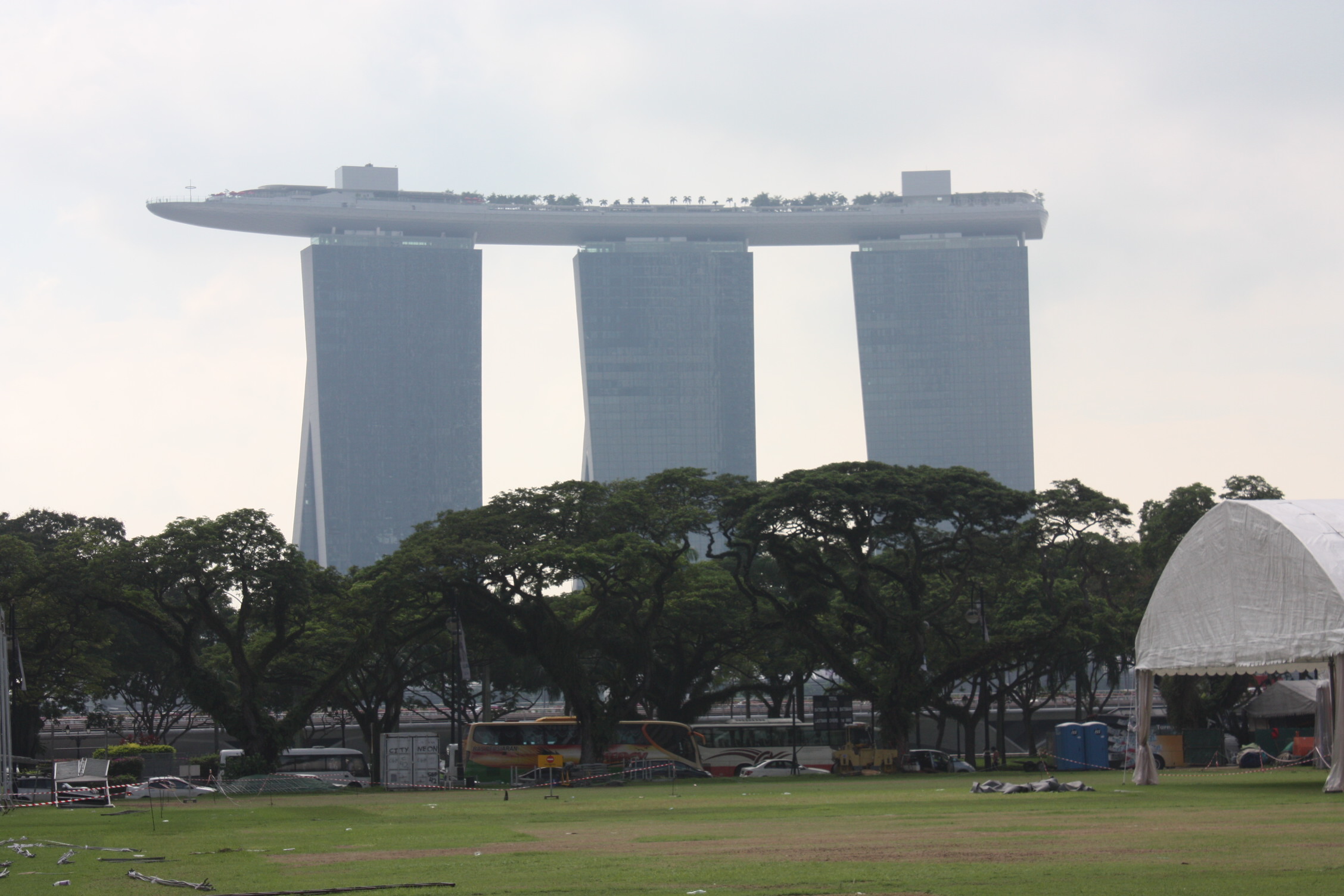
The impressive Marina Bay Sands
Turns out it is the colossal Marina Bay Sands, which opened in 2010. It has 57 floors of 2561 hotel rooms, the world’s largest freestanding casino and a convention centre that can cater for 10,000 guests a day. At the very top, the surfboard-shaped, 340-metre-long SkyPark stretches across the hotel’s three skyscrapers. This rooftop playground is for the leisure entertainment of guests only. It has a 150-metre-long pool. Jacuzzis, bar, lounge and gym (oh hey, it really is a fitness centre), and the best view in town. Or so I’m told.
If you want to get up there for a gander, you can grab a hotel room for ‘as little’ as $339 a night. But don’t expect complete value for money. Wish magazine is about style and quality, and the author of the article had a whinge about the calibre of the Marina Bay Sands’ interior.
He referred to little problems like furniture being scratched and cupboard doors being wobbly. And also complained about bigger issues like the general decor in rooms and public spaces, unimaginative use of space and the overall atmosphere. He said eating there ‘feels like a bit of a steamed bun-fight in a bank lobby. Not good’.
Nevertheless, it’s an incredible structure with an amazing presence on the city’s skyline. Besides, after spending months in a tent, I’m sure I could live with room art that looks ‘like someone spat on a lazy susan’ and ‘bedside lamps that are too far from the bed’.
* In case you’re wondering, WOHA is not an acronym and doesn’t seem to stand for anything.
Also don’t forget to pick a number before 29 February 2012.
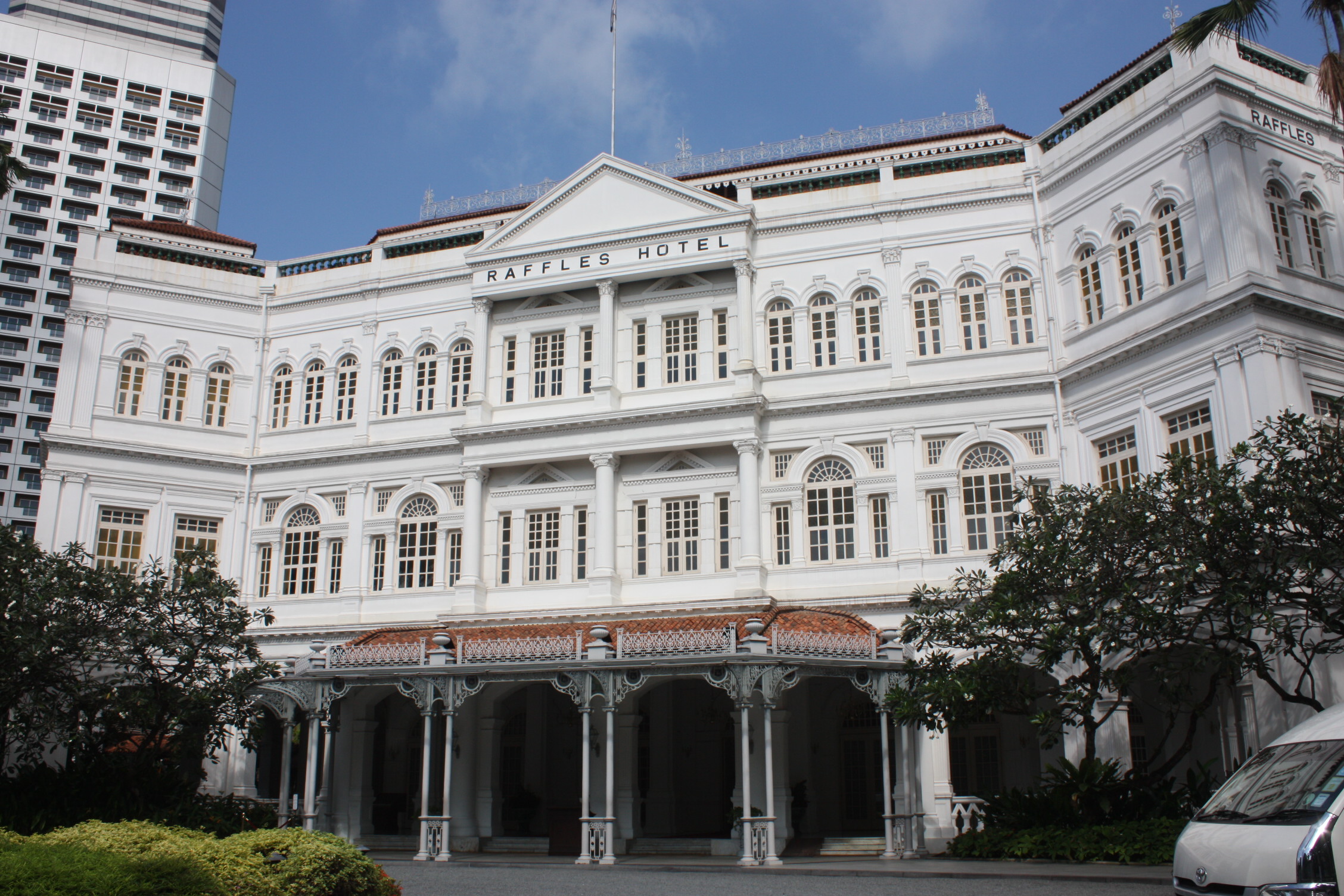
The main Raffles building, opened in 1902.
Raffles Hotel in Singapore is probably the most famous hotel in the world.
It’s where the Singapore Sling was invented in the early 1900s. It’s had plenty of famous guests, too, such as Ernest Hemingway and Somerset Maugham. And it is supposedly where the last tiger in Singapore was shot in 1902. He’d escaped from a nearby enclosure and was found cowering under the Bar and Billiard Room. Not a sporting shot, I’d say.
Opened in 1887 by the four Armenian Sarkies brothers, the hotel was named after Sir Stamford Raffles, who founded Singapore. It started as a 10-room, colonial bungalow on the seaside. All these years later it has been expanded several times. It is still in the same location, but after considerable land reclamation, it now sits 500 metres from the shore. In a refurbishment project in the early 1990s, all rooms were converted to luxury suites, featuring teak floors, handmade carpets and 14-foot ceilings.
The first time I went to Singapore, in 1984, we could freely wander into Raffles’ lobby, restaurants and bars. But that’s all changed. A sign on the front verandah says ‘Residents only’, and they mean it. There are a couple of doormen who make sure you don’t try to slip through. We were well-behaved, so went down the side verandah to get a glimpse of the Bar and Billiard Room. Couldn’t get into the courtyard.
Travelling companions, Lin and Norm, were determined to have a drink in the Long Bar, which is in the hotel’s shopping arcade. They got gussied up (there’s a dress code) and headed out late one afternoon for a pre-dinner drink. After spending something like $63 on the outing, they reckoned it was a worthwhile, but once-in-a-wallet experience.
Also don’t forget to pick a number before 29 February 2012.

Meet one of the baby elephants who is helping to save fellow Asian elephants.
When we saw the collection of colourful and quirky baby elephants near the port in Singapore, we had no idea it was a philanthropic and history-making exhibit.
Later I learned it was part of the ongoing Elephant Parade, and the brainchild of a father-and-son team, Marc and Mike Spits.
Six years ago they visited an elephant hospital in Thailand and were shocked to meet, Mosha, an elephant calf who’d been badly hurt after stepping on a landmine. They set out to create a sustainable event that would inspire, entertain and raise money to help save Asian elephants. They commissioned two Thai artists to create papier-mâché baby elephant prototypes, and then recruited artists to paint 50 fibreglass elephant figures that could be displayed and later auctioned off.
The first Elephant Parade debuted in the Netherlands in 2007, and sales from that event approached 250,000 euros. Since then hundreds more elephants have been made and painted. Subsequent parades and auctions have now earned millions of euros.
In Singapore, we were viewing the most recent parade. Those elephants are being auctioned off this month—January 2012—by Sotheby’s.
Funds raised are to go to the Asian Elephant Foundation and conservation arm of Wildlife Reserves Singapore.
Also don’t forget to pick a number before 29 February 2012.

Anyone for a bent eyelash?
We loved all the places we went in Vietnam—the sights, the people, the food, the markets, the hospitality—but Hoi An was the place that had something for everyone. Even extreme shopping and extreme weather.
There was a torrential downpour the day we arrived. It bucketed down for a couple of hours and we got soaked. It’s when I discovered that my old Goretex jacket was no longer waterproof (and when Poor John paid an absolute bomb for a plastic rain poncho in an eye-smiting shade of chartreuse). It rained heavily again the next day and I got a nice blue poncho at close-to-the-right price. But believe me, the ponchos they sell do not breathe, so it’s not much fun to traipse around in them.
But this wet introduction didn’t dampen our enthusiasm for or interest in Hoi An. We explored most of the city’s streets, and managed to wander casually in and out of the port, temples, businesses, houses, shops, restaurants and markets. We never made it to the nearby beach.
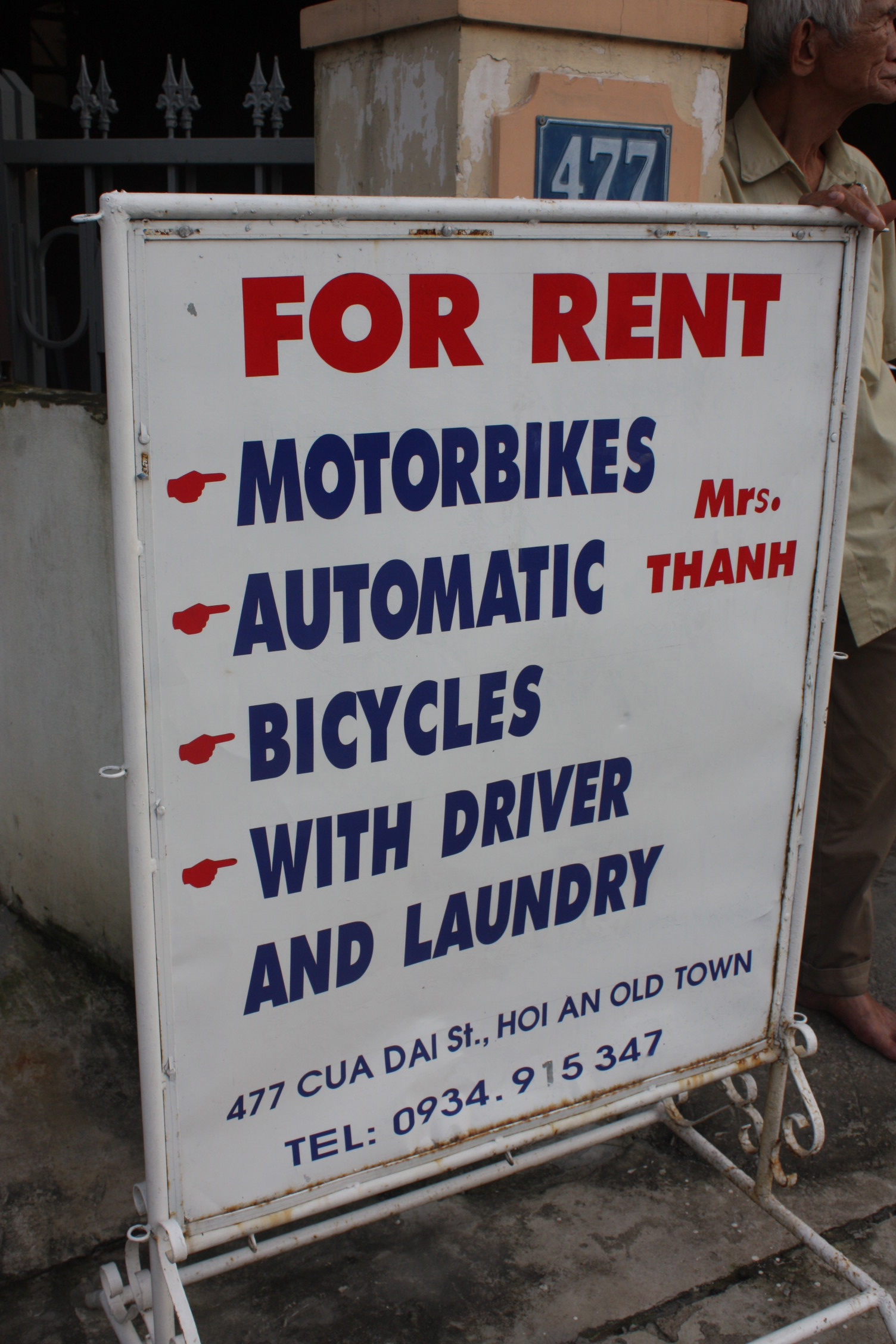
How about renting a driver and his laundry?
Even though the place has hundreds of clothes and shoe shops ready to make anything your heart desires, we resisted buying anything beyond the ponchos. Good grief, my entire wardrobe consists of camping shorts and pants, merino tops, runners and thongs (shoes, not undies, although I own undies too). I don’t need to buy more until what I have wears out.
Sadly, we didn’t manage to take the bicycle tour that I heard about after I got home. I think they offer half-day and day-long bike trips around the region, and friends who have done them say they are excellent. And not too strenuous because the whole area is quite flat.
Hoi An is also where we visited the sesame rice cracker factory and ate the sublime white roses.
It’s also where I saw two amusing sandwich-board signs. One offered to bend my eyelashes and the other promised a driver who seems to bring his own laundry. Or maybe he does mine?
We stayed at a friendly little hotel—Green Field—which I highly recommend. So reasonably priced and with a super-efficient travel agent who organised our side trip to Hanoi and Ha Long Bay. When we set out for the airport, they gave each of us a silk embroidered wallet as a souvenir. Nice touch.
Also don’t forget to pick a number before 29 February 2012.
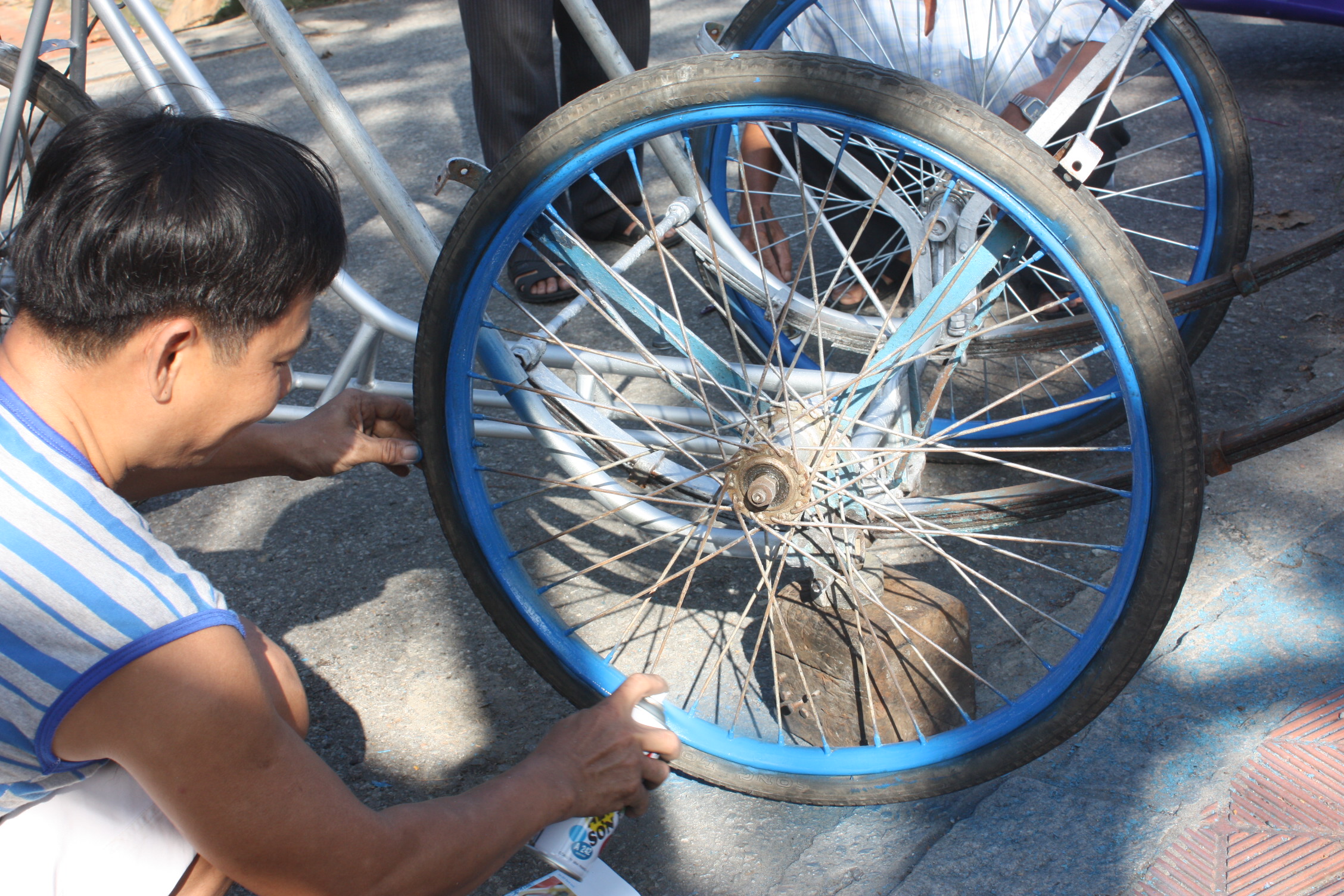
A cyclo in Hué, Vietnam, gets a blast of new blue paint.
Cyclos, or pedicabs, are a great form of transport across Vietnam. They’re fun to ride in, cheap and easy to hire, and gentle on the environment. Plus when you hire one, you help to support the country’s little-guy economy.
I was told that all the drivers are male (although I’m pretty sure I saw two female pedalers in one city).
Many drivers come from the countryside to the big city, hoping to make a fortune and settling on making a living. These outsiders often rent their vehicle by the day—once they have paid the rental, the fares are theirs to keep. Others are father–son operations, with one driving during the day and the other at night.
We were pestered constantly to hop aboard a cyclo, but Poor John and I are big-time walkers—often 6 to 8 hours in a single day. All through Vietnam, I felt bad, even guilty, about not hiring a cyclo (except for the time I was ‘rushed’ to hospital in one). And that ride cost us an absolute bomb (we were cornered).
So before you ride, you should negotiate a final price to make sure you aren’t overly cheated. But overall the fares are so reasonable, it seems very stingy not to hire one. But I wouldn’t be able to call myself Leggy Peggy if I let my calves go to ruin. 🙂
On our walks, we encountered cyclo drivers everywhere. They hover outside hotels, hostels and markets, and cruise the streets around touristic destinations. They pedal up to you, offering to take you to the major sights. Even if you decline, they stay close, pedalling slowly as you walk along. Sometimes offering lower fares. There’s always a chance you’ll change your mind or, even better, your legs will give out or the heat will get the best of you.
Many drivers know ‘their’ city quite well and can take you to some of the out-of-the-way places and, if they have some English, explain the things you see. Others may try to cheat or mislead you—saying that a touristic site is currently closed (when it isn’t) and urging you to stay with them for the rest of the day. If a driver says a site is closed, be sure to check more closely—maybe they just brought you to a wrong gate.
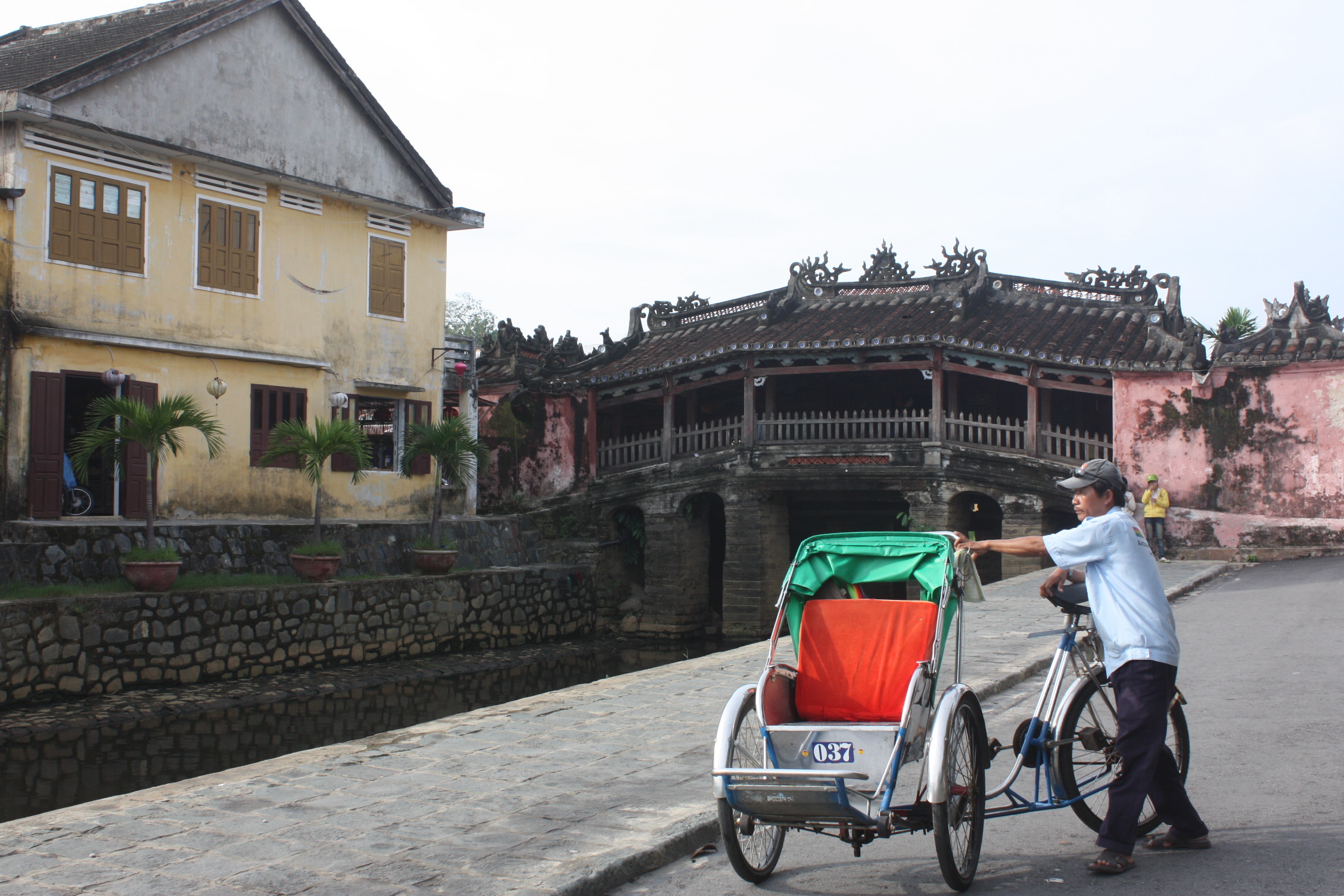
A cyclo driver waiting for a fare near the Chinese Bridge in Hoi An, Vietnam
When drivers aren’t pedalling, they’re snoozing, chatting to one another or looking after their cyclos. All of them seem to do routine maintenance, but I think the paint jobs and major repairs are done by the owners.
The most elaborate cyclos I saw were in Malacca, Malaysia, and I’ll do a post about them soon. Fully decorated and sounding like a disco hall. Real works of art.
Also don’t forget to pick a number before 29 February 2012.
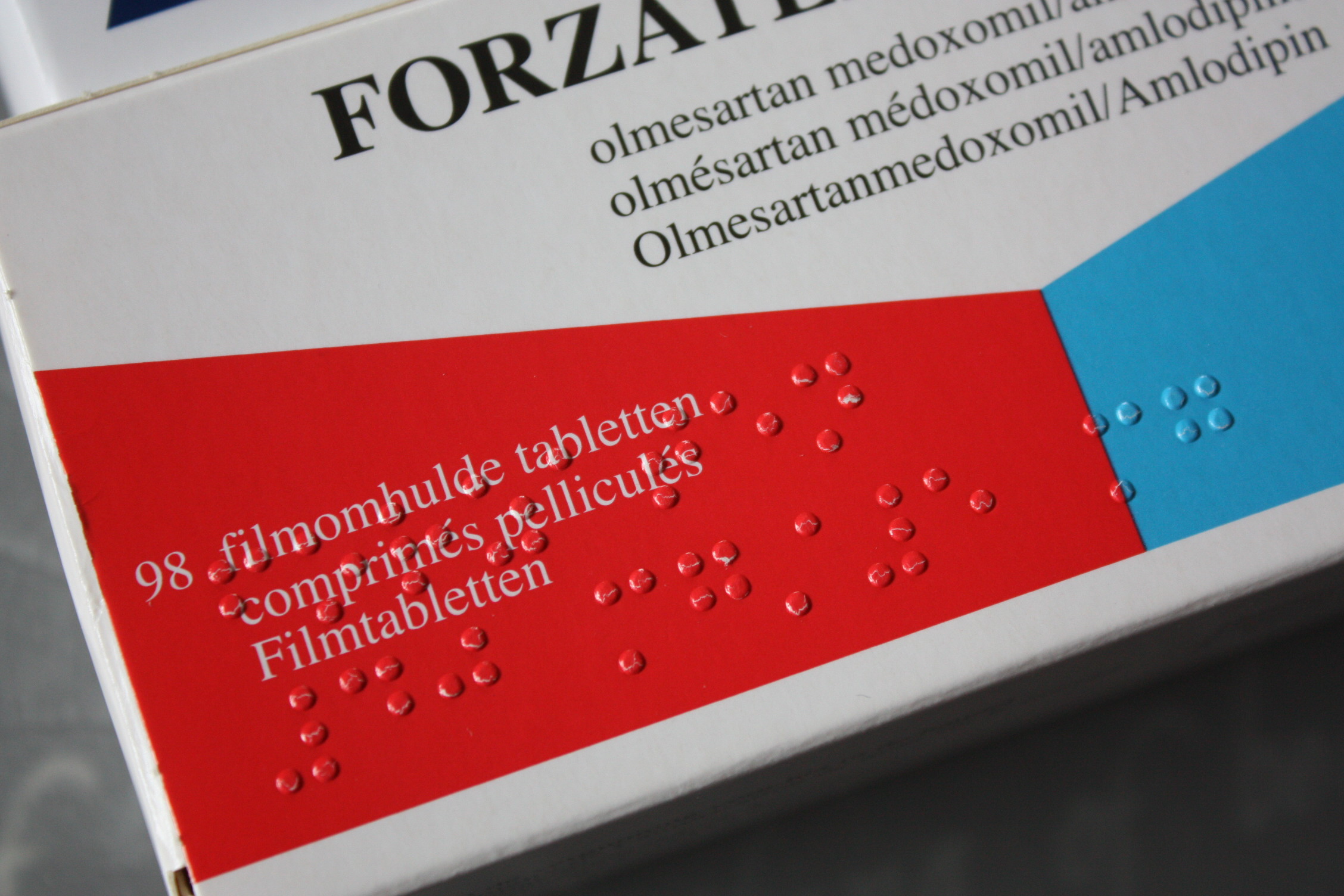
I was impressed to see that Europe uses braille on packaging for medications. What an amazing idea.
I have mixed feelings about the Travel Doctor. They do a useful service, but sometimes they overdo it.
Before we headed to Africa in 2009, Canberra’s Travel Doctor gave us a lot of excellent advice about malaria prophylactics and the medications to go with it (more about that soon*). They also gave us a whole raft injections (a couple of thousand dollars worth), and then some.
According to our yellow International Certificates of Vaccinations or Prophylaxis, Poor John and I are protected against yellow fever, hepatitis A and B, influenza, meningitis, typhoid (almost out-of-date), cholera, DTP (diphtheria, tetanus and pertussis, also called whooping cough), and rabies. I thought encephalitis was there too, but I can’t find it.
Regardless, I’m still annoyed about the rabies.
In 1986 in Burma, I was bitten by a dog that became rabid (long story). I had all the post-exposure injections, plus the serum. These were the new and improved French concoctions that came out about that time. These jabs are in the bum, not the stomach. Much better system.
Nowadays, the Travel Doctor gives a preventive jab, then tests your level of protection. If your level is still low, they give you a top-up poke. But preventive jabs only buy you time. If you are bitten by a rabid animal, you still need to go through the whole course of rabies injections, but you have a little extra time to get to help. This is especially useful when you are travelling in remote locations.
I told the Travel Doctor not to give me the first shot, but to jump straight to the test. Good grief, I’d had 15 rabies stabs in the bum and figured I was already well protected. But no, no! They argued that the French jabs were new in 1986 and not really tested when I had them, and I might not be protected.
I should have stood my ground. I paid $130 for the jab and then some additional outrageous sum for the test, only to be told that my immunity level was eight (8) times over the recommended level. Poor John’s was still low and he needed the second jab. My first jab would have paid for his second.
But their overdoing it doesn’t stop at rabies. The Travel Doctor recommends taking a slew of medications with you—a few general antibiotics, plus two or three for specific types of infections. Trying to be obedient travellers and in an effort to protect against the worst, we loaded up on double lots of everything, as well as malaria prophylactics. We’re talking $300-plus in meds (not including the stuff for malaria).
In the end, I never used any of them except the malaria prophylactics (which were essential). I gave most of the rest away, but ended up disposing of everything that was out-of-date when we got home. What a waste. Especially because almost everywhere you go, you can buy whatever meds you need at a fraction of the price you’d pay at home. Just be sure to check the expiry dates.
For that matter, check the expiry dates of any meds you take from home. The first malaria prophylactics we got from the Travel Doctor were going to expire halfway through our trip.* I’m so glad Poor John noticed that before we left. They replaced them all but, in my opinion, they weren’t nearly apologetic enough. It was their mistake because our paperwork specified our away-dates. Instead, they were annoyed that we’d discarded the packaging (which is how Poor John happened to notice).
And now for the meds we did use on the African trip.
We were lucky enough to have a doctor/nurse couple travelling with us for the first third of that trip. They freely shared advice, medical help and the meds they carried with them. They were so generous that when the wife/nurse got sick in Namibia, I was glad to be able to contribute some of my never-used supplies.
I got an ear infection in Mali, which didn’t really become a problem until a few countries later. Nothing in anyone’s medical kit would have helped. I needed ear-drops that I bought for next to nothing in a local chemist’s shop. And although there are genuine fears that meds in Africa might be fake, the ones I bought did the job.
I had one other problem—sort of secret women’s business. You don’t need to know the details because it wasn’t serious, but you should try to imagine me acting out where and what the problem was. Sometimes I have enough French to be dangerous, but not enough French to be understood.
We didn’t take many meds on the London to Sydney jaunt, but we still took too much. I took two courses of antibiotics (not the six or eight that went to Africa) and we didn’t use any. That said, these were for my teeth/gums and I’d have been damn glad to have them if I’d needed them. So no regrets there.
We also took ace bandages (someone else used one), water purifying tablets, Strepsils (used a few), paracetamol, plasters (band-aids), gauze and bandages.
Oh, and I took my blood pressure meds on both trips. If blood pressure is an issue for you, remember that you can get your blood pressure checked in most pharmacies/chemist shops around the world (not China). My blood pressure is great when I travel. So much so that my own local doctor says he now recommends overland travel to all his patients who suffer from high blood pressure.
Note: Comments on this post have some good tips about meds, so be sure to check them out.
Also don’t forget to pick a number before 29 February 2012.
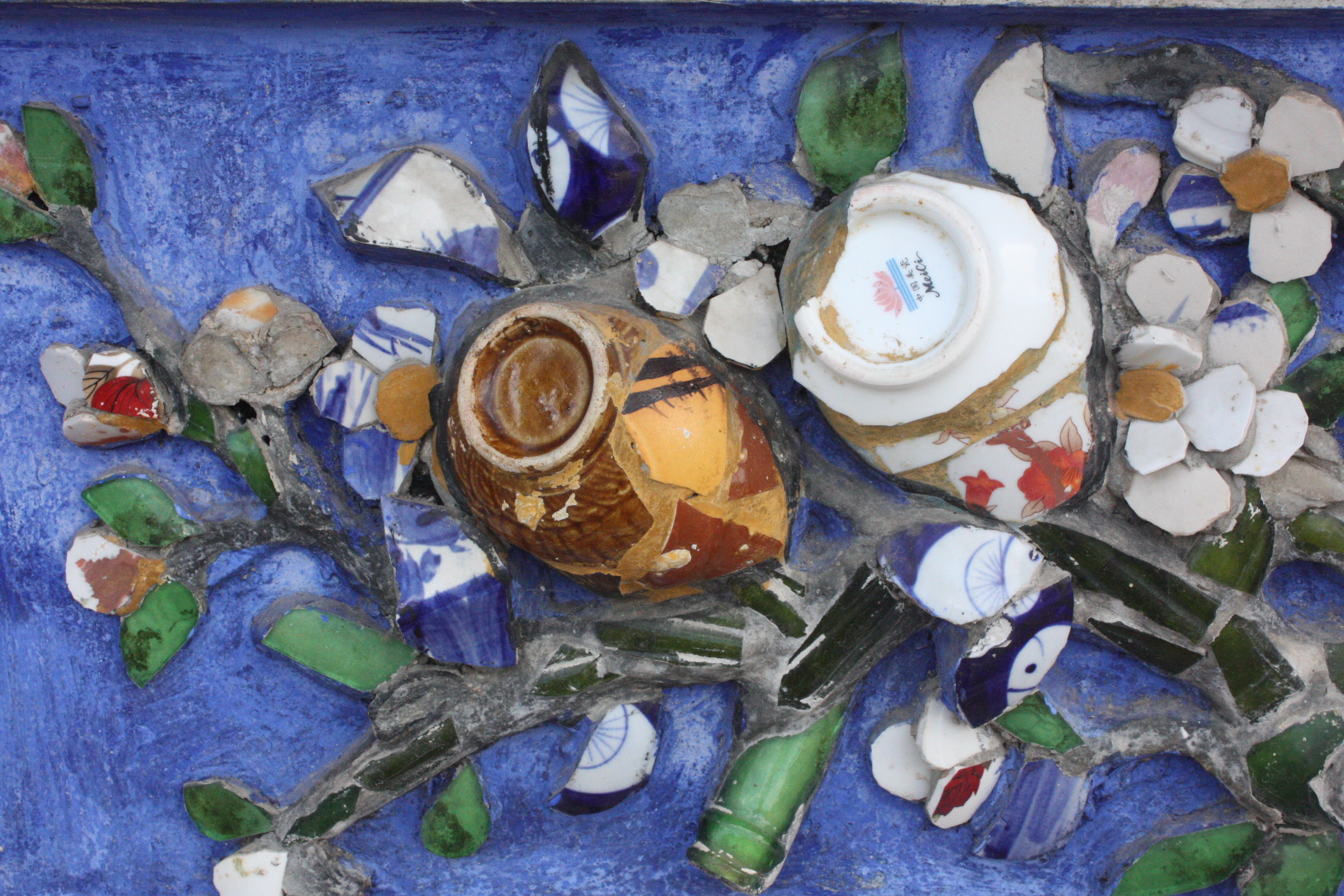
Broken pottery at the core of the designs
Hué, located in central Vietnam and on the Perfumes River, is considered to be one of country’s main cultural, religious and educational centres, and what an interesting and lovely city it is.
It hasn’t always been like that. As part of the Tet Offensive in 1968, Hué was the scene of one of the Vietnam War’s longest and bloodiest battles. Much of the area inside the Citadel (the imperial city) was devastated by bombs, artillery and brutal house-to-house fighting. About 10,000 people were killed, most of them civilians.
For the next 22 years, the Citadel’s old buildings were left to crumble and decay. They were viewed as politically incorrect relics from the times of the Nguyen emperors. But in 1990, local government officials recognised that these sites could be a boon for tourism and began to save them. A few years later, Unesco declared the monuments a World Heritage site, and restoration and preservation work began in earnest.
Built in the early 1800s, the Citadel is huge and still predominantly residential. It has a 10-kilometre perimeter and is surrounded by a moat. Within it’s walls is the Imperial Enclosure, also known as Dai Noi or Hoang Thanh. This citadel-within-a-citadel is where the emperor of the day carried out his official functions.
Poor John and I were keen to see the Imperial Enclosure, but it seemed to be closed. We met two Dutch tourists at a large gate and they told us their rickshaw driver had said the enclosure was closed on Sundays. He then offered to pedal them around town instead. They declined and it’s good they did. We walked around the corner to find the main gate open. We later learned that rickshaw drivers pull this scam in the hopes of extending the time you spend with them. Luckily we never encountered this problem because we always walked.
But I’m glad we started at the wrong gate. It’s covered in mosaics and when you get closer, you see that the designs are created from broken pottery.
The Imperial Enclosure has many parts, including the Thai Hoa Palace, Halls of the Mandarins, the Nine Dynastic Urns, the Forbidden Purple City, the Emperor’s Reading Room, the To Mieu Tmple, the Dien Tho Residence and two lakes. I hope they get around to posting explanatory signs on each of these, because the only thing I was sure that I was looking at was the palace and one of the urns.
We spent most of a day exploring the Citadel and its many parts.
Also don’t forget to pick a number before 29 February 2012.
 Where to next?