
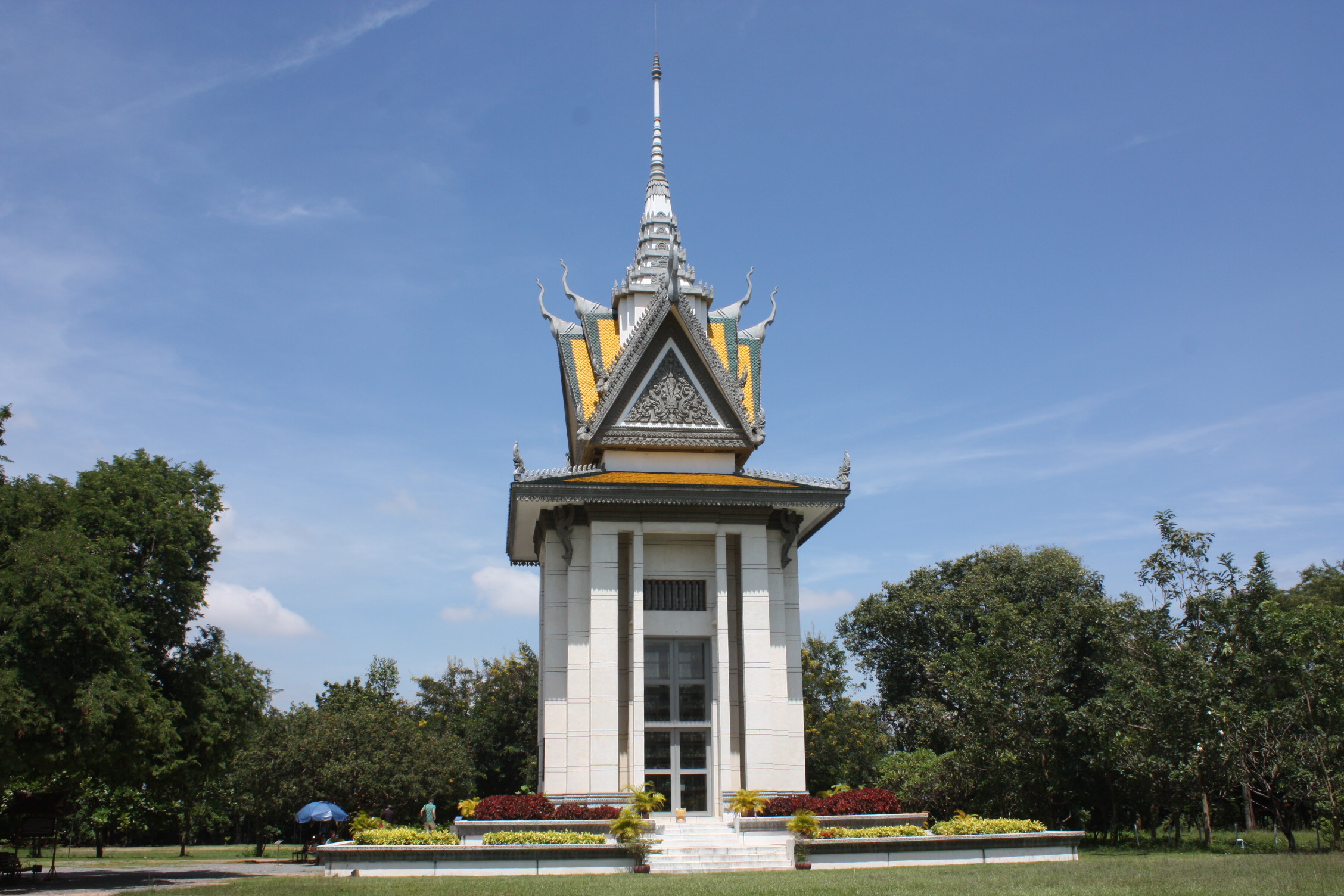
Memorial Stupa at the Killing Fields of Choeung Ek
Perhaps you have seen the movie The Killing Fields, or read Beyond the Killing Fields. I recommend both, but be prepared to be upset. They recount some of the horrors and cruelty of Pol Pot’s Khmer Rouge regime.
Our recent overland travels took us to Cambodia, where Poor John and I had the chance to tour the actual Killing Fields of Choeung Ek. These are the most well known of more than 300 killing fields throughout the country.
These ‘fields’ are only 15 kilometres from the capital Phnom Penh, and were originally a longan orchard. Their peacefulness today masks the horrors they saw in the late 1970s. That’s when about 17.000 people of all ages, who had been detained and tortured at the S-21 security prison, were sent to be executed. The victims were often bludgeoned to death to avoid wasting bullets and each night, as the killings were being carried out, music blared over loudspeakers to hide the cries of those being exterminated.
We got the audio pack with our tour, and I was glad we did—and if I recall correctly, it was included in the admission price. The audio gives a lot more detail about various points on the walking tour, such as mass graves and killing tools. There is also a collection of moving survivors’ stories.
The tour ends at the Memorial Stupa which was built in 1988. The stupa holds more than 8000 skulls that were exhumed in 1980. Many were found to be bound and blindfolded. The skulls are arranged by sex and age, and the visual impact is overwhelming.

Some of the many victims
The Killing Fields of Choeung Ek have at least 129 mass graves, with about 43 that have been left untouched. When there is heavy rain, bits of human bone and clothing often rise to the surface. Some are collected but many are left as visual reminders of the tragedies that took place.

Some of the cast from the Black Light Theatre.
A special bonus during our stay in Prague was a visit to the Image Black Light Theatre. This kind of theatre occurs around the world, but is considered a specialty of Prague.
Each performance showcases light, music, colour, dance, pantomime, drama and humour. Performers are a cross between dancers and acrobats. They use black curtains, a darkened stage and ‘black lighting’ (UV light), coupled with fluorescent costumes, to create visual illusions.
Tom’s* dad is friends with the owner, so we had free tickets for a performance of The Cabinet. This show features the unexpected and wonderful things that happen to someone when they enter The Cabinet—complete with various whirligigs, wheels, cranks, horns, bells, whistles and human movement.
This theatre, which has been going for 21 years, includes four other shows—Afrikania, Black Box, Studio Clip and The Best of Image. Performances rotate, and a different one is shown each night. There is also a troupe that performs abroad regularly. They’ll be touring in China and Mexico in 2012.

A round of applause.
The main theatre is based in a lovely old building on Parizska or Paris Street, one of Prague’s prettiest boulevards.
Photographs of the performance are not allowed, but I took pics before the show and during the encore. There are also images on the theatre’s website. Do have a look and be sure to click on the English translation.
* Tom was one of our many exchange students. He stayed with us for five months in 2008.
I get so frustrated with guidebooks. You want to believe and trust them, but you shouldn’t.
In Ouagadougou (pronounced wah-ga-doo-goo), Burkino Faso, West Africa, we walked in search of a hotel that was clearly marked on a map in the African edition of the Lonely Planet (which is often referred to by travellers as the Lying Planet). By following that damn map, we walked to the edge of town before we met a nice local woman who seemed to know where the hotel really was. She bundled us into a taxi and told the driver not to charge us more than a couple of dollars. Turned out the hotel was about two blocks from where we began our marathon stroll.
But this sort of glitch happens all the time. Some guidebook errors are genuine mistakes—misinformation and such—and some reflect blatant ignorance of indexing conventions. I’ll try to explain. We wanted to visit Mount Bromo in Indonesia. Is Mount Bromo listed in the Lonely Planet? No. It’s listed under G for Gunung Bromo, with gunung being the Indonesian word for mount. It’s also listed by its national park — Bromo-Tengger-Semeru National Park.
It boils down to the fact that I am not likely to know that gunung = mount.
But I’m only just getting started. The Rough Guides are just as bad. The Tibet version says the Potala Palace in Lhasa is covered on a single page. In actual fact, there are 18 pages devoted to the palace.
This is what annoys me about poor indexes—they don’t reflect how we think. I’m a tourist and I’ve heard of Mount Bromo. I want to go there. I try to look it up in an index of a guidebook. M for Mount = no answer, B for Bromo in isolation = no answer, G for gunang = numerous answers. All mounts in Indonesia are called gunungs. How in the world would I know that?
A friend, who is a professional indexer, says it’s better to have no index than a bad index. I have to agree. With no index, you are forced to explore.
I’ve seen a lot of book indexes that don’t mention what I’m looking for, but after a thorough search of that book, I finally find the info I want. Not surprisingly, most people don’t think to cruise through the content, if what interests them is not listed in the index.
That said, I shouldn’t complain too bitterly. Travel guidebooks are filled with lots of useful and helpful information. It’s the errors and gaps that are so annoying.
Also don’t forget to pick a number before 29 February 2012.
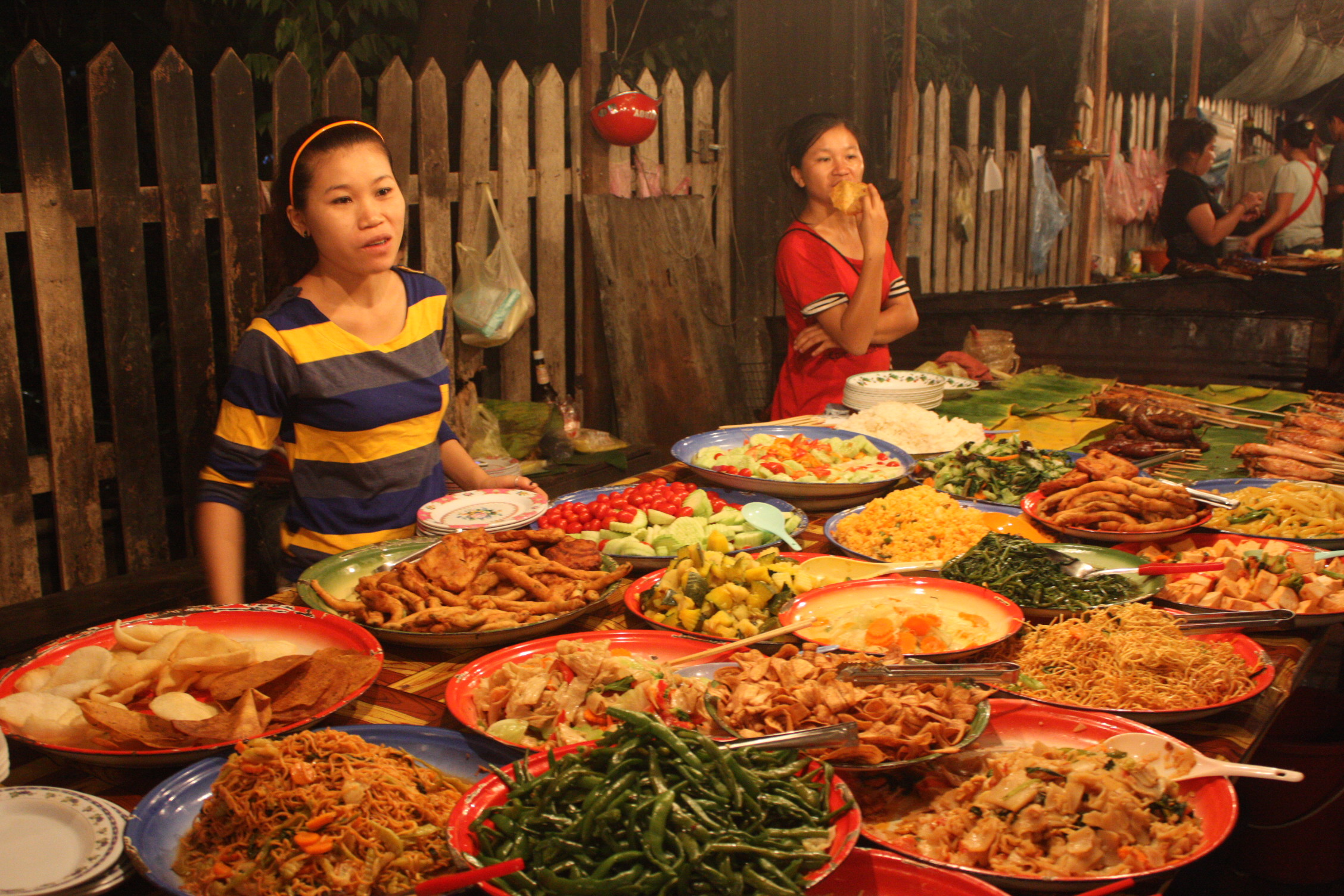
No shortage of choice at the Luang Prabang night food stalls.
Just off to one side of the night market in Luang Prabang, in northern Laos, runs a little street that bustles each night with hungry diners seeking a delicious, but cheap, meal at the many heavily laden food stalls. Long tables are set up on trestles and are then buried beneath platter after platter of exotic temptations—salads, vegetables, noodles, rolls, rice, meats, sausages, fish, stews, breads.
Prospective diners chose the stall they want to buy from, grab a plate and proceed to pile it high with the goodies of their choice. Drinks are extra and so are most of the protein dishes such as meat and fish. Both Poor John’s buffalo sausage and my 500-ml beer cost as much as each plate of food—just under $2.
Eating is a communal affair with diners taking a spot on the bench seats along still more long tables. You’re not supposed to linger over your meal. Traffic is heavy and places at the table are in high demand. After you eat you are expected to buzz off.
That’s okay because then you can go and shop.
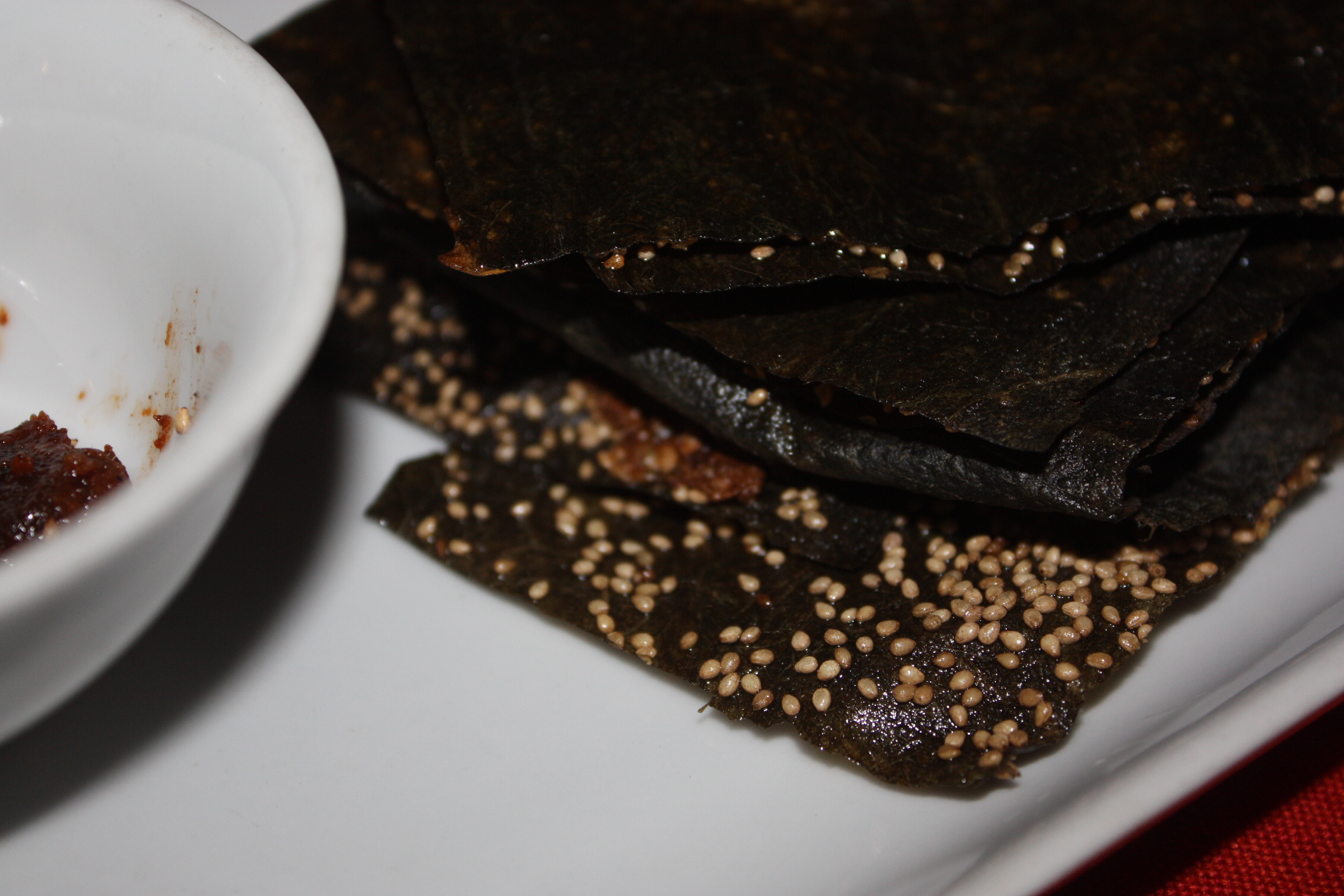
Mekong river weed—a tasty snack.
From the first night we were in Luang Prabang in Laos, Poor John was keen to sample the Mekong dried river weed. We saw it being sold in large packs in the night market and were intrigued to know how it should be cooked and what it tasted like.
It seemed impractical to buy a huge packet and then experiment, so we went exploring for a restaurant that served this much-loved local speciality. We finally found a very upmarket place—white tablecloths—that offered it as a starter. We were in shorts and looking preety daggy, but that didn’t stop us from going in and ordering one very expensive serving to share.
The dish is called khai paen (sorry but I can’t find the right accent marks to use here). That’s the dried river weed fried in a seasoned oil and topped with sesame seeds. It’s normally served with a thick condiment, jaew bong, another speciality, made of chillies and dried buffalo skin. We had both and we loved them. So much so that if I had access to dried river week, I’d probably make it quite often. It’s a light, crispy, flavourful snack, and I’m a sucker for sesame seeds. Can’t imagine that I’ll ever find buffalo skin to make the jaew bong.
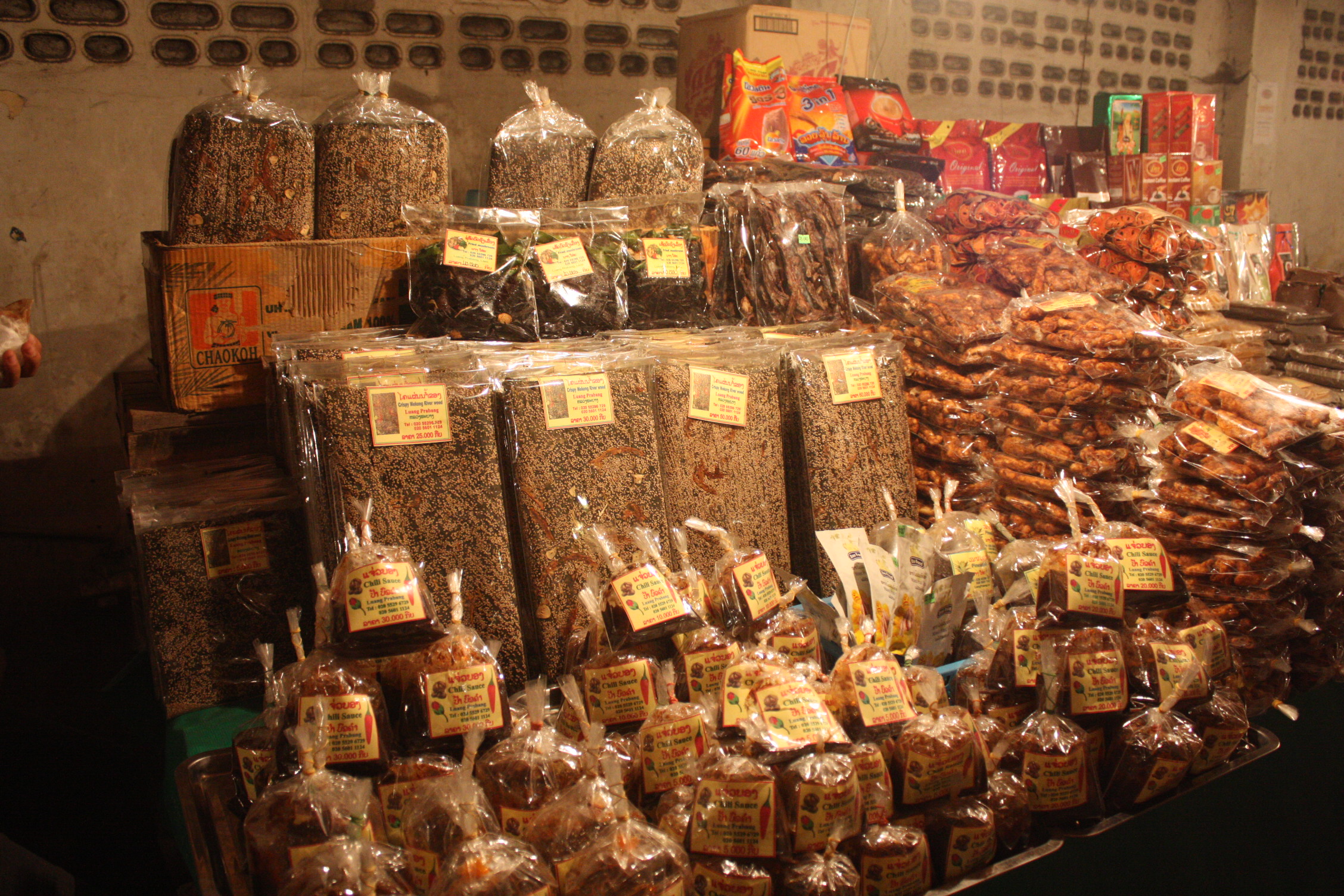
Mekong river weed is in the tallest packs—available in bulk at the night market.
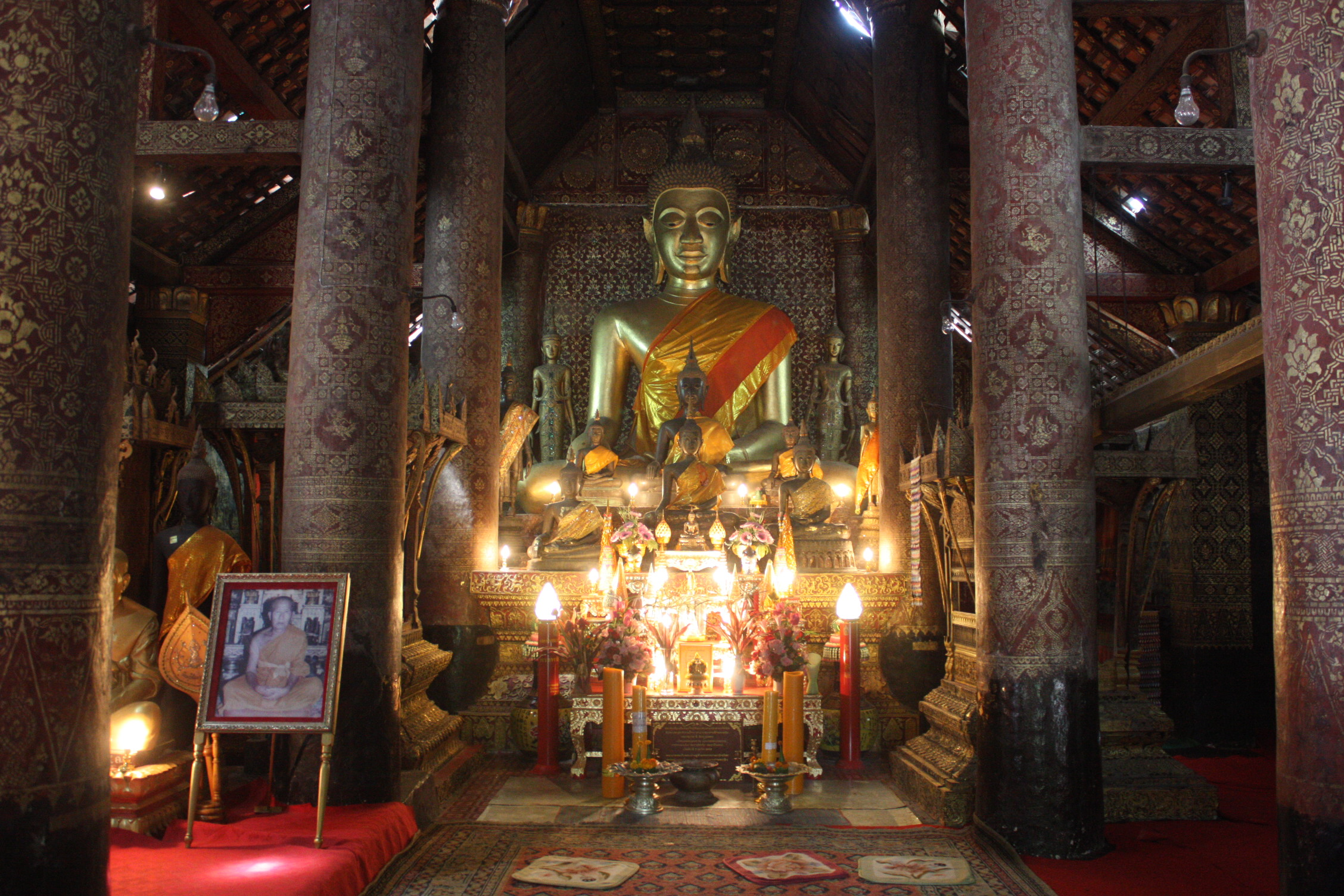
The buddha in the Wat Xieng Thong temple.
Our visit to Wat Xieng Thong was a highlight of our stay in the ancient royal city of Luang Prabang in northern Laos.
Built in 1560 by King Setthethirat, this magnificent temple has the classic architecture of Luang Prabang, with ornate roofs that sweep low to the ground. It also has many other buildings including a funeral chapel.
The main temple building houses a large Buddha that is surrounded by offerings. To one side is an almost life-size gold statue of a venerated monk. Pilgrims can add gold lead to the statue, which also has many offerings, as well as a photo of the monk. The walls and the wooden columns that support the ceiling are richly decorated with geometric patterns and bizarre scenes of what may, or may not, have been daily life.
Many exterior temple walls and railings are decorated with colourful glass mosaics, and one wall displays a large tree of life.
The funeral chapel is also decorated with more mosaics and numerous Buddhas. There’s also a 12-metre high golden funeral chariot, complete with dragon/serpent heads, and funeral urns for each member of the royal family.
This temple remained under royal patronage until 1975.
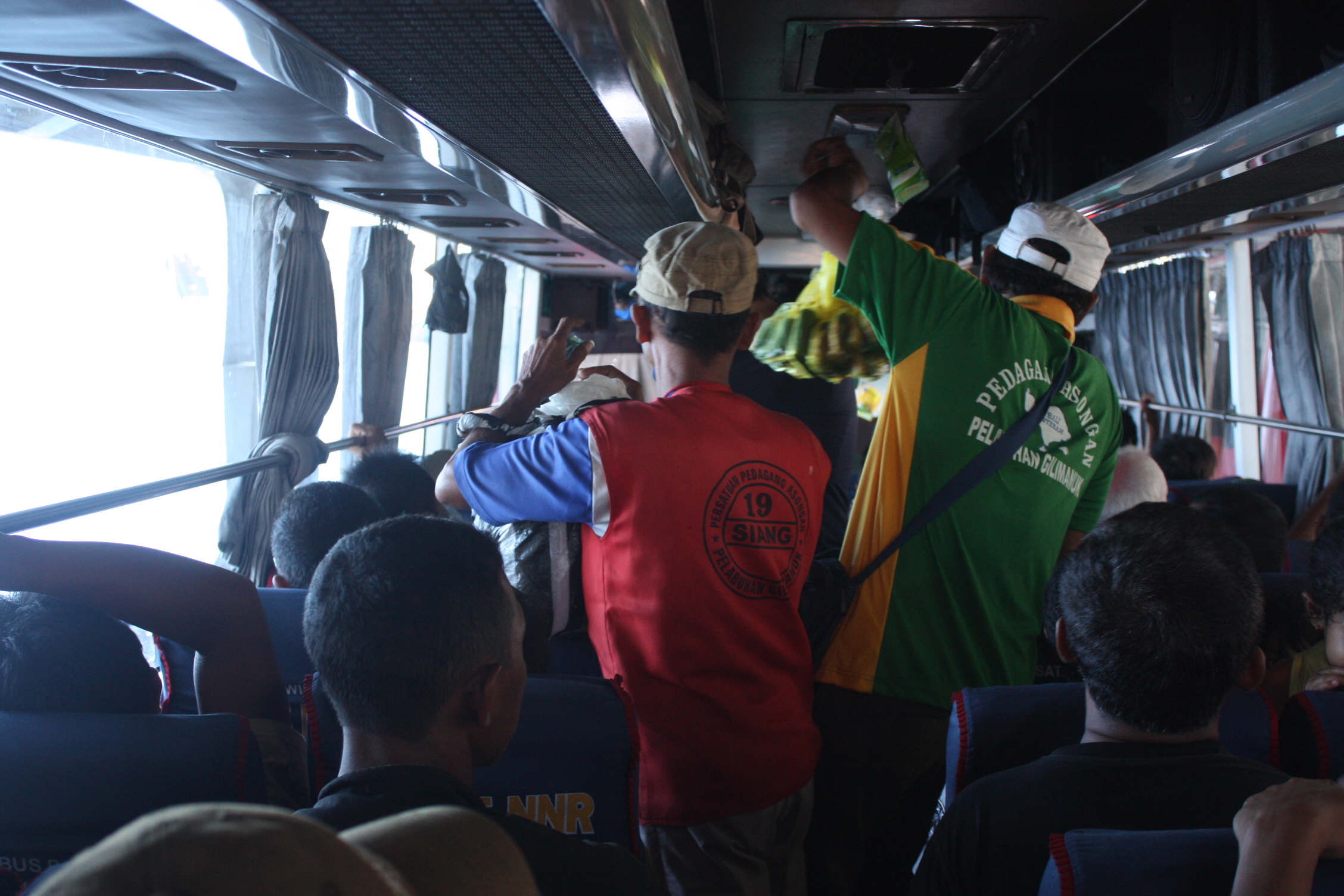
Sellers compete for the aisle space on the bus.
There’s no chance of starving on public transport in Indonesia.
Trains and ferries are oversupplied with sellers of all sorts of meals and snacks—fried rice, peanuts, noodles in a cup (they happily add the hot water), hot drinks, cold drinks, nuts, bready things, biscuits.
They walk down the aisles carrying trays of goodies and calling out their wares in Bahasa. Prices aren’t as outrageous as they would be in an airport, and the choice seems endless. I was tempted to ask for something they didn’t have to see if they’d jump off the train at the next stop and get it for me—a service that would be harder to provide on a ferry.
The whole process is fairly orderly UNTIL you get on the Java to Bali bus–ferry combo. As soon as you board the bus in Ketapang in Java the onslaught begins. Seller after seller, musician after musician pile on the bus in the hopes of relieving you of some cash. The problem is, there is no room on the bus. There are five seats across, so there is a much narrower-than-normal aisle. Seats have been oversold so at least 10 passengers are standing in the aisle. Add a guitarist, peanut seller and the conductor, who all expect to work their way from front to back, or vice versa, and you have the makings of a new version of the ship stateroom scene from the Marx Brothers’ classic movie, A Night at the Opera. As an aside, you must see this movie. It’s hilarious.
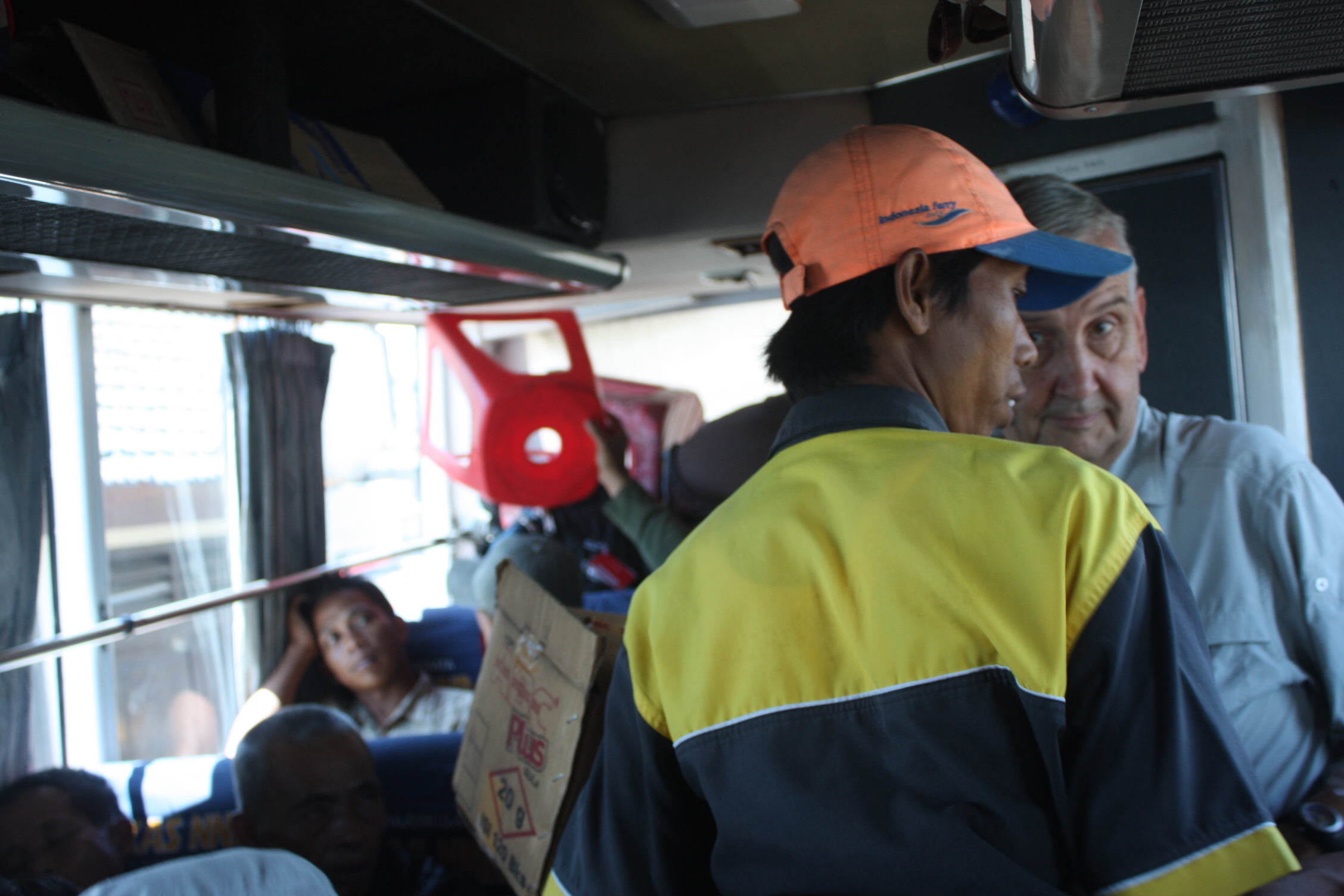
Poor John wonders how he might get this guy off the bus. Note the red plastic chair in the background, being passed up for someone standing in the aisle.
In less than 10 minutes, we had two guitarists come through, strumming a few chords and expecting a donation of a couple of coins or a single cigarette. They aren’t hitting up the tourists—the bus is crammed with locals who cough up a surprising amount of generosity. Then came the food sellers, an orator, a paper seller (he’d have done some business with Poor John if only he’d had something in English) and the conductor passing plastic stools to the passengers who were standing (including the two of us).
These intrepid salespeople attempt to board from either entrance of the bus, creating a stalemate in the middle. Poor John managed to prevent just one from hopping aboard, but it was hardly worth the effort. I managed to snap a couple of pics of the aisle congestion, including a snap of two sellers passing from opposite directions and one of a rather surprised-looking Poor John who is wondering how he might put a stop to all this.
Sorry about the prolonged silence. I’m still stunned by how horrible the Aussie internet connections were in the Outback. Absolutely infuriating. I’m hoping the National Broadband Network will change all that.
We’re home and mostly unpacked. This verges on being a miracle. Even I am stunned by this modest level of efficiency on my part—it usually takes me months to unload the bags.
At the moment, we are at our beach house with four fellow travellers—Lin and Norm, Ian and Eamon. Ian’s wife, Pat, and daughter, Cathryn, and Eamon’s wife, Mary, have joined us too. That means I’m cooking for 10—a role I enjoy and have done many times in the past.
Everyone has almost overdosed on kangaroos and other Australian wildlife, but they’re just getting started.
There’s still heaps of our European, Central Asian, Southeast Asian and Australian travels to share, plus many more new travels to come. So I’m getting back to writing again. Thanks for staying tuned.
Here’s a pic of the crowd on our arrival in Sydney. Poor John and I are on the far right.

London to Sydney—end of the trail.
We’ve spent six days in Australia and I’m yet to have a decent internet connection.
Places that swear they have WiFi, don’t. Libraries have it—if they’re open and you can get in or if you are already ‘registered’. I’ve paid for connections that never connect. I even spent $99 on a Telstra dongle (that should give me a connection anywhere a phone would work) and still no luck.
I’m home in a week and I know that works. Anything earlier will be a bonus.
Not a happy camper on this count, but okay otherwise.
Poor John and I, and the rest of the group, head for Darwin, Australia, in a few hours. We’re told we will be bush camping for the next two weeks. I’m not sure there will be any way to charge my computer or to connect to the internet.
Obviously, I’m not thrilled by this prospect, but there’s not a lot I can do except cross my fingers. I know I’ll have a connection by 11 December, but not sure about anything before then.
Wish me luck and stay tuned for the next episode.
 Where to next?